










Chaman Lal Setia Q2 EBITDA margin more than doubles to 20.8%
Key highlights
- Chaman Lal Setia reported Q2FY27 EBITDA of Rs 68.4 crore, up 182.1% year on year.
- Chaman Lal Setia's Q2FY27 EBITDA margin rose 1,192 basis points to 20.8%.
- Chaman Lal Setia's Q2FY27 net profit increased 197.4% year on year to Rs 56.3 crore.
- Chaman Lal Setia held Rs 550.9 crore of cash, bank balances and current investments at the end of H1FY27.
powered by IRIS
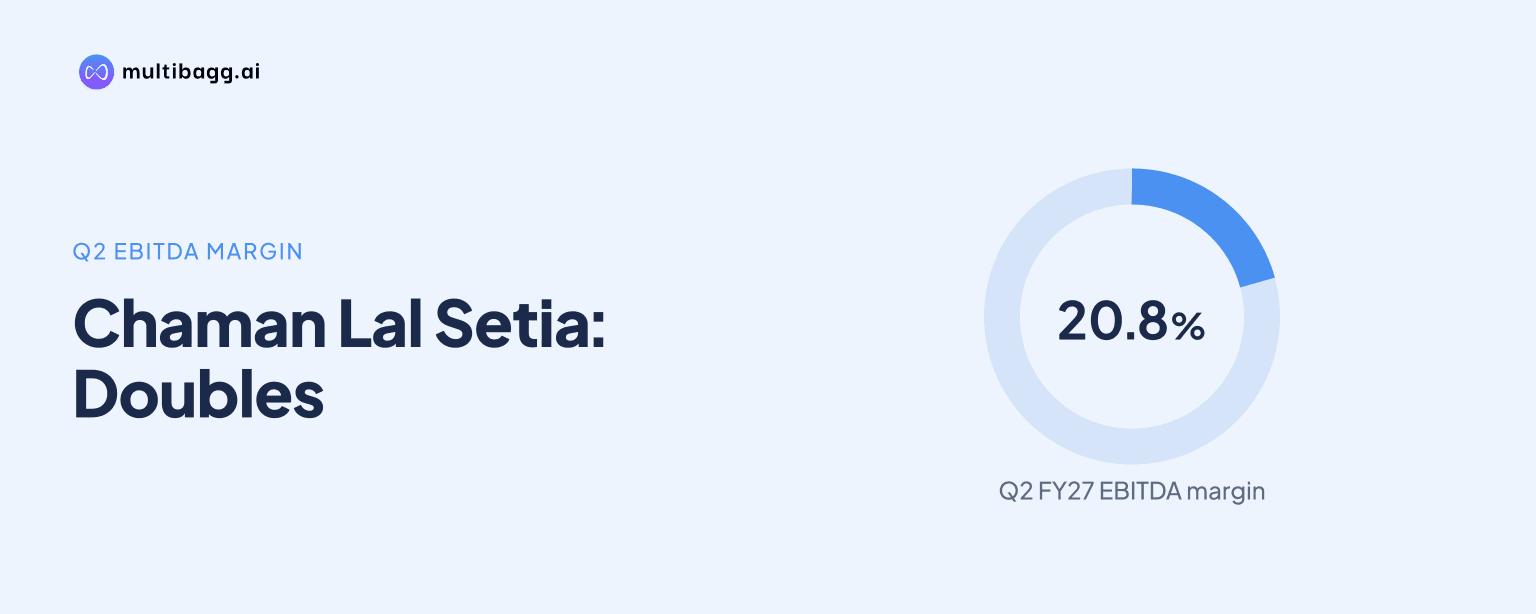
Chaman Lal Setia Exports Ltd reported a Q2FY27 EBITDA margin of 20.8%, up 1,192 basis points year on year, as Rs 68.4 crore of EBITDA was lifted by favourable earlier procurement costs, inventory gains and a higher contribution from branded sales.
Know Chamanlal Setia Exports inside out
Results, valuation, peers and who's buying, in one view.
What drove Chaman Lal Setia's Q2FY27 margin increase?
Chaman Lal Setia's Q2FY27 margin increase was primarily driven by procurement costs from earlier buying cycles, inventory gains and a larger branded-sales contribution, according to management. EBITDA, or earnings before interest, tax, depreciation and amortisation, rose 182.1% year on year to Rs 68.4 crore, while its margin rose from 8.9% in Q2FY26 to 20.8%. That 11.92-percentage-point change is also 1,192 basis points, where 100 basis points equal one percentage point.
The income statement shows the operating mechanism behind that expansion. Net sales increased 20.4% year on year to Rs 328.8 crore, but cost of goods sold fell 2.0% to Rs 212.7 crore from Rs 216.9 crore. Consequently, gross profit more than doubled, rising 107.2% to Rs 116.1 crore, and gross margin increased from 20.5% to 35.3%. Other expenses rose 74.8% to Rs 42.4 crore, but that increase was smaller than the Rs 60.1 crore rise in gross profit.
How did Chaman Lal Setia's Q2FY27 compare with earlier periods?
Chaman Lal Setia delivered higher profitability both year on year and sequentially in Q2FY27, despite quarterly net sales declining 5.0% from Q1FY27. EBITDA increased to Rs 68.4 crore from Rs 24.3 crore in Q2FY26 and Rs 43.6 crore in Q1FY27. The Q2FY27 EBITDA margin of 20.8% exceeded both the 8.9% recorded a year earlier and the 12.6% reported in the immediately preceding quarter.
Chaman Lal Setia's profit after tax, or PAT, rose 197.4% year on year to Rs 56.3 crore in Q2FY27 and increased 76.0% from Rs 32.0 crore in Q1FY27. PAT margin reached 17.1%, compared with 6.9% in Q2FY26 and 9.2% in Q1FY27. Other income also increased to Rs 10.1 crore from Rs 3.8 crore a year earlier and Rs 2.2 crore sequentially, while interest expense was Rs 2.0 crore.
Did branded sales and export pricing support Chaman Lal Setia's profitability?
Chaman Lal Setia's sales growth and branded-volume growth supported the Q2FY27 result, although export volumes declined. Total Q2FY27 sales volume was 33,175 metric tonnes, while branded sales volume grew 34.1% year on year and domestic sales volume rose 28.0%. Management identified the higher branded-sales contribution as one of the factors supporting the 20.8% EBITDA margin, alongside earlier procurement costs and inventory gains.
Export revenue rose to Rs 284.6 crore in Q2FY27 from Rs 237.0 crore a year earlier, even as export volume fell to 27,200 metric tonnes from 28,300 metric tonnes in Q2FY26. Management said export realisations increased to Rs 105 per kilogram and expected them to remain at higher levels in coming quarters. It also said sales executed on a free-on-board, or FOB, basis allowed it to pass the full increase in elevated global ocean freight costs to customers.
Got a follow-up? Ask IRIS
What does Chaman Lal Setia's first-half result show about margins?
Chaman Lal Setia's H1FY27 figures show that margin expansion was present across the first six months, although the 16.6% EBITDA margin was below Q2FY27's 20.8%. H1FY27 revenue rose 16.3% year on year to Rs 674.7 crore, while EBITDA more than doubled by 108.6% to Rs 112.0 crore. The H1FY27 EBITDA margin increased 734 basis points from 9.3% in H1FY26 to 16.6%.
Gross profit increased 54.0% year on year to Rs 203.8 crore in H1FY27, with gross margin rising from 22.8% to 30.2%. PAT grew 117.6% to Rs 88.3 crore, and PAT margin reached 13.1%, compared with 7.0% a year earlier. The gap between the H1FY27 EBITDA margin of 16.6% and Q2FY27's 20.8% reflects the sequential increase from Q1FY27, when gross margin was 25.4% and EBITDA margin was 12.6%.
How do cash, inventory and procurement affect Chaman Lal Setia?
Chaman Lal Setia had Rs 550.9 crore of cash, bank balances and current investments at the end of H1FY27, up 67.7% from Rs 328.4 crore in H1FY26. Management said inventory was controlled ahead of a key procurement season. Separately, working-capital data showed inventory of Rs 131 crore in September 2026, below Rs 215 crore in September 2025 and Rs 427 crore in March 2026.
Chaman Lal Setia says its inventory typically rises in the second half as paddy procurement begins in October-November after the kharif harvest, funded through internal cash and short-term debt. As sales occur in the first half, management says inventory is liquidated, cash rises and debt reduces. At September 2026, cash and cash equivalents were Rs 507 crore and total debt was Rs 73 crore, compared with Rs 254 crore and Rs 67 crore, respectively, at September 2025.
Conclusion
Chaman Lal Setia's Q2FY27 profitability improvement was substantially larger than its 20.4% sales growth: gross margin rose 1,478 basis points to 35.3%, EBITDA margin rose 1,192 basis points to 20.8%, and PAT reached Rs 56.3 crore. Management attributed that outcome to lower-cost earlier procurement, inventory gains and branded-sales mix, while higher export realisations and FOB sales helped contain the effect of freight costs.
The next disclosed operating milestone is the October-November paddy procurement period, when management says inventory normally rises and funding uses internal cash and short-term debt. Investors can watch whether export realisations remain at the higher levels management expects, how branded and domestic volumes develop, and whether the procurement cycle changes the inventory level of Rs 131 crore reported in September 2026.