










Chandan plans to exceed 4,000 franchise centres by FY28
Key highlights
- Chandan added 280 franchise centres in October and plans to exceed 4,000 centres by FY28.
- A franchise generating about Rs 2 lakh in monthly business can contribute nearly Rs 1 lakh monthly to Chandan.
- Chandan said franchise-level margin is about 75% after consumables because franchisees bear local operating costs.
- Chandan reported EBITDA margin of 37.26% for the quarter ended September 30, 2026, up 241 basis points year on year.
powered by IRIS
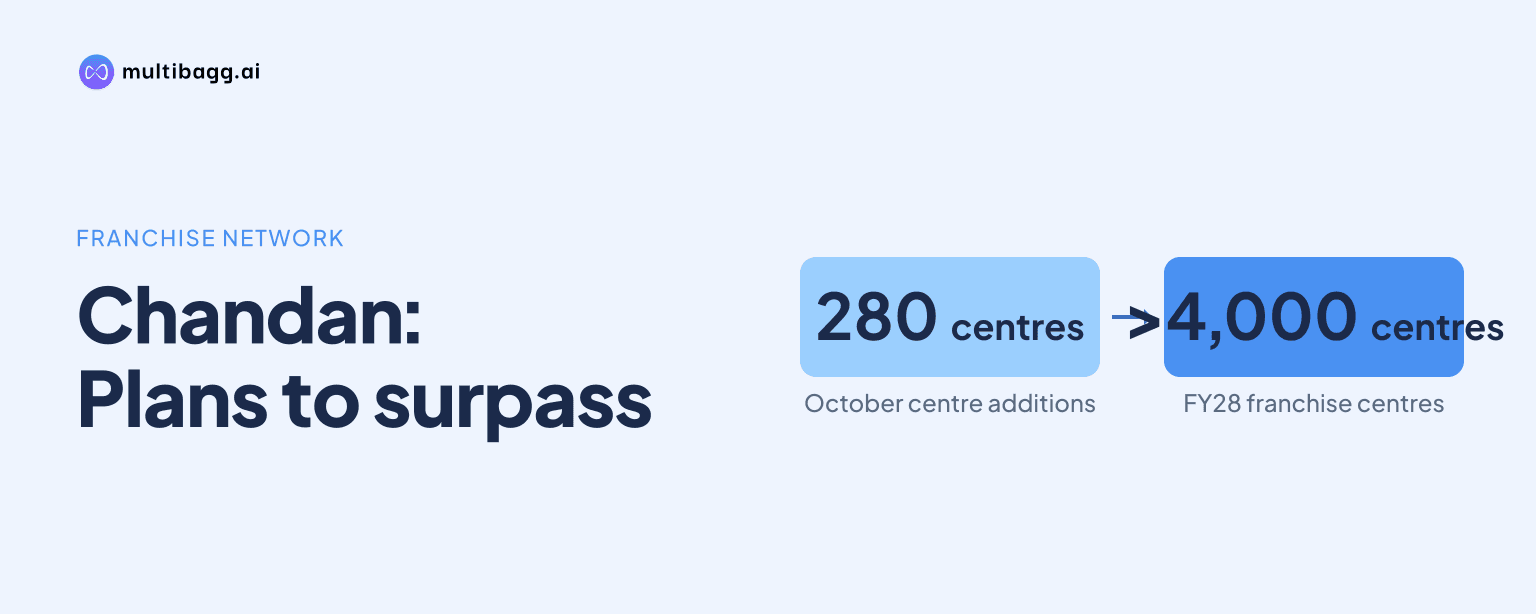
Chandan Healthcare Limited plans to exceed 4,000 franchise centres by FY28 after adding 280 in October, using a model where franchisees fund collection points and pay in advance for tests. Management said a franchise producing about Rs 2 lakh of monthly business can contribute nearly Rs 1 lakh monthly to Chandan.
Know Chandan Healthcare inside out
Results, valuation, peers and who's buying, in one view.
How will Chandan exceed 4,000 franchise centres by FY28?
Chandan expects to cross 4,000 franchise centres in FY28, management said, revising upward from the 3,000-centre figure cited in its presentation. The company added 280 franchises in October and said it was appointing more people to support the rollout. Chandan has more than 75 laboratories in 15 states, which management identified as the base for adding collection franchises.
The expansion uses a hub-and-spoke structure in which diagnostic centres and laboratories act as hubs while franchisees operate as spokes. Management said one diagnostic-centre acquisition can create an opportunity for at least 100 surrounding franchises. Chandan said it is considering acquisitions beyond Uttar Pradesh, citing Delhi, Bhopal and Jaipur, and had around 10 diagnostic centres under acquisition consideration during the call.
The franchise build is intended to help replace National Health Mission, or NHM, activity that Chandan is exiting. Management said total government business was about 28% of revenue, of which NHM accounted for about 22% to 23%. Chandan had 350 NHM collection points in Uttarakhand and had already closed 100, while saying it would not bid when the next tender arrives in an expected two to three months.
What does a Chandan franchise contribute after maturity?
Management said a franchise generally reaches more than Rs 2 lakh of monthly business after about six months, and Chandan receives nearly Rs 1 lakh when the franchise produces that level of collections. Franchisees receive discounts that range from 50% to 55%, depending on their business level. Management also described its planning range for Chandan’s monthly revenue from a mature franchise as Rs 1 lakh to Rs 2 lakh.
The company did not present the per-franchise outcome as a guaranteed target. Management said many franchises are run by phlebotomists, who collect blood samples, and that operators may be satisfied once their income exceeds Rs 50,000 a month. After maturity, management expects a franchise to grow by only about 10% to 15% annually, making the pace of new additions and six-month maturation important to the FY28 plan.
Chandan said franchise operations generate about 75% margin after consumables, principally reagents that account for about 25%, because franchisees bear local operating costs. Chandan receives samples at its facilities and performs the tests. Management said this should be understood as franchise-level margin rather than earnings before interest, tax, depreciation and amortisation, or EBITDA, because there is little direct operating expense at the collection point for Chandan.
Why is Chandan keeping capex out of collection points?
Chandan does not plan to invest in franchise collection points because franchisees provide the capital and use their own premises. Management said a company-owned collection point would require a location, lease documentation, marketing and other local spending. With Chandan adding 280 franchises in October, management said ownership of these points could slow the expansion and affect EBITDA.
The franchise arrangement also operates on a rolling-advance basis. Management said Chandan receives payment before any test starts rather than billing franchisees after testing. That mechanism differs from the receivables issues cited in the NHM exit, where management also referred to operational interference. Chandan said the move toward cash business is intended to improve cash flow, though it gave no company-wide working-capital target.
Instead of funding collection points, Chandan is directing capital toward laboratories, diagnostic centres and acquisitions. More than 80% of the investment in 11 comprehensive diagnostic centres had already been made by the September 2026 call, management said. Those 11 centres were expected to open in the next three to four months, alongside six diagnostic centres offering laboratory and X-ray services.
Got a follow-up? Ask IRIS
Where will Chandan deploy capital alongside franchising?
Chandan indicated investment of nearly Rs 110 crore in FY28 for 12 comprehensive centres and more than 50 general laboratories. A comprehensive diagnostic centre costs about Rs 8 crore to Rs 9 crore, while a standalone laboratory costs Rs 50 lakh to Rs 75 lakh. Management did not quantify acquisition spending because it depends on transactions completed, but said acquisitions are generally pursued at 1 times to 1.6 times an unspecified measure.
The company is also planning five to six PET scan installations in the next six months. Management said it had arranged refurbished PET scan units at nearly Rs 3.5 crore each, compared with a stated cost of nearly Rs 10 crore for a PET scan otherwise. The genome laboratory requires more than Rs 5 crore, according to management, while the company named Kanpur, Haldwani, Jodhpur, Bhopal, Raipur and Gorakhpur for PET scan centres.
Management described complementary roles for the network’s formats. A standalone lab typically produces Rs 15 lakh to Rs 20 lakh of monthly business, while certain comprehensive centres generate Rs 8 crore to Rs 10 crore annually. It said standalone labs perform nearly 90% of tests, about 10% move to comprehensive centres, and around 1% of super-specialty tests go to central reference labs; Chandan cited existing reference labs in Lucknow and Haldwani and a planned Delhi facility.
How does franchising fit Chandan’s reported growth and margin outlook?
Chandan reported revenue from operations of Rs 106.61 crore for the half year ended September 30, 2026, up 41.16% year on year, while EBITDA rose 66.52% to Rs 40.31 crore. Management said it had achieved 46% growth in the first half and hoped to finish the year with growth above 40%. It then said franchises and acquisitions should support growth of at least 40% to 50% from the following year.
For the quarter ended September 30, 2026, revenue from operations was Rs 57.94 crore, up 45.04% year on year, and EBITDA was Rs 22.12 crore, up 54.79%. EBITDA margin rose 241 basis points to 37.26%. Against the quarter ended June 30, 2026, total income increased 19.3%, EBITDA increased 21.57%, and EBITDA margin improved by 69 basis points.
Customer mix showed business-to-business revenue at 36.7% of quarterly revenue, up 106.5% year on year, compared with business-to-consumer at 34.5%, up 23.8%, and business-to-government at 28.8%, up 17.2%. Pathology accounted for about 75% of quarterly revenue and radiology 25%. Management said EBITDA margin could range from 30% to 40%, rather than committing to 40%, because new centres and PET scans may affect near-term profitability.
Conclusion
Chandan’s FY28 franchise ambition combines a faster collection-point rollout with investment in diagnostic hubs that process samples. The approach is designed to replace NHM activity while shifting collection-point capital and local costs to franchisees. Its economics depend on outlets reaching roughly Rs 2 lakh in monthly business, with nearly Rs 1 lakh then flowing to Chandan.
The next disclosures to watch are franchise additions after October’s 280, the closure of remaining NHM points, and the opening of 11 comprehensive diagnostic centres within the stated three-to-four-month period. Management also plans five to six PET scans in six months and nearly Rs 110 crore of FY28 spending on centres and laboratories, while guiding to a 30% to 40% EBITDA margin range.