










Chatterbox has 110 exclusive creators without fixed payouts
Key highlights
- Chatterbox represents 110 creators through typically annual exclusive-representation contracts.
- Chatterbox said it makes no fixed annual payouts to its exclusive creators.
- Creator payouts can reach 70% to 90% of campaign value for strategic client acquisition or retention work.
- Represent contributed about 40% of revenue and Brand Solutions about 44% in the reported period.
powered by IRIS
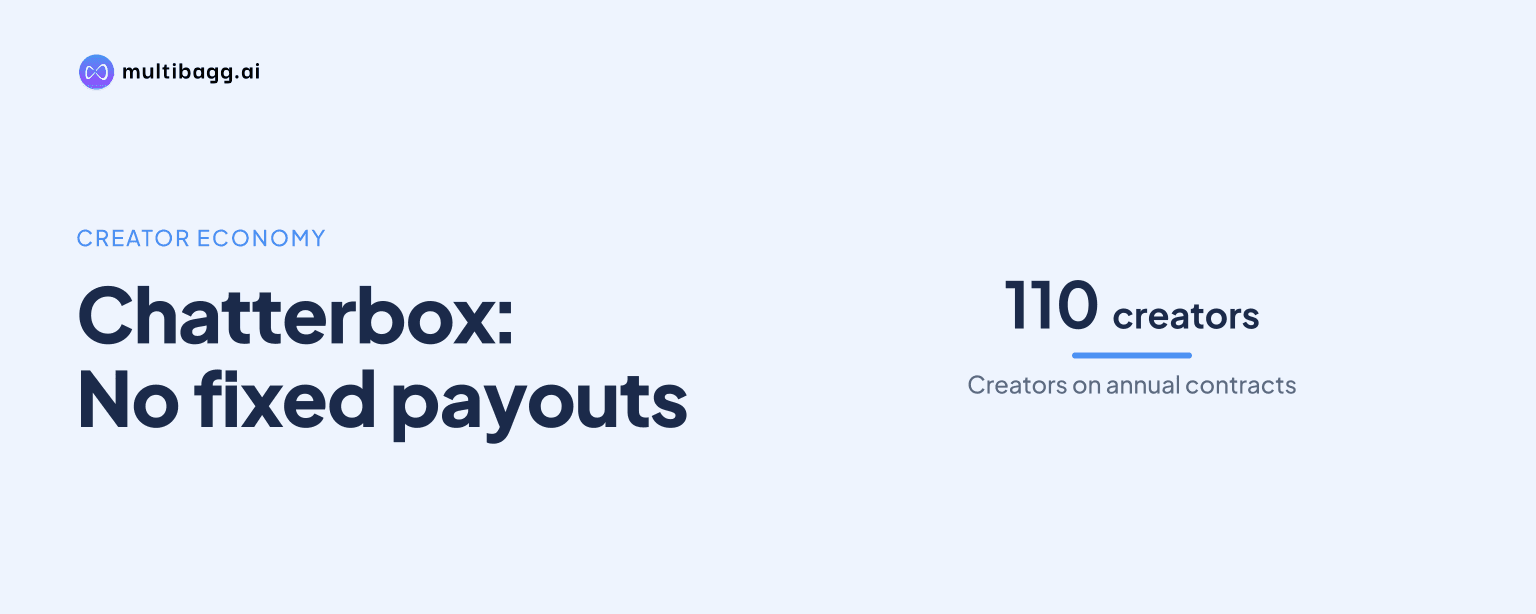
Chatterbox Technologies Limited said it represents 110 creators through typically annual exclusive contracts without making fixed annual payouts. Chatterbox instead retains a contractually specified commission or business share, while creator payouts can reach 70% to 90% of campaign value when management prices work strategically to win or retain a client.
Know Chatterbox Technologies inside out
Results, valuation, peers and who's buying, in one view.
How does Chatterbox pay its 110 exclusive creators?
Chatterbox pays its 110 represented creators through a variable commission model rather than an annual retainer. Management said the creators are bound by contracts under which Chatterbox is their exclusive representation partner, but directly confirmed that the company does not engage in a model involving fixed annual payouts.
The commercial split is set through a fixed commission or percentage of business that Chatterbox drives to the creator. Management illustrated the mechanism with a Rs 100 project, where an agreed percentage goes to the creator and the remaining percentage is retained by Chatterbox, meaning there is no single payout rate for every campaign.
Why can Chatterbox creator payouts reach 90% of campaign value?
Chatterbox said creator payouts can be about 70%, 80% or even 90% of a campaign’s value in selected cases. Management said it may accept a lower margin on a strategic campaign when it is seeking to onboard a client for the first time or retain an existing relationship.
This pricing approach makes the company’s retained share variable by campaign, client and business objective. Management said the payout decision depends on the business, timing and value Chatterbox can extract, so a 90% creator payout is a possible strategic outcome rather than a standard commission schedule.
What do exclusive creator contracts mean for Chatterbox revenue?
Chatterbox said the 110 represented creators are contractually exclusive, unlike creators in its wider network who can be approached by everyone when they are not bound by an agency. Under the exclusive arrangement, business conducted by those creators, whether generated organically or through Chatterbox, is accounted to the company for its commission share.
The contracts do not imply identical terms for all 110 creators. Management did not disclose an average commission, minimum creator income, renewal rate or total creator payouts, but said contracts specify a fixed commission or percentage of business. Represent contributed about 40% of revenue in the reported period, compared with about 44% from Brand Solutions.
How does Chatterbox connect creator management with brand work?
Chatterbox said Brand Solutions is often the entry point for a relationship with a brand, while Represent and Brand Solutions have historically contributed at broadly similar levels. After engaging a brand through Brand Solutions, Chatterbox said it can cross-sell social services, studios and campaigns involving its exclusive Represent creators.
This integrated model links the 44% Brand Solutions revenue contribution with the roughly 40% contribution from Represent in the reported period. Management said each segment contributes to both the top line and bottom line, although it did not provide separate creator-management margins or a target revenue mix for future periods.
Got a follow-up? Ask IRIS
How is Chatterbox seeking to improve campaign economics?
Chatterbox is investing in technology for creator discovery, audience intelligence, campaign planning, performance tracking and internal automation. Management said campaign execution, creator management, reporting and client servicing are currently resource-intensive, and it expects technology to help manage higher campaign volumes with more efficient refresh intervals for live campaigns.
The company’s captive technology is intended to automate campaign execution and talent discovery, while brand-facing products provide analytics and real-time dashboards. Management said these tools can improve creator matching and workflow efficiency, with expected benefits including productivity, margins and scalability, but it did not quantify technology spending or expected savings.
When does campaign seasonality affect Chatterbox?
Chatterbox said October to December is typically a festive period when brands reserve marketing budgets for visibility. Management also identified January to March as a period of increased activity as brands seek to exhaust budgets, making campaign volumes and related commissions dependent on the timing of brand spending.
Management described April to June as a typical slowdown because brands are beginning financial-year planning and may push campaign execution into the second quarter. Separately, Chatterbox said it held Rs 22 crore on its balance sheet in its H1 figures and expects accounts receivable to release in subsequent quarters, supporting healthier cash flow.
Conclusion
Chatterbox’s 110 exclusive creator relationships are based on representation rights and variable commissions, not guaranteed annual creator payments. The structure allows Chatterbox to receive a share of organic and company-driven business, but its campaign-level retained revenue can narrow when creator payouts rise to 70% to 90% for strategic client acquisition or retention.
The next disclosed item to watch is management’s planned publication of revenue mix and operating metrics for Dubai and other Middle East operations in the next quarterly or half-yearly results. Management also plans further technology investment in campaign and creator workflows, while its H1 international revenue contribution was 32.6%.