










Chatterbox Technologies Files H1 FY27 Earnings Call Transcript
Key highlights
- Chatterbox filed the transcript of its 19 November 2026 H1 FY27 earnings call on 24 November 2026.
- H1 FY27 revenue from operations rose 48.07% year-on-year to ₹53.28 crore.
- H1 FY27 EBITDA increased 47.34% to ₹9.77 crore, with an 18.33% EBITDA margin.
- Standalone H1 FY27 net profit rose 26.77% year-on-year to ₹5.96 crore.
powered by IRIS
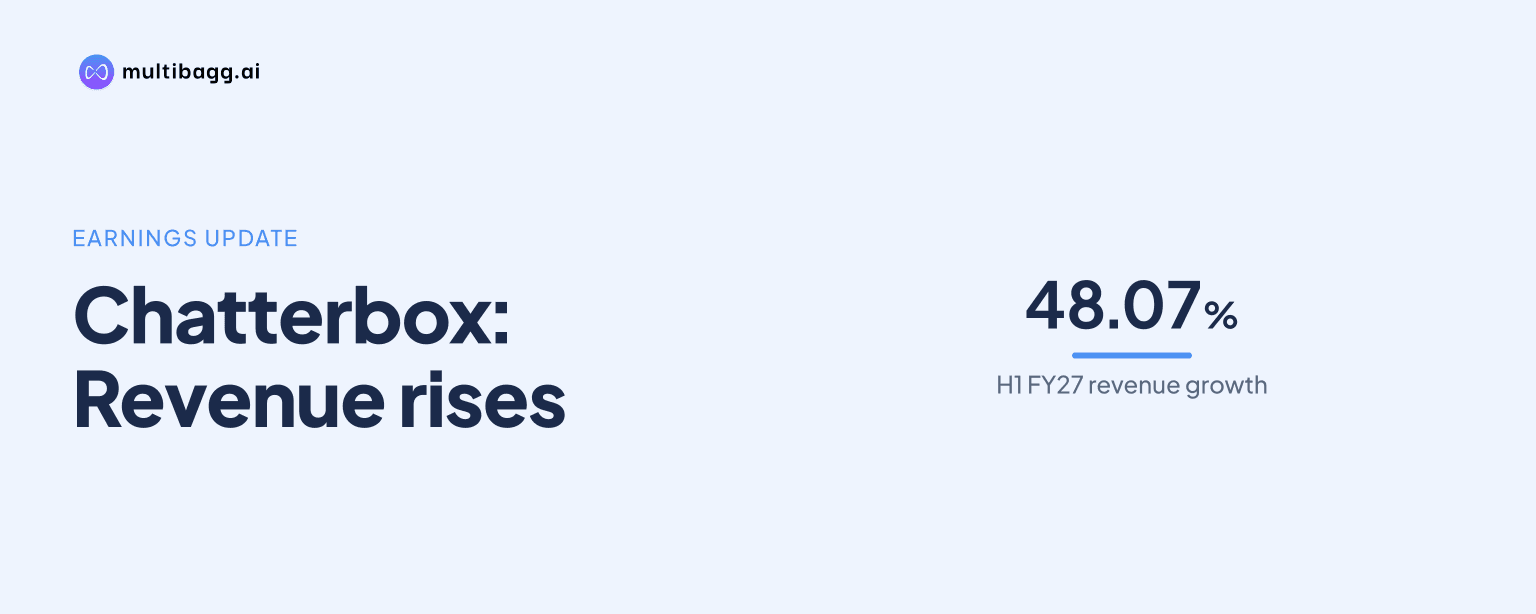
Chatterbox Technologies Limited filed the transcript of its 19 November 2026 H1 FY27 post-earnings conference call, following revenue growth of 48.07% year-on-year to ₹53.28 crore for the half year ended 30 September 2026. The filing gives investors a documented record of management's discussion on financial performance, operating activity and international business.
Know Chatterbox Technologies inside out
Results, valuation, peers and who's buying, in one view.
What did Chatterbox Technologies file for H1 FY27?
Chatterbox Technologies Limited, referred to hereafter as Chatterbox, filed the transcript of its post-earnings conference call held on 19 November 2026. The call covered the company's financial results and business updates for the first half of FY27. The filing date was 24 November 2026.
The company had earlier informed the stock exchange that the audio recording of the call was available on its investor relations website. The transcript now provides a written account of the discussion between management, investors and analysts. Such disclosures allow market participants to review management commentary alongside the reported half-year financial statements.
The event itself is a disclosure filing rather than a new financial result announcement. However, the transcript relates to a period in which Chatterbox reported growth in revenue, EBITDA and net profit, making it relevant for shareholders tracking the execution of its creator marketing and brand solutions businesses.
What were Chatterbox's H1 FY27 financial results?
Chatterbox reported revenue from operations of ₹53.28 crore in H1 FY27, up 48.07% from ₹35.98 crore in H1 FY26. EBITDA increased 47.34% to ₹9.77 crore, while the EBITDA margin stood at 18.33%.
Standalone net profit rose 26.77% year-on-year to ₹5.96 crore, compared with ₹4.70 crore in the comparable prior-year period. The difference between the revenue and EBITDA growth rates on one hand and profit growth on the other indicates that earnings conversion did not increase at the same pace as top-line growth during the half year.
The reported revenue increase was accompanied by growth in campaigns, brands served and creators, according to the provided earnings-call information. These operating indicators are important because Chatterbox earns through marketing campaigns and broader creator-led brand engagement services.
Got a follow-up? Ask IRIS
What did management discuss on the earnings call?
Management discussed deeper spending relationships with existing brands, a move from one-off campaigns toward integrated multi-service mandates, and the scaling of Represent, Brand Solutions and Chatter Social. It also referred to selective international expansion using capabilities developed in India.
Chatterbox operates across India, the UAE, Singapore, the US and the UK, with international revenue accounting for 32.6% of total revenue, according to the provided results coverage. Management described its Dubai presence as a route to serve Indian brands expanding into Gulf markets as well as global and regional brands seeking Indian audiences.
The call also addressed working-capital conditions in overseas operations. Management said that the average credit cycle in the US is typically higher than in India. This comment is relevant to investors because a longer collection cycle can affect the timing of cash conversion even when reported revenue is rising.
Management also cited technology and artificial intelligence-led campaign discovery, intelligence and operating efficiency as areas of focus. The transcript provides the context for these stated business priorities, but it does not itself establish a quantified financial contribution from them.
Why does the transcript filing matter to investors?
The transcript filing matters because it lets investors compare management's operating commentary with H1 FY27 financial performance. Revenue and EBITDA rose by about 48% and 47%, respectively, while net profit increased by about 27%, placing attention on expenses, investments and the conversion of operating growth into profit.
For shareholders, the disclosure also provides context on overseas business. International revenue represented nearly one-third of total revenue, while management acknowledged that US credit terms are generally longer than domestic terms. This makes receivables and cash-flow trends relevant areas to monitor in subsequent financial disclosures.
The filing comes as creator-led brand communication has become a larger part of digital marketing activity. Chatterbox has described itself as India's only publicly listed influencer marketing company. Its results and earnings-call disclosures therefore offer a listed-market reference point for investors following the sector, although the filing does not provide an industry-wide market-size estimate.
The company has stated that it is aiming for a 14% to 15% PAT margin in the next financial year. That is a management objective, not a reported outcome. Investors will need to assess future results for evidence of progress against that stated margin goal.
Conclusion
Chatterbox's 24 November filing documents the discussion held during its H1 FY27 earnings call, after the company reported ₹53.28 crore of revenue, ₹9.77 crore of EBITDA and ₹5.96 crore of standalone net profit. The transcript is significant because it links the reported financial growth with management's comments on integrated brand mandates, international operations and collection cycles.
The next point to watch is the company's execution against its stated 14% to 15% PAT-margin aim for the next financial year. Subsequent results will also provide further evidence on whether overseas revenue growth, longer international credit periods and investments in multi-service capabilities support or constrain profit and cash conversion.