










Chatterbox sees other expenses fall 30%-40% next financial year
Key highlights
- Chatterbox expects other expenses to decline 30%-40% in the next financial year.
- Management said IPO-related spending will continue through March, with next-half expenses expected to stay on similar lines.
- Chatterbox said 71% of business this year came from repeat clients.
- International operations contributed more than 30% of Chatterbox H1 FY27 revenue, according to management.
powered by IRIS
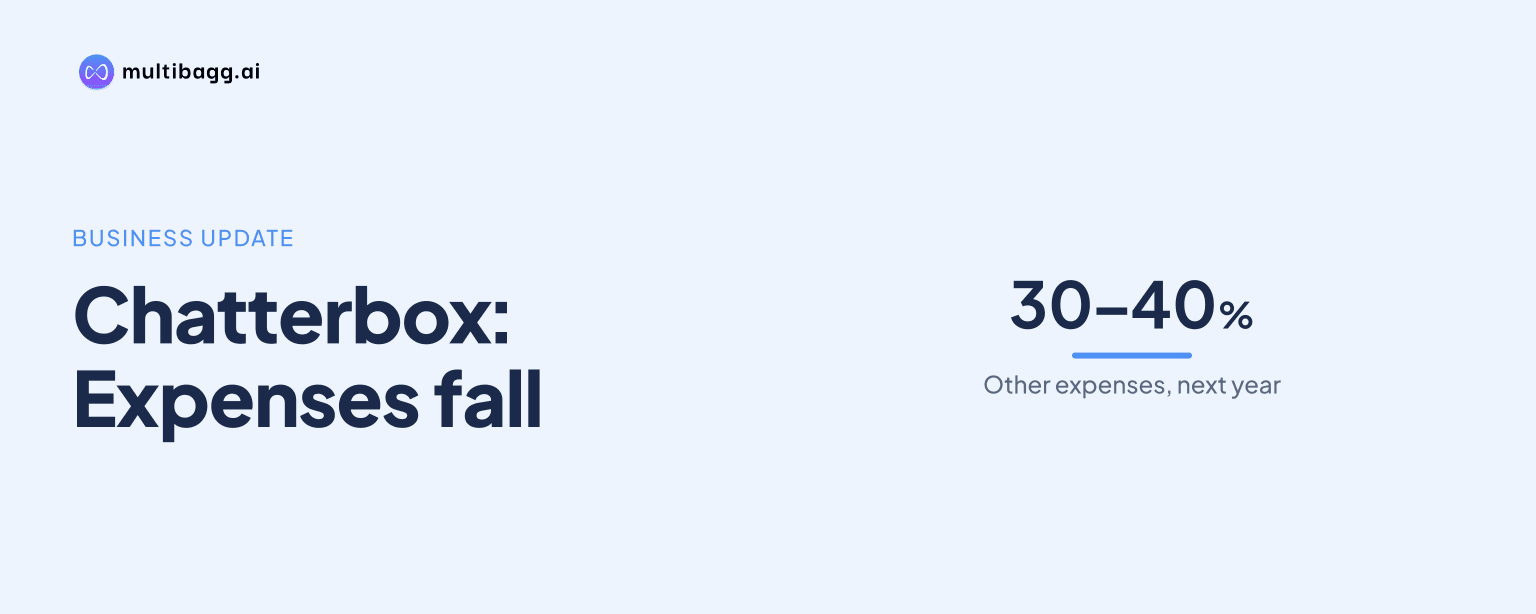
Chatterbox expects other expenses to fall 30%-40% in the next financial year after planned initial public offering, or IPO, spending continues through March. Management said the reduction should support profit after tax, or PAT, margin improvement if Chatterbox maintains gross margins, but it did not give an absolute expense or margin target.
Know Chatterbox Technologies inside out
Results, valuation, peers and who's buying, in one view.
Why does Chatterbox expect other expenses to fall?
Chatterbox expects other expenses to decline by 30%-40% in the next financial year. Management gave the range after an investor described the current expense level as about Rs 6 crore, but management did not provide an absolute rupee target or a category-by-category expense budget.
Chatterbox said costs would not fall immediately because planned activity is continuing until March. Management expects other expenses in the next half year to remain on similar lines rather than increase, placing the expected reduction in the financial year after the current IPO-investment period ends.
The timing reflects management’s statement that IPO investments are being used over roughly one year to one-and-a-half years. Public-relations activity is among those investments, while the September comparative period before the October listing did not include the same costs.
What has increased Chatterbox's other expenses?
Chatterbox attributed higher other expenses mainly to IPO-related public-relations spending and increased legal and professional costs following its October listing. Management described these as planned activities, rather than identifying a single exceptional charge, and said the spending programme would run through March.
Chatterbox also cited normal operating costs, including rent for a new office and studio. That means some expense drivers are linked to the IPO programme while others relate to operating infrastructure, although management still forecast a 30%-40% decline in the combined other-expense line next financial year.
The in-house studio has both a cost and a production role. Management said it enables faster reel production, reduces dependence on third-party studios and rented equipment, and supports ad production and artificial-intelligence-assisted output processing. It also said production has a higher margin rate than its typical core businesses, without quantifying either the margin difference or studio revenue.
How could lower costs affect Chatterbox PAT margin?
Chatterbox said a reduction in other expenses should lead to a natural increase in PAT margin next financial year if gross margins are maintained and strengthened. Management did not provide a PAT forecast, even after an investor referred to a previous 13%-15% range and a current level of about 11%.
Chatterbox said non-cash depreciation has also increased because of investments it considers necessary for growth. Management linked those investments to top-line growth, but did not disclose the depreciation amount, the associated revenue contribution, or how much of the 30%-40% other-expense decline would flow through to PAT.
Management identified revenue mix, technology-led efficiencies, production economics and cost optimisation as additional profitability levers. These are stated operating mechanisms rather than numerical guidance, and the only explicit cost forecast in the discussion was the 30%-40% decline in other expenses.
Got a follow-up? Ask IRIS
What operating factors could support Chatterbox's cost plan?
Chatterbox reported that 71% of business this year came from repeat clients. Management said its top 10 clients have typically worked with Chatterbox for four to five years, or more than one annual contract cycle, which it said supports retention, deeper client engagement and higher ticket sizes.
Chatterbox is seeking to turn transactional work into multi-service relationships using data, social listening, creator discovery, brand matching and campaign analytics. Management said brands increasingly seek measurable outcomes, including customer-acquisition-cost information, but did not disclose a timetable or cost-saving estimate for the technology programme.
The company described a relatively balanced revenue mix between key operating verticals in the period discussed: Represent contributed about 40% and Brand Solutions about 44%. Management said Brand Solutions can be the entry point for a brand relationship before cross-selling social services, studio work and its Represent creator roster.
What could affect the timing of Chatterbox's expense reduction?
Chatterbox said the remaining IPO and operating expenditure through March means next-half other expenses should stay on similar lines. Management did not separate the projected 30%-40% decline among public relations, legal and professional fees, office-studio rent, or any other cost category.
Working-capital collection timing is another disclosed consideration. An investor said debtor days had risen from 80 to 122 over two to three years, and Chatterbox said export revenue can extend credit periods because the American market typically has longer credit cycles than India. Management expects a decent part of recent-quarter receivables to be realised within the next six months.
Growth timing may also vary by period. Management said the second half is generally supported by the festive season, while international operations accounted for more than 30% of H1 FY27 revenue. The United Arab Emirates subsidiary was expected to become operational in the next quarter, and management said it would provide a revenue split in the next half-year update.
Conclusion
Chatterbox has set out a specific cost expectation: other expenses are expected to decline 30%-40% next financial year after IPO-linked public-relations activity and post-listing legal and professional spending run their course. The potential PAT-margin benefit remains conditional on gross-margin maintenance, depreciation, office-studio costs and the economics of production and technology investments.
The next items to watch are whether other expenses remain broadly stable through March, as management indicated, and whether the forecast decline appears in the following financial year. Management also pointed to receivable realisations over the next six months, second-half festive demand, and the next half-year disclosure on the United Arab Emirates subsidiary after it becomes operational in the next quarter.