










City Union Bank sells Rs 803 crore in aged stressed loans
Key highlights
- City Union Bank sold Rs 803 crore of stressed loans to an asset reconstruction company, including Rs 500 crore without collateral and Rs 303 crore fully collateralised.
- Almost Rs 740 crore of the sold pool was more than three years old, including Rs 645 crore across 757 loans that were over five years old.
- City Union Bank held Rs 792 crore of provisions against the sold accounts and recorded no provision reversal in profit and loss during the quarter discussed.
- The bank said its remaining technically written-off pool was Rs 900 crore after the sale and was fully provided for.
powered by IRIS
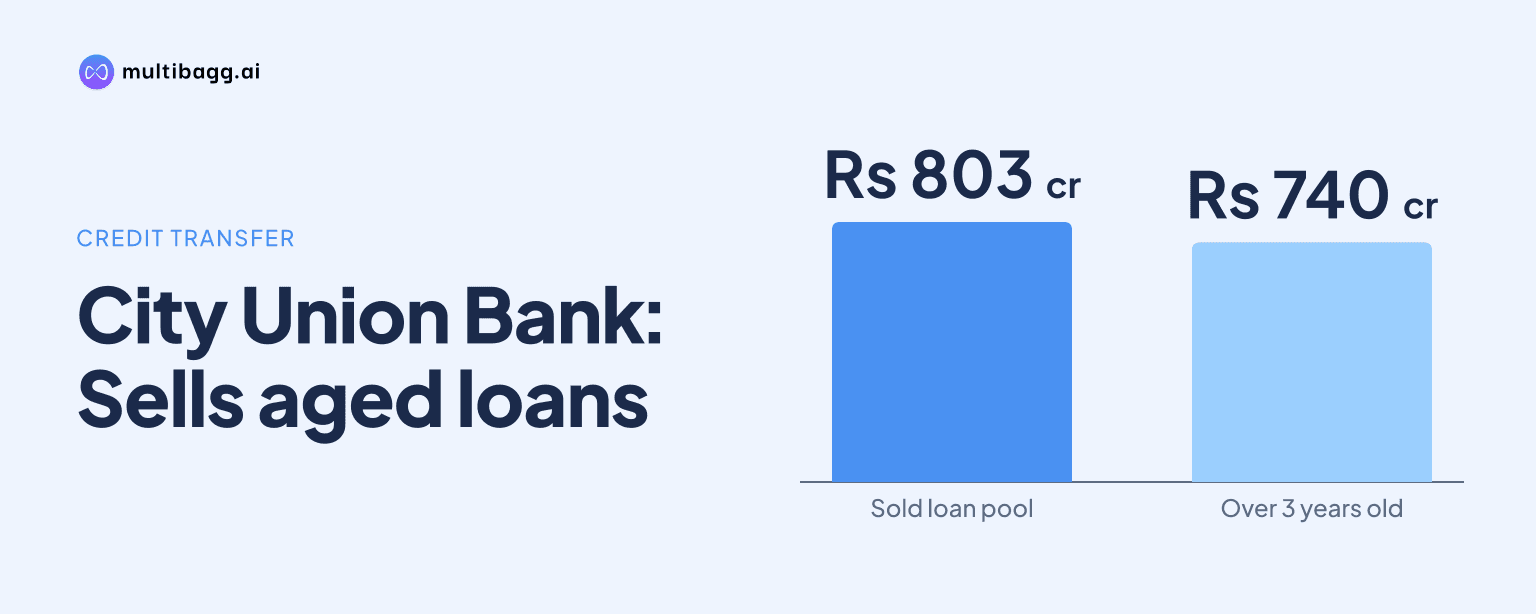
City Union Bank sold Rs 803 crore of stressed loans to an asset reconstruction company (ARC), chiefly removing long-outstanding exposures rather than describing a broad disposal of its secured book. Almost Rs 740 crore of the pool was more than three years old, Rs 500 crore had no collateral, and City Union Bank held Rs 792 crore of provisions against the sold accounts.
Know City Union Bank inside out
Results, valuation, peers and who's buying, in one view.
What did City Union Bank sell to the ARC?
City Union Bank sold a Rs 803 crore stressed-loan pool and said it had provided Rs 792 crore against those exposures. Management described the sale as an outcome of its internal assessment of the time value of money for accounts that had stayed unresolved for several years. The transaction involved both residual claims after prior recoveries and loans that still had collateral.
City Union Bank illustrated the residual-claim mechanism using an account where it had recovered most of an originally secured loan through a property sale but retained the unpaid balance as a claim against the borrower. Management said such a remaining balance becomes unsecured after the underlying property has been sold, while the bank has not issued a closure or no-objection certificate for the loan. This was the rationale management gave for selling some aged residual balances.
The sale was not presented as a uniform pool of recently defaulted secured lending. Management said City Union Bank generally operates with a loss given default, or LGD, assumption of 20%, but explained that collateral recovery can leave an unsecured residual claim. The Rs 803 crore pool consequently contained both fully collateralised accounts and accounts with no collateral.
How old were the loans City Union Bank sold?
Almost Rs 740 crore of City Union Bank's sold pool had been outstanding for more than three years, according to management. The largest disclosed category was Rs 645 crore across 757 loans that were more than five years old, for which City Union Bank said provision was held. This age profile was management's central explanation for the disposal decision.
Loans aged four to five years represented Rs 40 crore across 91 accounts, while loans aged three to four years represented Rs 54 crore across 84 accounts. The three disclosed age buckets therefore covered Rs 739 crore across 932 loans, close to management's description of almost Rs 740 crore aged beyond three years.
Management referred to Rs 802 crore while discussing the age profile, versus the Rs 803 crore sale amount it had stated earlier. City Union Bank did not provide an ageing split for the difference between the Rs 739 crore in disclosed buckets and the overall sold pool. The call therefore establishes that most of the transaction was aged, but not the precise age of every rupee sold.
How much collateral backed City Union Bank's loan-sale pool?
City Union Bank said Rs 303 crore of the Rs 803 crore pool was fully collateralised and Rs 500 crore was without collateral. The no-collateral component was larger than the collateralised component, although management said the transaction was a mix of both types. The figures add to the stated Rs 803 crore sale total.
The Rs 500 crore without collateral was relevant to the analyst's question over why a bank that described its book as secured would sell such accounts. Management said residual balances can remain after collateral is realised on an originally secured exposure. It did not say that every one of the Rs 500 crore of uncollateralised loans resulted from that same mechanism.
The Rs 303 crore collateralised portion means the sale was not limited to residual unsecured claims. At the same time, the Rs 500 crore without collateral supports management's explanation that aged recovery balances formed a material part of the transaction. City Union Bank did not disclose the collateral type, account-level recovery history, or buyer's intended collection approach for either component.
Got a follow-up? Ask IRIS
What was City Union Bank's provision and profit-and-loss effect?
City Union Bank said it had provided Rs 792 crore against the Rs 803 crore sold pool and recorded no provision reversal in profit and loss from the transaction during the quarter discussed on the call. When asked directly about a reversal, management answered no. The disclosed treatment indicates that the sale did not produce an immediate provision write-back in that period.
After the sale, City Union Bank said its outstanding technically written-off pool was Rs 900 crore and fully provided for. That amount was larger than the Rs 803 crore sold pool, showing that the post-sale pool included exposures outside the transaction. Management did not give a collateral, ageing or recovery breakdown for the Rs 900 crore balance.
An analyst referred to cash recoveries of around 16% while asking about the sale. Management did not confirm that figure in its reply, nor did City Union Bank disclose the sale price, cash consideration, security-receipt structure or any recovery-sharing arrangement. The confirmed disclosures were the Rs 792 crore provision, the absence of a reversal and the Rs 900 crore post-sale technically written-off pool.
Does the sale mean City Union Bank is disposing of its mainstream secured book?
No, City Union Bank did not portray the transaction as a disposal of its mainstream secured book. Management emphasised the Rs 645 crore more than five years old, the nearly Rs 740 crore outstanding for over three years, and its time-value assessment of continued recovery. Its explanation focused on removing aged accounts and residual claims rather than setting out a plan to sell current secured lending.
The sale nevertheless included Rs 303 crore of fully collateralised loans, so it was not exclusively an unsecured residual-claims transaction. The larger Rs 500 crore no-collateral component helps explain why management characterised the pool as different from a straightforward sale of secured loans. City Union Bank gave no plan for another stressed-asset sale and did not identify an intended size or timetable for future transactions.
Conclusion
The transaction combined an aged-account clean-up with the transfer of both collateralised and non-collateralised claims. City Union Bank had largely provided for the sold Rs 803 crore pool, and management said no provision reversal was recorded in the quarter, making the disclosed effect a balance-sheet action rather than an immediate earnings release.
The next point to watch is movement in City Union Bank's Rs 900 crore fully provided technically written-off pool, including any later recovery or profit-and-loss effect. The sale price, buyer economics, recovery-sharing terms and any further sale plan remained undisclosed on the call.