










City Union Bank to cap gold loans at 31%-32% of advances
Key highlights
- City Union Bank plans to keep gold loans at 31%-32% of total advances, allowing only 1-2 percentage points of further share growth.
- Current gold-loan originations carry a blended yield of 10.8%, while portfolio yield was 10.7%; management expects a further 5-10 basis-point increase as older loans are replaced.
- Gold-loan business is concentrated in Southern India, which accounts for 96% of the portfolio, and is mainly originated through 250-260 rural and semi-urban branches.
- The bank expects net interest margin of 3.85%-3.95% while anticipating a 10-basis-point increase in deposit costs.
powered by IRIS
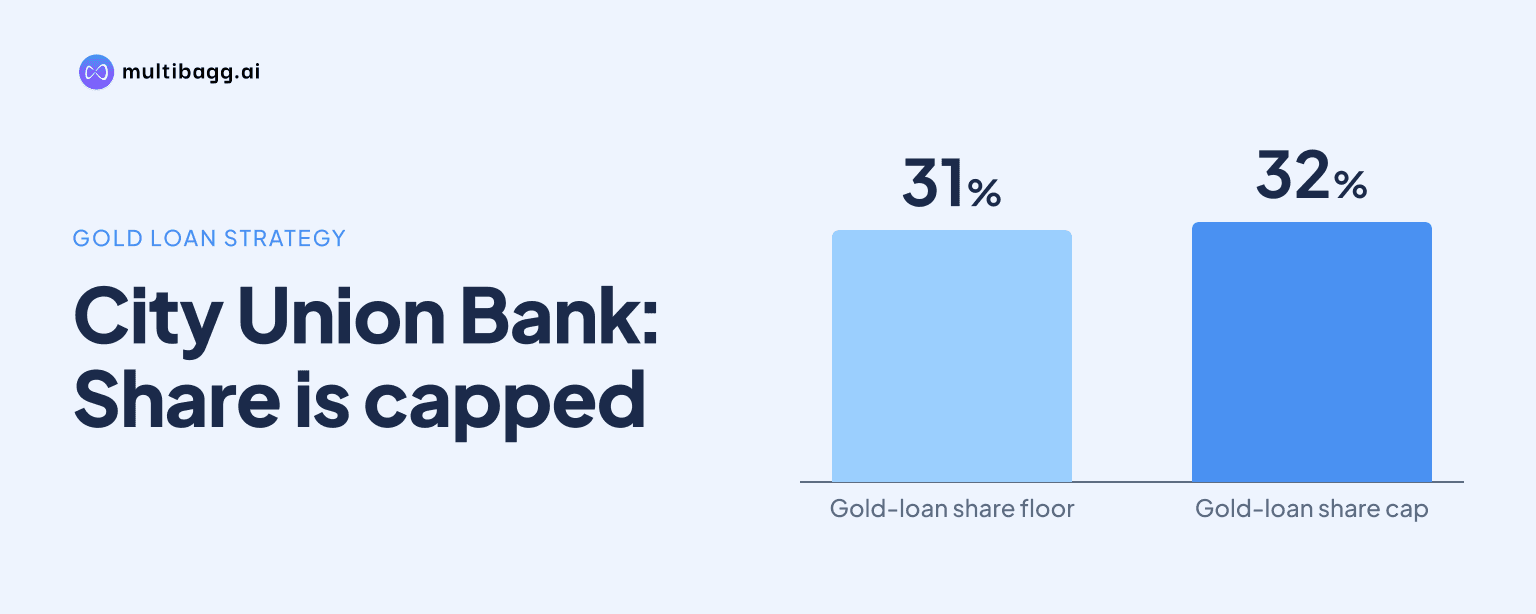
City Union Bank said it does not want gold loans to exceed 31%-32% of advances, from a level an analyst described as about 30%. Management indicated that the product’s share may rise by only 1-2 percentage points, while agricultural gold loans receive greater underwriting comfort because documented activity and harvest cycles help assess end use and repayment timing.
Know City Union Bank inside out
Results, valuation, peers and who's buying, in one view.
Why is City Union Bank capping gold loans at 31%-32%?
City Union Bank is limiting gold loans because management said it does not want the portfolio to move beyond 31%-32% of total advances. When an analyst asked whether the share, described as 30%, could rise to 35%, management said it was looking for a maximum increase of 1% or 2%.
The limit does not mean City Union Bank will stop originating eligible gold loans. Management said non-agricultural gold lending can grow when the borrower meets its framework, including a matching credit-bureau record, a satisfactory personal discussion, or PD, and a clean assessment. It did not provide a volume-growth target for non-agricultural gold loans.
Gold loans also matter to the bank’s margin management because the entire portfolio is fixed rate. Management guided for net interest margin, or NIM, of 3.85%-3.95% and said deposit costs could rise by 10 basis points, where 100 basis points equal one percentage point. The concentration ceiling therefore sits alongside the bank’s focus on loan pricing, funding costs and underwriting.
Why does City Union Bank favour agricultural gold loans?
City Union Bank favours agricultural gold loans because documents can evidence the eligible activity and harvesting seasons can help establish the expected timing of cash flows. Management cited familiarity with cultivation in the Kaveri delta belt, where it can assess what is being cultivated and when the harvest is expected.
For consumption loans, City Union Bank said it needs to establish why the borrower requires funds and what the money will be used for. Management did not say non-agricultural gold loans would decline, but said their growth would be based entirely on risk assessment. The difference is therefore in the information available for underwriting rather than the existence of gold collateral.
Non-agricultural accounts have an average ticket size Rs 1.10 lakh above agricultural accounts and broadly 100 basis points more yield, management said. City Union Bank also said a customer can hold a maximum of 20 gold-loan accounts, with each loan subject to eligibility, income and credit-bureau assessment. The Rs 1.90 lakh and Rs 3 lakh figures are per account, not per customer.
Where does City Union Bank originate its gold loans?
City Union Bank offers gold loans across India, although 96% of its gold-loan business is in Southern India and 4% is outside the region. Management said the product is commonly originated through 250-260 rural and semi-urban branches rather than as a metro-led cross-selling product.
A typical gold-loan branch has a 500-700 square-foot office and a book of Rs 40 crore-Rs 50 crore, management said. About 50% of gold-loan customers are agricultural customers. All gold-loan customers hold a savings-bank account with City Union Bank, although management said broader cross-selling is limited because these borrowers are generally not the bank’s core micro, small and medium enterprise, or MSME, customers.
Loan sizes differ by market and agricultural requirement. City Union Bank said it can originate Rs 30,000-Rs 40,000 loans in 50-60 unbanked rural locations where it may be the only bank, while tickets can rise to Rs 2 lakh in semi-urban markets. For agricultural borrowers, management said loan requirements also depend on acreage and the expected harvest.
Got a follow-up? Ask IRIS
How could the gold-loan cap affect City Union Bank's pricing and margins?
City Union Bank said the blended rate on current gold-loan originations was 10.8%, compared with the 10.7% portfolio yield cited by an analyst from the bank’s presentation. Management attributed higher lending yields to rate increases in markets where it had an opportunity to raise prices.
Management said it did not expect to raise gold-loan rates in the current quarter. It nevertheless estimated that portfolio yield could rise by another 5-10 basis points as borrowers with older loans repay and take fresh loans at prevailing rates. Because all gold loans are fixed rate, outstanding contracts are not repriced in the way floating-rate loans can be.
Across the broader advances book, management said 55% was linked to the external benchmark lending rate, or EBLR, 33% was fixed rate and 12% was linked to the marginal cost of funds-based lending rate, or MCLR. It maintained the 3.85%-3.95% NIM range and said both liability costs and lending in secured retail and MSME products would influence the outcome.
What repayment and underwriting features matter for City Union Bank's gold loans?
City Union Bank said the interval between a gold loan becoming a non-performing asset, or NPA, and auction is 45 days. Management said customers who want their gold returned normally repay within that period, describing gold as an emotional product for many borrowers in Southern India.
Management said City Union Bank is not the highest lender on a rate-per-gram basis, which can leave borrowers with scope to raise funds elsewhere against the same gold value. It did not quantify the effect on recoveries or identify the source of any individual borrower’s repayment. The bank instead described its process as combining the 45-day auction timeframe with eligibility, income, bureau and end-use checks.
Conclusion
City Union Bank’s approach retains gold loans as a material part of advances while setting a stated ceiling of 31%-32%. Agricultural gold loans have greater underwriting visibility through documents and harvest cycles, while non-agricultural loans offer roughly 100 basis points more yield but require more detailed assessment of the borrower and use of funds.
The next measures to watch are whether gold loans remain within the 31%-32% range, whether replacement originations deliver the 5-10 basis points of portfolio-yield movement management identified, and whether NIM remains in the 3.85%-3.95% range despite the projected 10-basis-point increase in deposit costs. Management also said it aims for credit growth 2%-3% above the industry level, supported by MSME, retail and gold-loan additions.