










City Union flags challenge to sustaining 21%-plus deposit growth
Key highlights
- City Union Bank said sustaining 21%-22% deposit growth for the next two years would be challenging and did not provide an FY28 target.
- Term deposits below Rs 3 crore accounted for 48% of the deposit book, compared with 17% for deposits of Rs 3 crore to Rs 50 crore and 8% above Rs 50 crore.
- The bank’s branch network grew from 800 to more than 1,000, with management citing improving productivity and consistent contributions from new branches.
- City Union Bank’s Q2FY27 profit after tax rose 27% to Rs 416 crore from Rs 329 crore, while its cost-to-income ratio fell to 45.96% from 49.16%.
powered by IRIS
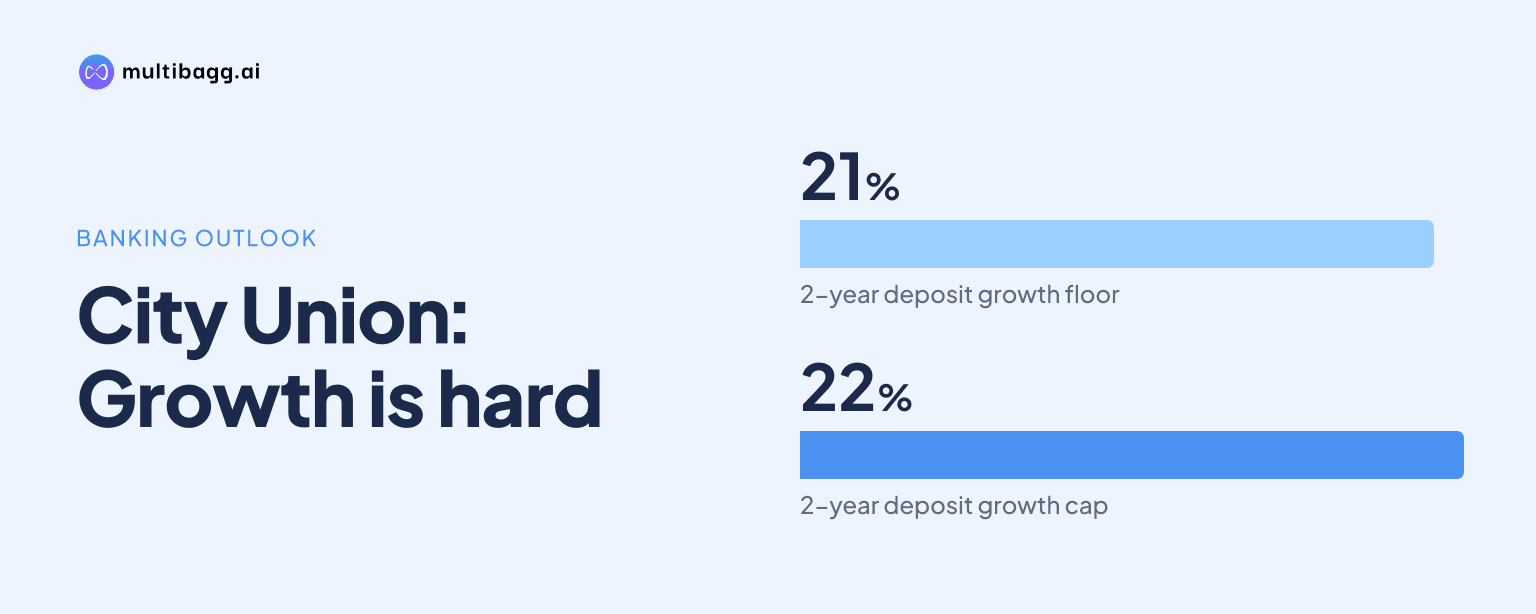
City Union Bank said it is doubtful that it can sustain deposit growth of 21%-22% for the next two years. Management cited the challenge of maintaining that pace, while pointing to more than 1,000 branches, improving new-branch productivity and a 48% contribution from term deposits below Rs 3 crore as current supports.
Know City Union Bank inside out
Results, valuation, peers and who's buying, in one view.
Can City Union sustain 21%-plus deposit growth for two years?
City Union does not yet expect to confirm that 21%-22% deposit growth can continue over the next two years. Asked about the 12-to-18-month outlook and FY28, management said 20%-plus growth would be challenging and that it was doubtful about sustaining such a rate over that period.
The distinction is between recent performance and a formal target. City Union said it had been consistent over the last couple of quarters, but management said it needed to watch results for longer before confirming it had the appetite to maintain the current pace. The call disclosed no deposit-growth target for FY28.
City Union said deposits are aligning with credit growth and should continue to do so. Its stated FY27 lending objective is credit growth of 2%-3% above the industry level, focused on secured lending in micro, small and medium enterprises and gold loans. That alignment, rather than a commitment to 21%-22% deposit growth, is management’s disclosed funding objective.
How granular is City Union’s deposit base?
City Union described 75% of its deposit book as “slightly granular,” while saying it had not pursued bulk deposits or certificates of deposit. Management reported that term deposits below Rs 3 crore contributed 48%, deposits from Rs 3 crore to Rs 50 crore contributed 17%, and deposits above Rs 50 crore contributed 8%.
The three disclosed ticket bands total 73%, while management separately referred to 75% of the book as granular. City Union did not reconcile that difference or provide ticket-size detail for the remaining portion. The largest disclosed category was term deposits below Rs 3 crore, at 48%, compared with 8% for deposits above Rs 50 crore.
Management presented this mix as part of its explanation for recent deposit growth, specifically contrasting it with bulk deposits and certificates of deposit. However, the granular composition did not alter its caution on the outlook: City Union said it would need more time to assess whether growth can remain at 21%-22% over two years.
What is supporting City Union’s deposit growth now?
City Union said rising branch productivity and contributions from new branches are providing a cushion. The network had expanded from 800 branches to more than 1,000 branches as of the call, and management said newly opened branches had started delivering consistently.
The bank did not disclose a deposit balance or growth rate per branch. It did, however, describe branches as distribution centres, a model it also cited for gold lending through roughly 250-260 rural and semi-urban branches or distribution centres. For deposits, management linked the 1,000-plus branch network to improving productivity and new-location contributions.
City Union also said it had made substantial hiring from other banks and created specialised deposit-gathering verticals. These include current account savings account, or CASA, salary accounts, a vertical called TASC, government business and non-resident Indian, or NRI, business. Management said the structure appeared to be working, but did not disclose separate balances or growth rates for any vertical.
Got a follow-up? Ask IRIS
How is City Union seeking to increase CASA balances?
City Union said it has increased the weighting of CASA in branch-manager scores, with average CASA rather than terminal CASA determining ratings. Management said terminal CASA does not generate an incentive outcome for branch managers, whereas average CASA does.
The incentive design is intended to focus managers on balances maintained through the period rather than an end-period balance. City Union also cited relationship-led service, including meeting customers beyond transactions, as a deposit-sourcing mechanism. The call did not provide a CASA ratio or a comparison of CASA balances between FY26 and FY27.
The specialised model combines the CASA vertical with salary accounts, TASC, government and NRI business. Management said it hoped to replicate the approach every quarter, following its expansion to more than 1,000 branches, but it gave no numerical CASA target for FY27 or FY28.
What does the deposit outlook mean for City Union’s FY27 plan?
City Union’s deposit caution accompanies FY27 operating targets that assume funding can support lending growth. Management guided for net interest margin, or NIM, of 3.85%-3.95% in Q3 and Q4 of FY27, and said its cost-to-income ratio should be within 45%-47% for FY27.
The bank reported profit after tax of Rs 798 crore in 1HFY27, compared with Rs 635 crore in 1HFY26, a 26% increase. In Q2FY27, profit after tax was Rs 416 crore, up 27% from Rs 329 crore in Q2FY26. These results show higher earnings during the period of recent deposit momentum, but they do not establish a future deposit-growth rate.
City Union also made a Rs 50 crore contingent provision in Q2FY27 for potential future economic uncertainties and said it intended to build this provision in coming quarters. Management expects return on assets to move above 1.6%, while the unresolved issue remains whether deposits can keep growing at 21%-22% for two years.
Conclusion
City Union’s position is that recent deposit growth has support from its more than 1,000-branch network, newly productive branches, targeted hiring and specialised CASA-related verticals. Its disclosed deposit mix also places 48% of the book in term deposits below Rs 3 crore, but management has not converted those operating measures into a commitment to sustain 21%-22% growth.
The next point to watch is whether new branches continue to deliver and whether the CASA, salary, TASC, government and NRI verticals add balances consistently each quarter. Management has set a 3.85%-3.95% NIM range for Q3 and Q4 of FY27 and a 45%-47% FY27 cost-to-income range, while leaving the longer-term deposit-growth outcome open.