










Clean Max Enviro Energy Solutions Approves Gangotri Stake Deal
Key highlights
- Clean Max approved the sale of a 26% stake in Clean Max Gangotri to Gujarat Alkalies and Chemicals.
- Clean Max approved investment of up to ₹214.49 crore in renewable energy capacity.
- The investment is proposed through a shareholders’ agreement.
- The filing summary does not disclose the consideration for the 26% stake sale.
powered by IRIS
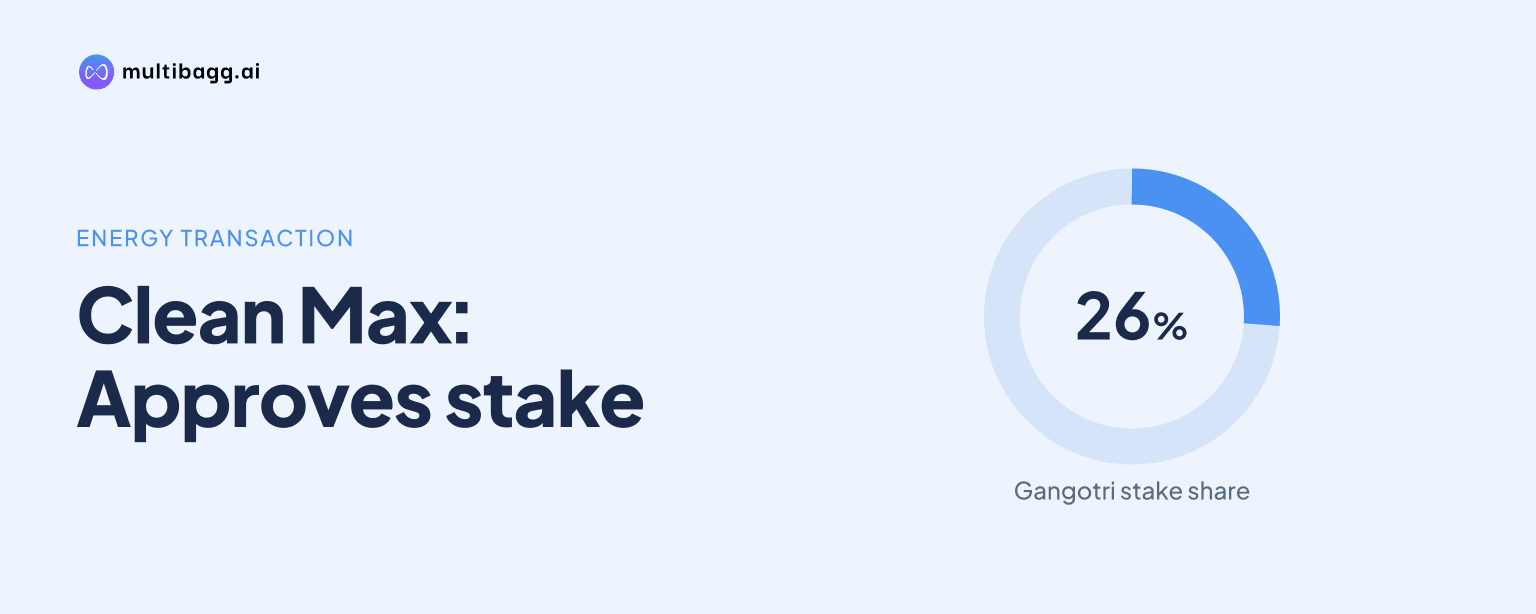
Clean Max Enviro Energy Solutions approved the sale of a 26% stake in Clean Max Gangotri to Gujarat Alkalies and Chemicals, alongside an investment of up to ₹214.49 crore in renewable energy capacity through a shareholders’ agreement.
Know Clean Max Enviro Energy Solutions inside out
Results, valuation, peers and who's buying, in one view.
What did Clean Max approve in the filing?
Clean Max approved two connected actions involving Clean Max Gangotri. The first is the sale of a 26% equity stake in Clean Max Gangotri to Gujarat Alkalies and Chemicals. The second is an investment of up to ₹214.49 crore in renewable energy capacity through a shareholders’ agreement.
The disclosure identifies the stake sale and investment approval as the principal event. It establishes Gujarat Alkalies and Chemicals as the buyer of the specified minority interest and sets the upper limit for the renewable-capacity investment. The filing does not state the consideration for the 26% stake sale.
It also does not provide a project commissioning schedule, the specific location of the planned capacity, or a capacity figure in megawatts. Those details therefore cannot be inferred from the approval alone.
Which parties are involved in the Clean Max Gangotri agreement?
The parties named in the filing are Clean Max, its subsidiary Clean Max Gangotri, and Gujarat Alkalies and Chemicals. Clean Max is the seller of the 26% stake, while Gujarat Alkalies and Chemicals is the proposed buyer under the approved arrangement.
The investment is to be made through a shareholders’ agreement. Such an agreement generally records the rights and obligations of shareholders in relation to funding, governance, and the relevant business, but the filing summary does not disclose the agreement’s detailed provisions. It would not be appropriate to assume board rights, funding proportions, or operating responsibilities beyond what has been stated.
The transaction is significant because it combines a change in ownership at the subsidiary level with a planned capital commitment. The disclosed investment ceiling provides the clearest financial measure of the proposal.
How much renewable energy investment has Clean Max approved?
Clean Max approved investment of up to ₹214.49 crore in renewable energy capacity under the shareholders’ agreement. The wording sets a maximum approved amount rather than confirming that the full amount has already been deployed.
For investors, the distinction between an approval limit and an actual expenditure matters. The filing confirms the board-level decision to support capacity investment up to the stated amount, but it does not disclose the timing of capital deployment, sources of funding, or the split between equity, debt, and other forms of financing.
No revenue, profitability, generation estimate, or customer supply arrangement has been disclosed with the approval. Consequently, the filing does not provide a basis to quantify the investment’s future financial contribution to Clean Max or to Gujarat Alkalies and Chemicals.
Got a follow-up? Ask IRIS
What does the stake sale mean for investors and operations?
The approved sale would give Gujarat Alkalies and Chemicals a 26% interest in Clean Max Gangotri, while the remaining 74% would stay outside the stake being sold by Clean Max. The filing communicates a proposed ownership change, but does not state whether the transaction has been completed.
The arrangement links ownership participation with renewable energy capacity investment. This can be relevant to investors because the subsidiary’s capital structure and shareholder composition may change once the approved actions are implemented. However, the disclosure contains no information on valuation, earnings impact, capacity size, or completion date.
There is also no share-price movement, market reaction, or financial guidance included in the filing. Any assessment of the effect on Clean Max’s consolidated financials would require further disclosures on transaction completion, investment deployment, and operating performance.
Why is the shareholders’ agreement relevant?
The shareholders’ agreement is relevant because it is the stated route for the investment of up to ₹214.49 crore in renewable energy capacity. It connects the proposed minority stake sale with the planned funding framework for Clean Max Gangotri.
The agreement may govern how the approved investment is carried out, but the filing summary does not disclose its commercial terms. In particular, it does not state the project type, capacity addition, ownership of resulting assets, or conditions that must be met before funding.
The disclosure should therefore be read as an approval of the transaction framework rather than as confirmation of completed investment or commissioned renewable capacity. Subsequent regulatory filings, if made, would be relevant for confirmation of execution and operational progress.
Conclusion
Clean Max has approved a 26% stake sale in Clean Max Gangotri to Gujarat Alkalies and Chemicals and an investment of up to ₹214.49 crore through a shareholders’ agreement for renewable energy capacity. The filing sets out the parties, ownership percentage, and investment ceiling, while leaving the stake-sale consideration and detailed implementation terms undisclosed.
Investors should watch for disclosures on completion of the stake transfer, the consideration paid, the timing and structure of the investment, and details of the renewable capacity to be developed. These items will determine the financial and operating implications of the approved arrangement.