










CleanMax Enviro Energy Solutions Plans ₹50,000 Crore Project
Key highlights
- CleanMax signed an MoU to invest ₹50,000 crore in an integrated green-energy complex in Andhra Pradesh.
- The proposal includes 3 GW of wind and solar generation capacity and 1 GW of pumped hydro storage.
- The project is intended to power a 2 GW compute factory planned in Kurnool district with Neysa.
- CleanMax previously secured approximately $575 million to develop nearly 1 GW of renewable projects in Rajasthan and Karnataka.
powered by IRIS
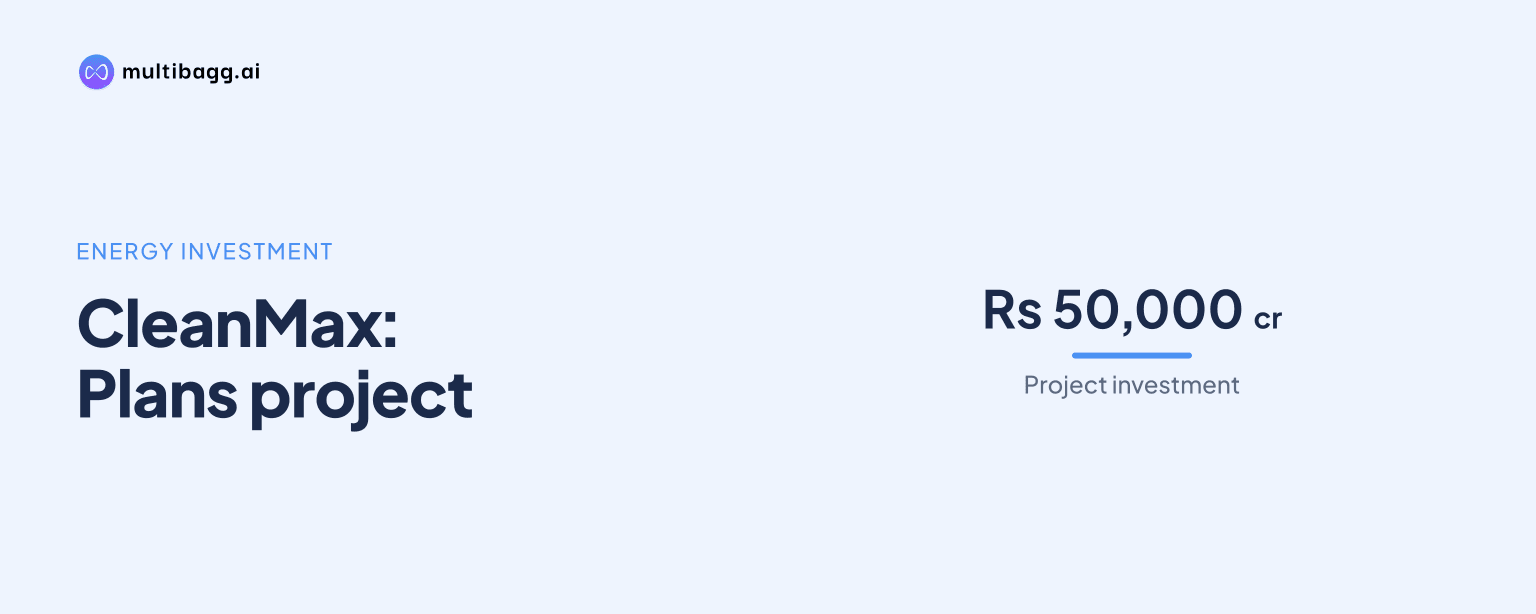
CleanMax Enviro Energy Solutions Ltd. has signed an MoU to invest ₹50,000 crore in Andhra Pradesh for an integrated green energy complex with 3 GW of wind and solar capacity and 1 GW of pumped hydro storage. The project is intended to supply a 2 GW compute factory planned in Kurnool district.
Know Clean Max Enviro Energy Solutions inside out
Results, valuation, peers and who's buying, in one view.
What has CleanMax committed to build in Andhra Pradesh?
CleanMax has committed ₹50,000 crore to an integrated clean-energy project in Andhra Pradesh under an accord with the Andhra Pradesh Economic Development Board. The proposed investment combines renewable electricity generation, energy storage and distribution infrastructure to support large-scale, round-the-clock power requirements.
The project is anchored by a compute factory planned in Kurnool district in collaboration with Neysa. CleanMax has stated that the power infrastructure will help serve the compute facility while addressing rising demand for clean electricity from commercial and industrial users. The company has not disclosed a project execution schedule, commissioning date or detailed investment phasing in the available information.
How will the proposed power system operate?
CleanMax plans to combine wind, solar and storage assets so that electricity can be supplied beyond the variable generation periods of renewable resources. The 3 GW generation portfolio is to use wind and solar power, while the proposed 1 GW pumped hydro facility is designed to add storage capability to the integrated system.
Pumped hydro storage generally stores energy by moving water to a higher reservoir when electricity is available and generating power as water is released later. In the context of the announced complex, the storage component is intended to support the company's objective of providing round-the-clock electricity. The disclosure does not provide details on the storage duration, land requirement, grid connection or the capacity split between wind and solar projects.
The integration of generation, storage and distribution is central to the proposal because a compute factory requires reliable electricity availability. CleanMax has positioned the project as infrastructure for clean power demand rather than as a standalone wind or solar installation. The company has also referred to local youth training programmes and upgrades to educational infrastructure as part of its broader plans in the state.
What is CleanMax's existing renewable-energy business?
CleanMax provides renewable power solutions to commercial and industrial customers across India, the Middle East and South-East Asia. Its customer-focused model includes renewable generation projects structured to supply corporate electricity users, including group-captive arrangements.
The company recently highlighted customer wins involving technology, data-centre and industrial names, including Meta, Apple and STT GDC India. It also announced in April 2026 that it would supply about 30 MW of hybrid renewable electricity to Shell India's assets in Gujarat and Karnataka. That programme includes a 16.83 MW hybrid plant in Gujarat, comprising 6.93 MWp of solar capacity and 9.90 MW of wind capacity.
CleanMax has separately secured approximately $575 million in multi-lender financing for nearly 1 GW of solar and wind projects in Rajasthan and Karnataka for corporate clients. These projects show the company's existing focus on supplying businesses through renewable assets, although the Andhra Pradesh proposal is materially larger than the capacities cited in those announcements.
Got a follow-up? Ask IRIS
Why does the Andhra Pradesh MoU matter for investors and industry?
The MoU matters because it links renewable generation and storage with a large computing facility, where uninterrupted electricity supply is a core operational requirement. The proposed 3 GW renewable portfolio and 1 GW pumped hydro facility place storage alongside generation at the centre of the project design.
For Andhra Pradesh, the plan identifies Kurnool as the location for the compute factory and includes proposed youth training and education-related measures. The available announcement does not state the number of jobs expected, the investment committed by Neysa, or the timelines for these local programmes. Those details will be important in assessing the project's eventual local economic effect.
For the renewable-power sector, the project reflects demand from energy-intensive digital infrastructure and industrial users for cleaner power with improved reliability. However, an MoU signals an agreed investment intention rather than completed capacity. The project will still require execution across development, financing, generation assets, storage infrastructure and power delivery arrangements.
How does this plan compare with CleanMax's recent partnerships?
CleanMax's recent partnerships indicate a pattern of developing renewable assets for specific corporate offtakers. In Rajasthan, Nuvoco Vistas Corp agreed to acquire a 26% stake in Clean Max Ilgohp Pvt Ltd, a special purpose vehicle for a 46.4 MW wind-solar hybrid project at Bhikamkhore.
Another disclosed arrangement involves Gujarat Alkalies and Chemicals Ltd, which holds 26% in Clean Max Sphere Energy Private Ltd for a 75.9 MW renewable hybrid project. CleanMax holds the remaining 74%, and the project is intended to provide 100% captive power consumption to Gujarat Alkalies and Chemicals under a power consumption agreement valid for 25 years unless terminated earlier.
These arrangements are much smaller than the Andhra Pradesh proposal but illustrate the company's experience with hybrid renewable projects and corporate power-supply structures. The Andhra Pradesh plan broadens that approach by combining a large generation portfolio with pumped storage and a compute-factory demand centre.
Conclusion
CleanMax's ₹50,000 crore Andhra Pradesh MoU outlines a large integrated clean-energy proposal built around 3 GW of wind and solar capacity, 1 GW of pumped hydro storage and a 2 GW compute factory in Kurnool. The proposal is significant because it connects renewable generation and storage directly with the electricity needs of computing infrastructure.
The next developments to watch are project timelines, financing arrangements, capacity allocations between wind and solar, and implementation details for the pumped hydro system. Further disclosures on the agreement with Neysa, grid and distribution arrangements, and the proposed local training programmes would provide a clearer view of the project's execution path.