










CleanMax says it holds 35% of India's hyperscaler energy deals
Key highlights
- CleanMax said it holds about 35% of India’s aggregate contracted hyperscaler energy volumes.
- Hyperscaler clients account for roughly 27%-28% of CleanMax’s 6,200 MW contracted portfolio.
- CleanMax said all of its existing CTU-connected capacity through September 2028 was sold.
- Management said 1 GW of data-centre capacity could require 3 GW each of wind and solar plus 2.5 GW to 3 GW of storage.
powered by IRIS
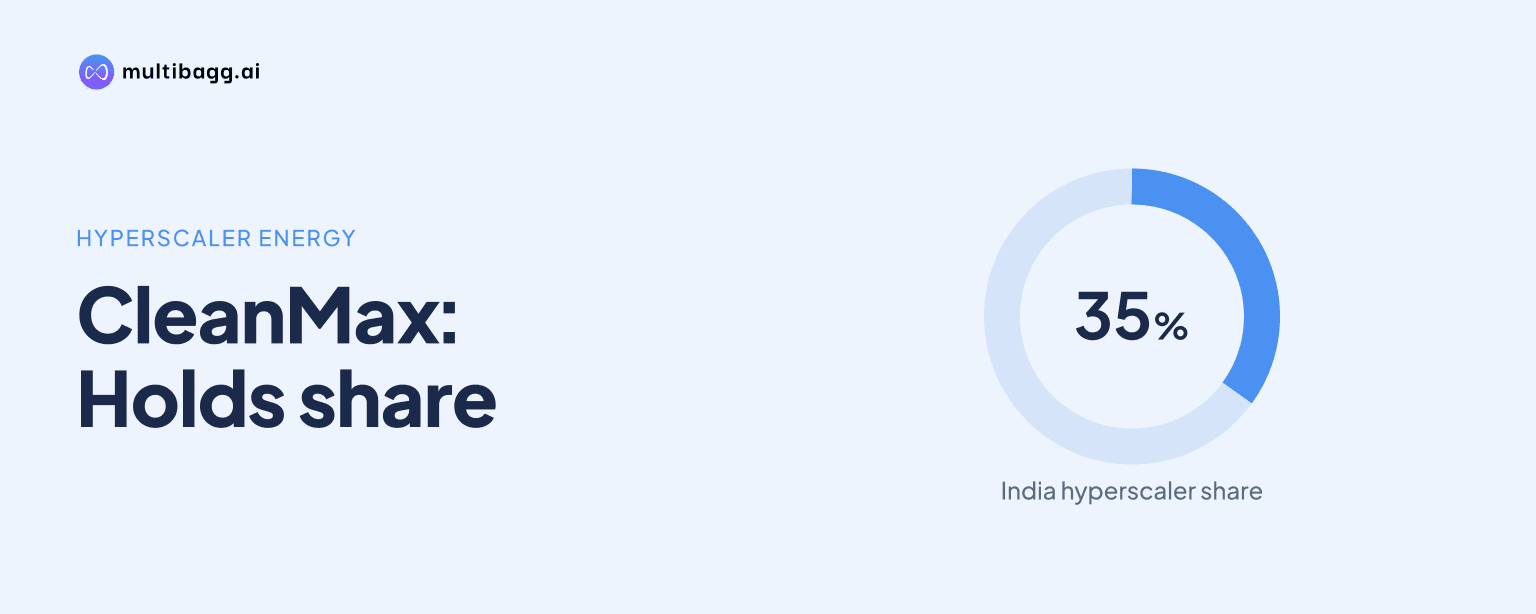
CleanMax said it held about 35% of India’s contracted hyperscaler energy volumes as of September 30, 2026, while hyperscaler customers represented roughly 27%-28% of its 6,200 megawatt contracted portfolio. Management said buyers increasingly favour Central Transmission Utility-connected wind-solar hybrids in South India and retain flexibility over physical power and green attributes.
Know Clean Max Enviro Energy Solutions inside out
Results, valuation, peers and who's buying, in one view.
How large is CleanMax’s hyperscaler energy business?
CleanMax said it has about 35% of the aggregate hyperscaler energy volume contracted in India so far. Management said this share is spread across multiple hyperscaler relationships and multiple contracts signed over several years, rather than being dependent on one or two customers. The call did not disclose the total megawatts contracted by hyperscalers across India or the value of those contracts.
Hyperscaler clients account for roughly 27%-28% of CleanMax’s 6,200 MW contracted portfolio. CleanMax separates its data and artificial-intelligence business into colocation customers, including NTT, STT, Equinix and Iron Mountain, and hyperscalers including Amazon, Google and Meta. Management said hyperscaler contracts are large and bulky, so the company may announce no more than one such transaction in a year.
The two measures cover different bases. The 35% figure is CleanMax’s stated share of all contracted hyperscaler energy volumes in India, while the 27%-28% figure is the hyperscaler share of CleanMax’s own 6,200 MW portfolio. Management said conversations with both hyperscalers and colocation data-centre operators were at a record high, but it did not provide guidance for future contract signings.
What projects do hyperscalers want from CleanMax?
CleanMax said hyperscalers prefer projects connected to the Central Transmission Utility, or CTU, and prefer wind-solar hybrids over solar-only projects. Management said the combination offers a better match across both the day and the year, which is relevant to customers with persistent electricity demand from data-centre operations.
Buyers are increasingly seeking CTU-connected wind-solar hybrid projects in South India, according to CleanMax. Management cited perceived curtailment risks in Kutch and Rajasthan, alongside the location of some new hyperscaler data centres in southern India. This describes buyer preference stated on the call and does not establish where all future Indian data-centre capacity will be built.
CleanMax said all of its CTU-connected capacity through September 2028 was already sold. It had reported 6.1 gigawatts of evacuation availability, including 1 gigawatt of CTU connectivity received and 2.2 gigawatts of CTU connectivity applied for when an analyst asked about the pipeline. Management added that it had applied for a further 2 gigawatts of CTU connectivity after September 30, 2026.
The company has reserved much of its limited CTU capacity for hyperscaler customers rather than group-captive industrial users. Management said CTU group-captive structures can work for industrial demand of at least 50 MW, and typically hundreds of MW, such as steel or aluminium smelters. In comparison, CleanMax said it contracts and executes about 1,100 MW to 1,200 MW annually in State Transmission Utility, or STU, and rooftop segments through roughly 100 deals each year.
Got a follow-up? Ask IRIS
Can hyperscalers choose green attributes instead of power delivery?
CleanMax said hyperscaler customers can choose, at their sole discretion, whether to use contracted output as electricity delivered to a data centre or as green attributes for offset requirements. Management said this flexibility suits customers that are expanding data centres while also managing energy-attribute requirements, particularly where project delivery can be a couple of years away.
Management said CleanMax receives the same tariff under either option, with tariffs locked in for 20 to 25 years. The company therefore said it is indifferent to whether a customer uses the contracted output as physical power or green attributes. The call did not disclose the tariff on hyperscaler agreements or the portion of contracts expected to result in direct data-centre power supply.
That contracting structure means CleanMax’s 35% share does not indicate the proportion of its generation that will physically serve Indian data centres. It measures contracted hyperscaler energy volumes. Management said bottlenecks in other parts of the world could lead more compute-factory activity to India and increase clean-energy demand, but it did not provide a megawatt forecast or timing for that potential demand.
How could storage change CleanMax’s data-centre offering?
CleanMax said 1 GW of data-centre capacity could require about 3 GW of wind generation, 3 GW of solar generation and 2.5 GW to 3 GW of energy storage. Management said that mix could cover about 75% of a data centre’s electricity demand and require capital expenditure of about Rs 40,000 crore. It identified wind, solar and storage as the combination clients prefer for the least-cost power outcome.
CleanMax is offering wind-solar-battery energy storage system, or BESS, solutions, but it had not signed an agreement incorporating the full wind-solar-storage combination discussed on the call. Management said it would disclose any material agreement after signing it, in line with Securities and Exchange Board of India requirements. Storage can be installed at the customer site or generation site, while a customer may also procure storage separately through a pumped-storage project arrangement.
CleanMax said it had already begun storage work with STU-connected customers, including a farm combining STU-linked generation with some storage and contracts with customers in Maharashtra. BESS was not yet large enough to be reported separately from solar and wind. Management said separate reporting could become relevant when storage reaches about 5%-10% of overall profit and loss, but gave no capacity target or date for that threshold.
Conclusion
CleanMax’s stated 35% share of India’s contracted hyperscaler energy volumes shows that data-centre customers are already a significant component of its contracted business. Its 27%-28% hyperscaler exposure within the 6,200 MW portfolio, combined with its decision to allocate limited CTU capacity to these customers, underlines the importance of CTU-connected wind-solar hybrids to the company’s commercial approach.
The next points to watch are whether CleanMax secures additional CTU connectivity after its further 2 GW application, and whether it signs a material wind-solar-BESS contract. Its existing CTU-connected capacity is sold through September 2028, while management said BESS remains below the 5%-10% profit-and-loss scale at which separate reporting could become relevant.