










CleanMax Bikaner curtailment falls to 26%, hits H1 EBITDA
Key highlights
- CleanMax said Bikaner curtailment declined from 70% at Q1 FY27 commissioning to 26% in October.
- Bikaner grid curtailment reduced CleanMax’s H1 FY27 EBITDA by about 5%, management said.
- CleanMax reported H1 FY27 EBITDA of Rs 1,047 crore, up 56% from Rs 670 crore a year earlier.
- CleanMax had 3,600 megawatts operational and 2,600 megawatts under execution on 30 September 2026.
powered by IRIS
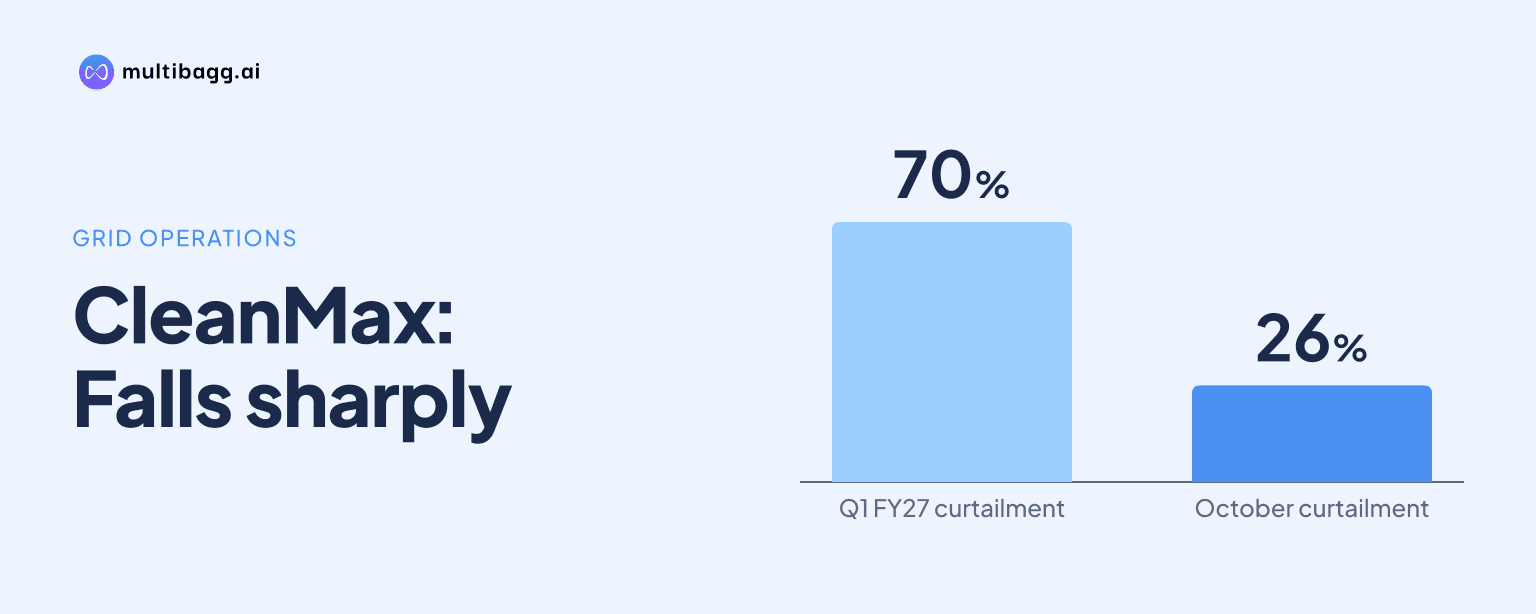
CleanMax said Bikaner grid curtailment fell to 26% in October from 70% at commissioning in Q1 FY27, but the constraint reduced first-half FY27 EBITDA by about 5%. CleanMax reported H1 FY27 EBITDA of Rs 1,047 crore, up 56% year on year, and gave no timetable for full Bikaner connectivity.
Know Clean Max Enviro Energy Solutions inside out
Results, valuation, peers and who's buying, in one view.
What happened to CleanMax’s Bikaner grid curtailment?
CleanMax’s Bikaner grid curtailment declined to 26% in October from 70% in Q1 FY27, when the plant had just been commissioned. Management said curtailment was nearly 50% in July and August, then fell to 44% before reaching 26% in October as the grid upgraded and commissioned new sections.
Management attributed the initial level to transmission congestion rather than a stated generating-asset issue. It said congestion had reached “peak proportions” after commissioning, while grid work reduced the constraint over subsequent months. The October rate nevertheless indicates that curtailment had not been eliminated at Bikaner.
Management described the improvement as the issue becoming “more in control,” rather than as a completed resolution. It framed the inverse of curtailment as about 30% ramp-up in the first quarter, 50% in the second quarter and around 70% from October onward. That ramp-up description was management’s explanation of how greater transmission availability was improving delivered generation.
How much did Bikaner curtailment affect CleanMax’s earnings?
CleanMax said Bikaner curtailment reduced H1 FY27 EBITDA, or earnings before interest, tax, depreciation and amortisation, by about 5%. The company reported Rs 1,047 crore of H1 FY27 EBITDA, compared with Rs 670 crore in the corresponding period a year earlier, producing reported growth of 56%.
Management said the same H1 FY27 EBITDA growth could have been 61% without the curtailment. This comparison quantifies the effect as a reduction in the growth rate, while CleanMax still reported higher earnings than the prior-year first half. Management did not disclose a separate rupee EBITDA impact specifically for Bikaner.
The effect came amid growth in both operating segments. Renewable-energy power-sales EBITDA rose to Rs 986 crore in H1 FY27 from Rs 620 crore a year earlier, while renewable-energy services EBITDA increased to Rs 60 crore from Rs 52 crore. CleanMax also reported Q2 FY27 EBITDA of Rs 553 crore, versus Rs 386 crore in the corresponding quarter.
Plant-load factor, or PLF, was also discussed during the call. After initially saying reported PLF included the curtailment effect, management corrected the response and said reported PLF is adjusted for curtailment. As a result, CleanMax did not provide a from-to PLF figure that would show the precise effect of the lost Bikaner evacuation.
Got a follow-up? Ask IRIS
When will Bikaner transmission constraints be fully resolved?
CleanMax did not provide a timetable for full Bikaner connectivity, saying it was difficult to forecast because the remaining grid work is outside the company’s control. Management said a relevant substation and some associated lines were delayed at the grid end, preventing final connectivity.
The October 26% curtailment rate followed grid upgrades and the commissioning of new sections, according to management. However, CleanMax did not state when the remaining substation work would finish, what the final curtailment rate would be, or when Bikaner would have unrestricted evacuation. The disclosed improvement therefore does not establish a date for complete resolution.
CleanMax contrasted Bikaner with Koppal, where management said there was no connectivity issue or transmission bottleneck. It expected to start Koppal commissioning from December, with one bay providing 220 megawatts of evacuation capacity in the October-to-December quarter and a second bay expected within FY27 to connect 300 megawatts.
Management said the Koppal bays were contained within a grid substation and therefore did not carry right-of-way risk. It said the second bay was likely to be completed in January, while noting that delays remained possible. The distinction between Koppal and Bikaner indicates that CleanMax described Bikaner as a location-specific transmission issue, not a portfolio-wide constraint.
How does Bikaner compare with CleanMax’s wider expansion?
CleanMax had 3,600 megawatts of operational renewable-energy power-sales capacity and 2,600 megawatts contracted and under execution as of 30 September 2026. It commissioned around 600 megawatts in H1 FY27, while management said the trailing-12-month commissioning rate in renewable-energy power sales was about 1,400 megawatts a year.
Operational power-sales capacity rose from 1,712 megawatts in March 2025 to 3,100 megawatts and then 3,600 megawatts at the reported date. The 2,600 megawatts under execution represented about 20 to 21 months of growth at a 1,500-megawatt annual addition rate, according to management. This expansion puts the Bikaner ramp-up within a broader increase in commissioned assets.
CleanMax’s aggregate portfolio, including operational capacity, contracts and evacuation categories, reached about 13,200 megawatts on 30 September 2026, compared with 7.8 gigawatts 18 months earlier. The company said its evacuation-received capacity was 3,200 megawatts, up from about 1,100 megawatts 18 months earlier.
The company said it was building plants in 10 states, with seven states operational and three contracted and under execution. About 80% of capacity added during the latest six months was in Gujarat, Karnataka, Maharashtra and Tamil Nadu, and those four states accounted for roughly two-thirds of total capacity. Management reiterated a target of at least 1,500 megawatts of new capacity additions in FY27.
Conclusion
CleanMax’s reduction in Bikaner curtailment to 26% in October from 70% at commissioning shows that grid upgrades improved evacuation availability. But the remaining constraint had a measurable H1 FY27 earnings effect, reducing EBITDA by about 5% as the company reported Rs 1,047 crore of EBITDA and 56% year-on-year growth.
The next disclosure to watch is the progress of the relevant Bikaner substation and associated grid lines, for which management gave no firm completion date. CleanMax also reiterated targets for at least 1,500 megawatts of FY27 capacity additions and at least Rs 3,000 crore of reported EBITDA in FY28, making future updates on commissioning, grid availability and generation relevant to those plans.