










Concord DPWCS Is Designed for 25,000-Tonne Freight Trains
Key highlights
- Concord says DPWCS supports freight trains from 2 km to 3.5 km long and up to 25,000 tonnes.
- Concord states that its DPWCS platform is extendable to train lengths of up to 7 km.
- DPWCS enables simultaneous control and braking across all locomotives, according to Concord.
- Concord cites a 30% to 50% downtime-reduction range for its predictive-maintenance technology stack.
powered by IRIS
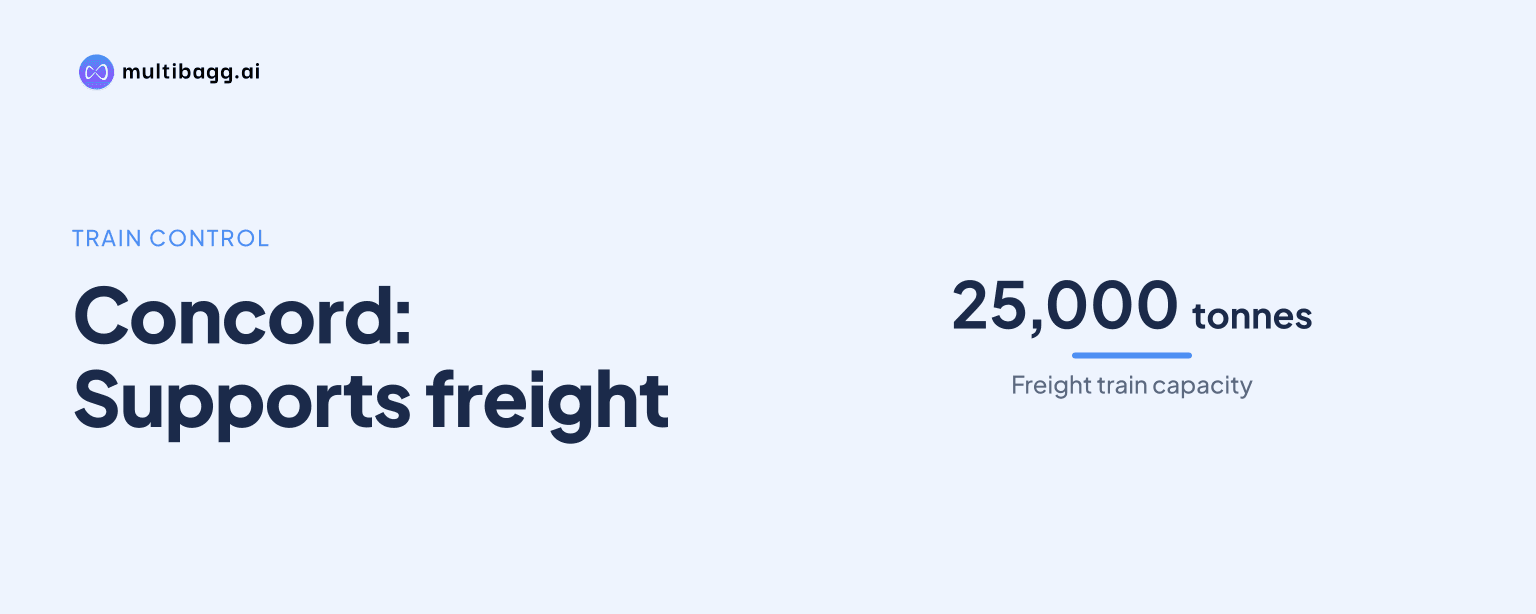
Concord Control Systems Limited says its Distributed Power Wireless Control System is designed for freight trains of up to 25,000 tonnes and 3.5 km in length, with simultaneous control and braking across all locomotives. Concord also states that the heavy-haul platform, presented for trains from 2 km to 3.5 km long, is extendable to 7 km.
Know Concord Control Systems inside out
Results, valuation, peers and who's buying, in one view.
What freight train size can Concord DPWCS support?
Concord says its Distributed Power Wireless Control System, or DPWCS, supports heavy-haul operations for freight trains from 2 km to 3.5 km long and up to 25,000 tonnes. The company presents these specifications in its Smart Trains with Intelligence section, where DPWCS is identified as an advanced solution for long and heavy freight formations.
The disclosed extension length of up to 7 km is 3.5 km longer than the stated 3.5 km upper end of the primary heavy-haul range. Concord does not give a separate load specification for a 7 km train, so its presentation links the 25,000-tonne figure specifically to the disclosed 2 km to 3.5 km heavy-haul application.
Concord labels the DPWCS example “Super Anaconda” in the presentation. The company does not disclose an installed base, customer route, wagon count or operating result for that example, but it identifies the ability to move more wagons and higher tonnages as a key advantage of the freight-control platform.
How does Concord DPWCS control long freight trains?
Concord says DPWCS provides simultaneous control and braking across all locomotives in a freight formation. This mechanism is the stated operating feature for managing trains of up to 3.5 km and 25,000 tonnes, allowing command and braking functions to be applied across the locomotives rather than described as separate actions.
The presentation also says DPWCS helps manage schedules efficiently between passenger and freight trains. Concord does not provide a measurement of schedule improvement, capacity gain or journey-time reduction, but it places this scheduling function among the advantages of the platform’s simultaneous locomotive control and braking capability.
Concord further says the platform enables seamless command, real-time insights and fleet orchestration. The company connects those functions with lower operating costs, higher asset utilisation and recurring revenues through networked services, although the presentation does not disclose revenue, margin, contract duration or a quantified utilisation outcome for DPWCS.
What intelligence layer does Concord pair with DPWCS?
Concord pairs its smart-train proposition with a data and artificial intelligence, or AI, layer that provides real-time monitoring and predictive maintenance. Its disclosed technology stack uses a multi-sensor edge device measuring vibration, temperature, current and Global Positioning System, or GPS, data, with onboard AI for rail assets.
The connectivity layer listed by Concord includes 4G, 5G, Wi-Fi and LoRa, or long-range radio connectivity, alongside cloud and digital-twin integration. Concord says this stack delivers real-time predictive maintenance and a 30% to 50% downtime reduction, but it does not identify the fleet, customer, baseline or measurement period behind that range.
The data-and-AI platform is broader than DPWCS’s freight-control use case. Concord identifies safer and lower-cost operations as core capabilities of the intelligence layer, while DPWCS is specifically described as the platform for simultaneous control and braking across locomotives in freight trains of up to 25,000 tonnes.
Got a follow-up? Ask IRIS
How does Concord DPWCS differ from its diagnostic products?
Concord positions DPWCS as a locomotive-control platform, while its sensing and AI-driven diagnostics products focus on monitoring components, track conditions and overhead railway infrastructure. The sensor range includes pressure sensors for pneumatic and hydraulic monitoring, load sensors for passenger-load monitoring, fire detection, and speed sensors for velocity tracking and overspeed protection.
Concord’s Wheel Impact Load Detector, or WILD, is a hardened electronic data-collection device for railway track monitoring. The company says WILD detects impact forces caused by damaged wheels, while its connected data-acquisition system gathers real-time data, computes values and relays information to railway servers and key stakeholders for action.
The company also describes real-time overhead-line monitoring and diagnostics, including health insights for pantographs and overhead lines. Its PANTOhealth simulation panel is presented as an online simulation platform for engineers and designers, whereas DPWCS addresses the separate task of coordinating locomotives within freight formations from 2 km to 3.5 km long.
What could drive wider use of Concord DPWCS?
Concord says Railways are aiming to implement DPWCS in every freight locomotive in the country. That stated ambition would extend beyond the platform’s disclosed 2 km to 3.5 km heavy-haul use case, but the presentation does not provide a deployment timetable, procurement plan, order quantity or installation target.
The presentation also identifies the platform as extendable to 7 km, compared with its stated operating range ending at 3.5 km. Concord does not disclose whether the 7 km configuration has been deployed, tested commercially, assigned a separate 25,000-tonne specification or linked to a specific railway programme.
Conclusion
Concord’s disclosed DPWCS proposition is centred on long, heavy freight trains: simultaneous locomotive control and braking for formations from 2 km to 3.5 km long and up to 25,000 tonnes. The platform sits alongside a wider intelligence architecture that uses sensor inputs, onboard AI, 4G, 5G, Wi-Fi or LoRa connectivity, cloud tools and digital-twin integration.
The next disclosed point to watch is the gap between the stated plan for DPWCS in every freight locomotive and evidence of execution. Concord identifies an extension capability of up to 7 km and cites Railways’ implementation aim, but it gives no timing, confirmed order volumes, installed-base figure or operating data for either the national rollout or the 7 km configuration.