










Concord builds rail diagnostics portfolio with onboard AI
Key highlights
- Concord’s smart-train platform states it can deliver a 30-50% reduction in downtime through predictive maintenance.
- Concord’s onboard edge device combines vibration, temperature, current and GPS inputs with AI.
- Concord’s WILD system relays real-time wheel-impact data to railway servers and sends stakeholder alerts.
- Concord’s overhead suite uses cameras and point-cloud scanners for pantograph and OHE diagnostics.
powered by IRIS
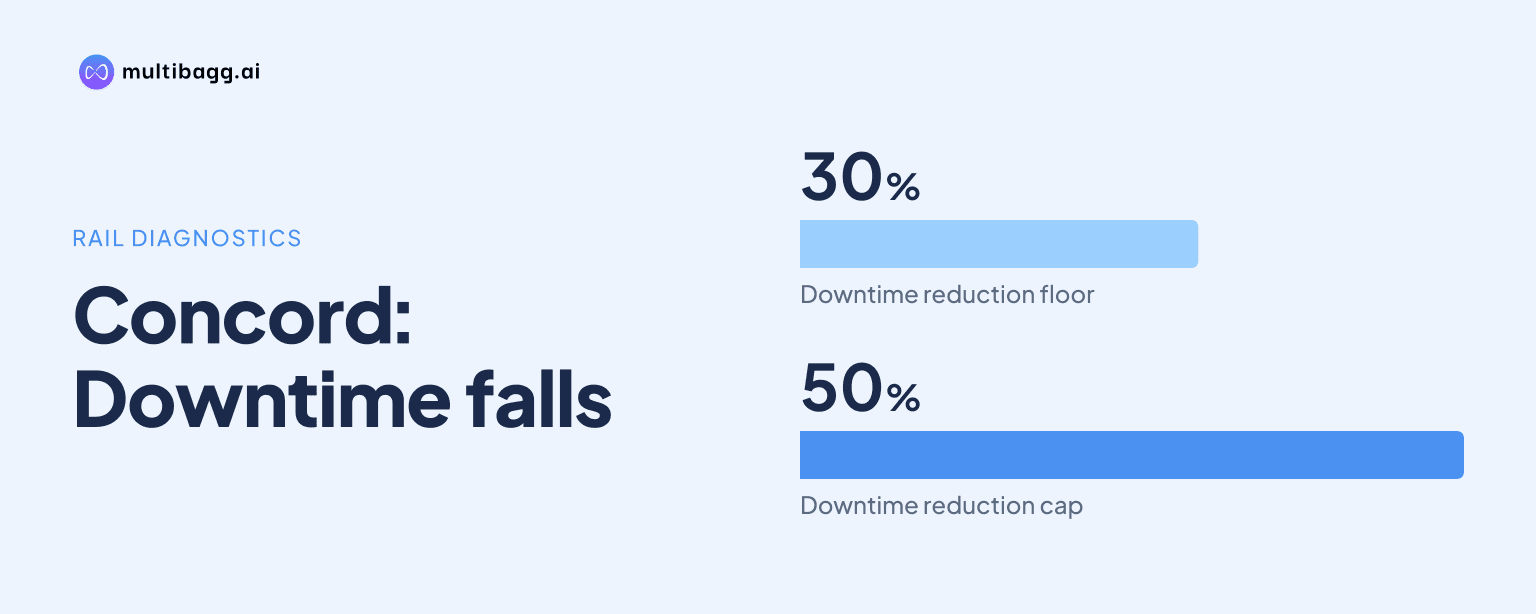
Concord Control Systems Limited is assembling a rail-diagnostics portfolio spanning onboard artificial intelligence, or AI, sensors, wheel-impact detection and overhead-line monitoring; its smart-train platform states it can deliver a 30-50% reduction in downtime through real-time predictive maintenance. The presentation describes systems that collect and process condition data on trains, trackside equipment and the pantograph-overhead equipment interface.
Know Concord Control Systems inside out
Results, valuation, peers and who's buying, in one view.
What sensing systems does Concord offer for rail diagnostics?
Concord offers pressure, load, fire-detection and speed sensors as the foundation of its advanced sensor systems. Pressure sensors are listed for pneumatic and hydraulic monitoring, brake-system safety and pipeline control, while load sensors are intended for passenger-load monitoring, energy optimisation and door control.
Concord positions fire-detection sensors around smoke and heat detection, alarm integration and passenger safety. Its speed sensors are listed for train-velocity tracking, overspeed protection and traction monitoring, separating movement-related data from the pressure measurements used for pneumatic and hydraulic applications.
The four categories address different equipment and operating conditions rather than a single failure mode. Concord does not provide deployment volumes, customer names or order values for these sensor systems, but presents them as the sensing base for its rail diagnostics and AI-enabled monitoring activities.
How does Concord turn onboard data into maintenance insights?
Concord uses a multi-sensor edge device combining vibration, temperature, current and Global Positioning System, or GPS, inputs with onboard AI. The company describes this configuration as supporting real-time monitoring and predictive maintenance for locomotives through condition data gathered at the train.
The platform can use 4G, 5G, Wi-Fi or LoRa connectivity, together with cloud and digital-twin integration. Concord states that this technology stack can deliver real-time predictive maintenance and a 30-50% reduction in downtime, although the presentation does not identify a baseline, test period, train category or customer installation behind the range.
Management describes the data and AI layer as a source of high-margin recurring income, scalability and customer stickiness. That is a management characterisation rather than a reported financial measure, because the presentation gives no revenue, contract count or share of recurring income for the platform.
How does Concord’s WILD system identify wheel problems?
Concord’s Wheel Impact Load Detector, or WILD, is a hardened electronic data-collection device for railway track monitoring that detects impact forces caused by damaged wheels. Concord says the system works through the life of a wheel and is intended to reduce the chance of derailment associated with damaged-wheel impacts.
The WILD device connects to a data-acquisition system that acquires real-time data, computes values and relays the information to railway servers. Concord says the system then sends alerts to key stakeholders for quick action, creating a sequence from trackside measurement to calculation, transmission and notification.
WILD differs from Concord’s onboard stack in where and what it monitors. The onboard device collects vibration, temperature, current and GPS data from the locomotive, while WILD is a track-monitoring product focused on wheel-impact forces. The presentation does not disclose detection accuracy, the number of monitored tracks or the time between a detected impact and an alert.
Got a follow-up? Ask IRIS
How does Concord monitor pantographs and overhead equipment?
Concord’s overhead-monitoring product suites provide real-time monitoring and diagnostics for pantographs and overhead equipment, or OHE. The presentation identifies cameras and point-cloud scanners in the monitoring arrangement, indicating that the suite uses visual and spatial data alongside AI and data integration.
Concord says the system provides real-time health insights for the pantograph and OHE, with the stated aims of extending asset lifespan, ensuring performance and avoiding premature breakdowns and restoration costs through predictive-maintenance support. This differs from WILD’s wheel-impact function because the overhead suite focuses on the current-collection interface and fixed overhead infrastructure.
Concord also lists PANTOhealth, an online simulation panel intended for engineers and designers. The company calls PANTOhealth advanced, accessible and interactive, but gives no user number, commercial terms, measured performance or timetable for the platform.
What operating and revenue outcomes does Concord expect from diagnostics?
Concord states that its smart-train platform can support safer and lower-cost operations through real-time monitoring and predictive maintenance. Its only quantified operating statement for the data and AI stack is the stated 30-50% downtime reduction; the presentation does not specify whether that range applies to locomotives, a subsystem, a trial or the full diagnostics portfolio.
The portfolio covers multiple data sources and maintenance mechanisms: pressure sensing for pneumatic and hydraulic systems, onboard vibration and temperature inputs, WILD wheel-impact data, and pantograph and OHE health insights. That scope means Concord is presenting a connected set of sensing and diagnostic products across rolling stock, trackside monitoring and overhead infrastructure.
Management links the smart-train data layer to recurring income, scalability and customer stickiness. However, Concord does not disclose product pricing, contract duration, installed base, product revenue or financial contribution for WILD, the overhead-monitoring suites or the four sensor categories, so the presentation does not permit a calculation of their revenue significance.
Conclusion
Concord’s disclosed diagnostics portfolio combines four sensor categories with an onboard AI and connectivity stack, a WILD track-monitoring device and overhead monitoring using cameras and point-cloud scanners. Together, these products are intended to collect real-time condition data across brake-related systems, wheel impacts, locomotive operation and the pantograph-OHE interface.
The next evidence to watch is execution of Concord’s stated real-time predictive-maintenance plan and the basis for its cited 30-50% downtime-reduction range. The presentation leaves installed base, validation conditions, customer deployments, diagnostic accuracy and revenue contribution unresolved, while PANTOhealth remains described as an online simulation panel for engineers and designers.