










Concord reports Rs 846 crore order book, 4x FY26 revenue
Key highlights
- Concord reported an unexecuted order book of approximately Rs 846 crore at 30 September 2026.
- Concord's Rs 846 crore order book equals four times FY26 revenue and has an 18-to-24-month execution period.
- Concord received Rs 308 crore of orders and executed Rs 159.1 crore from an Rs 697 crore opening order book.
- Concord's TTM cash conversion cycle improved by 37 days to 338 days in H1 FY27.
powered by IRIS
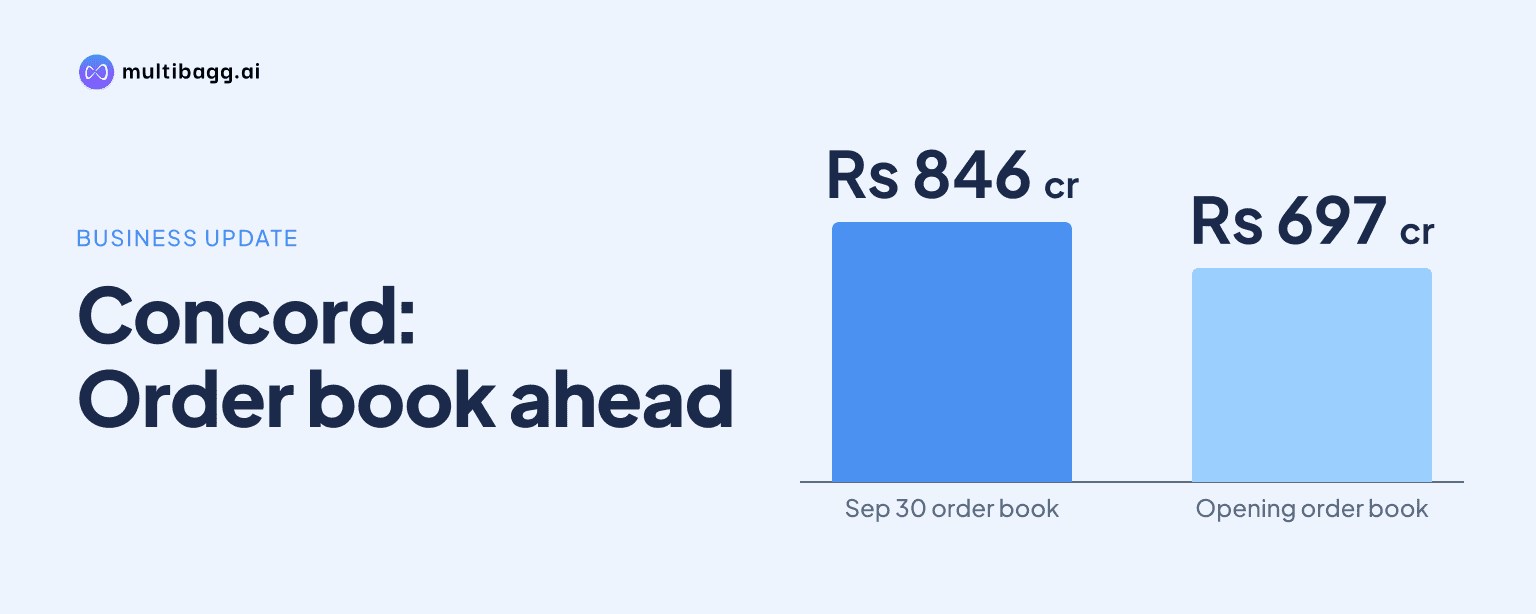
Concord Control Systems Limited reported an unexecuted order book of approximately Rs 846 crore at 30 September 2026, equal to four times FY26 revenue and carrying an 18-to-24-month execution period. The balance followed an Rs 697 crore opening order book, Rs 308 crore of orders received and Rs 159.1 crore of orders executed.
Know Concord Control Systems inside out
Results, valuation, peers and who's buying, in one view.
Why is Concord's Rs 846 crore order book important?
Concord's approximately Rs 846 crore unexecuted order book is important because management states that it equals four times FY26 revenue and is expected to be executed over 18 to 24 months. The figure is the balance of work yet to be executed at 30 September 2026, rather than the Rs 308 crore of orders received during the period.
The order-book bridge broadly reconciles to the disclosed balance: Rs 697 crore plus Rs 308 crore of orders received, less Rs 159.1 crore executed, produces Rs 845.9 crore. That calculation rounds to approximately Rs 846 crore. The presentation does not disclose contract-level customers, margins, product mix or the timing of individual orders within the balance.
How long will Concord take to execute its order book?
Concord says its approximately Rs 846 crore unexecuted order book has an execution period of 18 to 24 months. Its growth roadmap identifies execution of this order book as the immediate priority, together with scaling Kavach and Distributed Power Wireless Control System, or DPWCS, products.
Concord reported consolidated H1 FY27 revenue of Rs 159.11 crore, compared with Rs 81.55 crore in the prior-year period, an increase of 95.1%. Consolidated earnings before interest, tax, depreciation and amortisation, or EBITDA, rose 114.7% to Rs 46.66 crore from Rs 21.73 crore, while net profit increased 94.9% to Rs 31.23 crore from Rs 16.02 crore. The presentation does not state how much of H1 FY27 revenue came from the Rs 846 crore order book.
The 18-to-24-month range is an execution timeline rather than a financial-year revenue forecast. Concord does not allocate the order book between FY27 and FY28 or provide delivery milestones for Kavach, DPWCS, sensing, diagnostics or propulsion products. This leaves the timing of revenue recognition within the stated execution period undisclosed.
Is Concord improving working capital during order execution?
Concord reported a 37-day improvement in its cash conversion cycle to 338 days in H1 FY27, from 375 days in FY26, on a trailing 12 months, or TTM, basis. The metric combines debtor collection, inventory holding and payable days, making it relevant to the cash demands of executing an 18-to-24-month order pipeline.
Inventory days recorded the biggest absolute reduction, falling 54 days to 259 from 313, while debtor days declined 32 days to 178 from 210. Payable days also fell 49 days to 100 from 149, indicating faster supplier payments and partly offsetting the gains from inventory and receivables. Concord attributes the net 37-day cash-conversion-cycle improvement to working-capital efficiency and cash-flow management; it does not provide operating cash flow or cash-balance figures on this slide.
Got a follow-up? Ask IRIS
Which products support Concord's execution plan?
Concord's near-term plan combines execution of the current order book with Kavach and DPWCS scale-up within its core railway business. The company groups its activities into four technology platforms: green mobility, smart locomotive intelligence, sensing and artificial intelligence, or AI, driven diagnostics, and railway safety.
Concord states that more than 8,000 locomotives are equipped with its technologies and that it has more than 100 engineering and research-and-development professionals. Its commercialisation map lists Driver Machine Interface, or DMI, Vehicle Control Unit, or VCU, LocoSync or DPWCS, LocoHealth, speed sensing, Brake Interface Unit, or BIU, fire sensing and legacy cards as field-deployed or scaling products. Kavach, selected green-propulsion programmes and newer wayside or overhead monitoring are classified as order-backed or in qualification.
New AI analytics modules, broader export variants and technology-licensing applications are listed as emerging or in research and development. That distinction means the presentation separates deployed products from those still being qualified or developed, while providing no order-book value by platform. It also does not specify how the Rs 846 crore balance is divided between railway safety, locomotive intelligence, green mobility or diagnostics.
What does Fusion Electronics add to Concord's growth plan?
Concord identifies Fusion Electronics, its 80% subsidiary, as part of its advanced-electronics and backward-integration strategy. The presentation says Fusion supports flex printed circuit boards, premium electronics manufacturing services, box-build manufacturing, import substitution and supply-chain control for railway and industrial electronics.
Fusion has annual capacity of 200,000 square metres, according to Concord's presentation. Management also cites potential revenue of approximately Rs 400 crore or more after doubling capacity and EBITDA margins of 25% or more. These are presentation figures associated with planned capacity expansion and potential outcomes, not reported financial results, and no timetable for doubling capacity is disclosed.
Concord's next-stage roadmap includes Fusion utilisation alongside diagnostics, overhead-equipment monitoring, battery and hydrogen initiatives, and lifecycle or recurring revenues. The longer-term roadmap names international markets, technology licensing and global railway applications. Concord says international relevance for locomotive intelligence, electronics, battery and hydrogen propulsion, sensors, software and diagnostics depends on technology maturity and expanding certifications.
What growth target has Concord set after its current order book?
Concord has set a targeted revenue compound annual growth rate, or CAGR, of 40% to 50% over three to five years. Management presents this target on its FY30 way-forward slide and links it to the four technology platforms, rather than solely to the Rs 846 crore unexecuted order book.
The presentation's stated sequence is to execute the existing order book now, pursue Fusion utilisation and diagnostics-related activities next, and build international and licensing applications over the longer term. Although the FY30 slide includes columns for FY26 revenue share and expected FY30 revenue share by platform, it provides no percentages. The future revenue mix between green mobility, smart trains, sensing and diagnostics, and railway safety therefore remains undisclosed.
Conclusion
Concord enters its stated 18-to-24-month execution period with approximately Rs 846 crore of unexecuted orders, a balance management equates to four times FY26 revenue. Its H1 FY27 consolidated revenue of Rs 159.11 crore and EBITDA of Rs 46.66 crore were higher than the prior-year period, while the TTM cash conversion cycle improved by 37 days to 338 days.
The next measures to watch are order-book execution within the stated period, progress in Kavach and DPWCS scale-up, and whether debtor and inventory-day reductions persist as work is delivered. Management's 40% to 50% revenue-CAGR target over three to five years also depends on disclosed plans for Fusion utilisation, diagnostics, green propulsion, certifications and longer-term international opportunities.