










Coromandel Cuts Sales 30% as Rabi Subsidy Targets NPK Recovery
Key highlights
- Coromandel cut Q2 FY27 primary fertilizer sales 30% to 10 lakh tonnes and fertilizer production 15% to 7.7 lakh tonnes.
- Coromandel said its fertilizer consumption fell 33% in Q2 FY27, while industry NPK production and consumption each declined about 40%.
- Q2 FY27 EBITDA declined 18% to Rs 944 crore despite a 6% rise in total income to Rs 10,348 crore.
- Management said NP 20:20 fertilizer prices could moderate by at least 10% to 15% under revised Rabi subsidy support.
powered by IRIS
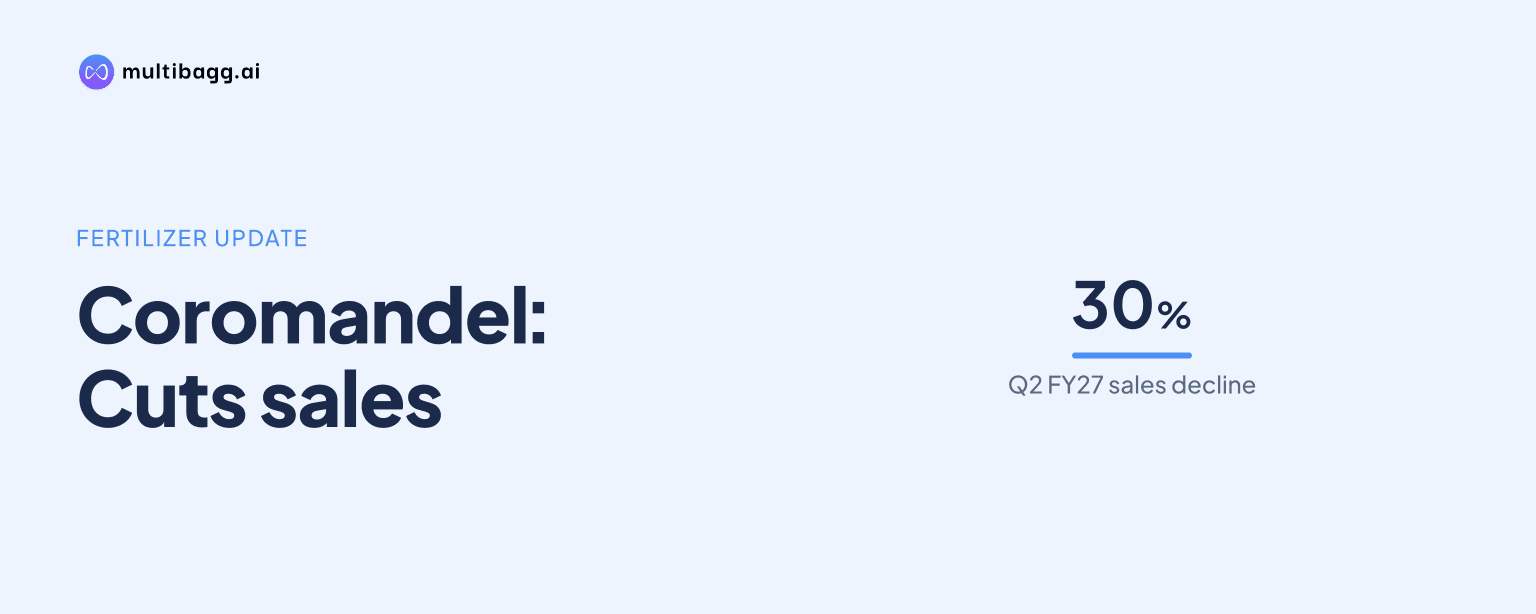
Coromandel International Limited cut Q2 FY27 primary fertilizer sales by 30% to 10 lakh tonnes after its consumption declined 33%, as weak rainfall, higher inputs and an unfavourable price gap with DAP reduced NPK demand. Coromandel also lowered fertilizer production by 15% to 7.7 lakh tonnes to manage working capital.
Know Coromandel International inside out
Results, valuation, peers and who's buying, in one view.
Why did Coromandel cut fertilizer sales and production in Q2 FY27?
Coromandel cut sales and production because demand for complex fertilizers contracted sharply in Q2 FY27. Management said rainfall was 20% to 30% below normal in key markets including Andhra Pradesh, Telangana, Karnataka and Maharashtra, reducing agricultural activity and farm-input consumption. Industry production and consumption of nitrogen, phosphorus and potassium, or NPK, fertilizers each fell about 40% during the quarter.
Coromandel deliberately moderated primary sales by 30% to 10 lakh tonnes and production by 15% to 7.7 lakh tonnes. Management described the reduction as a working-capital decision based on tracking consumption, production and supplies. Its own fertilizer consumption declined 33%, indicating that lower primary sales broadly reflected weaker end-market offtake rather than only an inventory decision.
The price gap between diammonium phosphate, or DAP, and complex fertilizers altered farmer buying behaviour, according to management. Higher raw-material costs and Kharif nutrient-based subsidy, or NBS, rates that did not adequately compensate those costs affected the fertilizer value chain. Coromandel nevertheless said its fertilizer market share rose to 19% in H1 FY27 from 17% in the prior-year first half.
How could the Rabi subsidy affect Coromandel's NPK sales?
Management expects the Rabi 2026-27 NBS rates announced before the November 12, 2026 call to improve manufacturing viability and narrow the pricing imbalance between DAP and complex fertilizers. It said the Cabinet had approved the revised rates, although the detailed notification was still awaited. Management expects part of the benefit to be reflected in lower maximum retail prices, or MRPs, for farmers.
For NP 20:20 fertilizer, management cited an MRP increase to Rs 2,100 per bag from Rs 1,350 per bag and said moderation could be at least 10% to 15%. It did not commit to a final reduction, noting that manufacturers had faced negative margins and that ammonia prices had begun rising. The actual MRP response therefore depends on the notified subsidy structure and input-cost movements.
The government also announced special support for exceptional increases in sulphur and sulphuric-acid costs, which are inputs for phosphatic fertilizers. Management said the sulphur subsidy applied to shipments above a floor price of US$800, but did not quantify its Q2 benefit. It said the support was helpful in August and September after Coromandel had curtailed purchases during the price increase.
Management expects improved policy support, moderating raw-material costs and seasonal Rabi activity to support a better operating environment in H2 FY27. That is a management outlook, not a reported recovery. It specifically linked a potential rebound in production, sales and consumption to revised NBS rates, better farm economics and a correction in the DAP-complex fertilizer price difference.
Got a follow-up? Ask IRIS
What did the demand slowdown do to Coromandel's earnings and operations?
Coromandel's Q2 FY27 consolidated total income rose 6% to Rs 10,348 crore from Rs 9,771 crore a year earlier, while earnings before interest, tax, depreciation and amortisation, or EBITDA, declined 18% to Rs 944 crore from Rs 1,147 crore. Management attributed the EBITDA decline mainly to NPK margin compression, because higher input prices were not matched by NBS-rate and MRP revisions.
Net profit after tax fell to Rs 523 crore in Q2 FY27 from Rs 793 crore in Q2 FY26. Subsidy-linked business accounted for 81% of quarterly revenue, versus 83% a year earlier, but its share of profitability decreased to 58% from 72%. The comparison shows that revenue increased largely with higher subsidy rates and business growth, while fertilizer profitability declined under higher-cost conditions.
For H1 FY27, total income increased 10% to Rs 18,563 crore from Rs 16,897 crore, but EBITDA fell 12% to Rs 1,705 crore from Rs 1,929 crore. H1 net profit after tax declined to Rs 905 crore from Rs 1,295 crore. The subsidy business contributed 53% of H1 profitability, compared with 70% in the prior-year period, extending the Q2 margin pattern.
Coromandel's Kakinada phosphoric-acid and sulphuric-acid plant returned to full capacity after the sulphur subsidy notification in August, management said. The facility had operated at lower capacity amid high sulphur costs. Management said the plant improves access to key raw materials, while the Kakinada granulation project was expected to be commissioned by February, with capacity available in the following year.
Single super phosphate, or SSP, volumes fell 13% to 1.9 lakh tonnes in Q2 FY27, although management said differentiated GroPlus and urea-SSP grades improved margins. In crop protection, Q2 revenue grew 22%, supported by export markets, and Coromandel introduced six agrochemical and biological products. These businesses provided activity outside the weaker NPK demand environment.
Conclusion
Coromandel's 30% reduction in Q2 FY27 primary fertilizer sales and 15% production cut were deliberate responses to a period when its consumption fell 33% and industry NPK volumes declined about 40%. The company preserved working-capital discipline, but higher inputs and the DAP-complex fertilizer price gap still contributed to an 18% decline in quarterly EBITDA.
The next factors to watch are the detailed Rabi 2026-27 NBS notification, the extent of any MRP reduction in NP grades such as 20:20, and management's February target for commissioning the Kakinada granulation plant. Management also identified Rabi demand, ammonia and sulphur costs, and the sustained operation of its Kakinada acid plant as determinants of the expected H2 FY27 recovery.