










Coromandel says NACL reset needs two to three years to deliver
Key highlights
- Coromandel said NACL’s new product-registration cycle can take two to three years.
- CPC export revenue grew 44%, while NACL had an export setback.
- Exports accounted for more than 40% of Coromandel CPC revenue.
- A commercial fluorination plant could require about Rs 250 crore to Rs 300 crore after customer clearance.
powered by IRIS
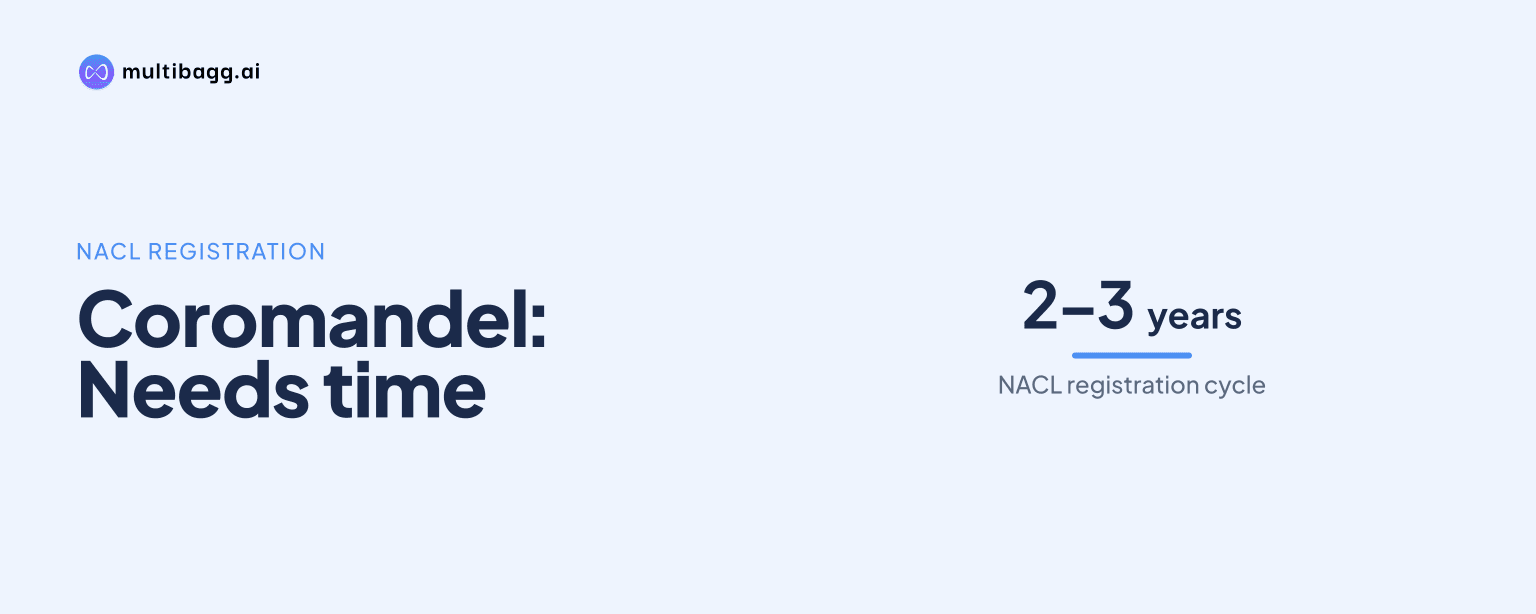
Coromandel said on November 12, 2026 that NACL’s shift from older generic molecules to new crop-protection products will take two to three years because registrations take time, while it works to lower inventory costs and use NACL’s spare active-ingredient capacity, research and development capability, and contract development and manufacturing potential.
Know Coromandel International inside out
Results, valuation, peers and who's buying, in one view.
Why will Coromandel’s NACL reset take two to three years?
Coromandel said NACL’s reset will take two to three years because new crop-protection products require registrations before they can contribute commercially. Management said NACL’s current portfolio contains older generic molecules rather than new-age products, creating pressure on margins and earnings before interest, tax, depreciation and amortisation, or EBITDA. Coromandel said it knew of this portfolio issue when assessing NACL and has since inducted talent and begun work on new product introductions.
Management said NACL should not be assessed solely through quarterly EBITDA in the near term because registration, development and product-introduction cycles are longer than a reporting quarter. The stated two-to-three-year period is not financial guidance for revenue or profit. It is management’s estimate of the time needed for new registrations and products to alter a portfolio that currently relies on older generic agrochemical molecules.
What is weighing on NACL’s near-term performance?
Coromandel said high-cost inventories at NACL have declined, but the unit still faces cost and product-mix issues that affect margins. Management is renegotiating raw-material prices, examining whether selected intermediates can be produced in-house, and seeking to optimise production across the operating plants. It said selected raw materials were secured at competitive prices during the current quarter and expects the actions to affect performance in coming quarters.
Plant utilisation is another operating issue because Coromandel said running a plant at low capacity raises efficiency losses and conversion costs. Management said a broader combined portfolio could reduce the variation associated with periodic agrochemical margin compression and expansion. The company did not quantify NACL’s utilisation, inventory value, EBITDA or cost savings, so the scale and timing of any improvement remain undisclosed.
Coromandel contrasted NACL’s position with its Crop Protection segment, or CPC, where export revenue grew 44% and exports accounted for more than 40% of revenue. Management said molecules gaining volume in export markets drove CPC’s growth, while NACL had an export setback. This comparison indicates that management attributes NACL’s near-term issue to its own inventory, cost base and ageing molecules, rather than describing it as a group-wide export decline.
Got a follow-up? Ask IRIS
How will Coromandel use NACL’s manufacturing and R&D capability?
Coromandel said NACL’s spare active-ingredient capacity is the first strategic advantage of the transaction because it may reduce the need to build fresh active-ingredient capacity in the medium term. Active ingredients are the chemical components that provide a crop-protection product’s intended effect. Management did not disclose NACL’s installed capacity or utilisation, but said Coromandel can leverage the available capacity to a considerable extent.
The company also sees scope to combine NACL’s research and development, or R&D, capability with its own work on new-age chemistries, including fluorination. Coromandel said it would not have entered fluorination or established a launch plant as quickly without NACL’s R&D team and technical capability. The intended change is from NACL’s older generic molecules towards products and intermediates that can support new crop-protection and specialty-chemical applications.
Coromandel’s approach to its Kakinada phosphoric-acid and sulphuric-acid, or PA-SA, plant illustrates its focus on extracting value from existing assets before adding capacity. It invested Rs 1,100 crore in that plant in the prior year and said the immediate priority is full utilisation and cash generation. Management also said it would retain some bought-out acid rather than pursue 100% captive supply, indicating that in-house manufacturing will remain balanced with external sourcing.
What must happen before fluorination and CDMO scale up?
Coromandel said fluorination and contract development and manufacturing, or CDMO, can scale up only after products are tested and cleared by customers. It has a fluoro pilot plant and is setting up a launch plant, which management described as commercial scale for supplying samples. Global customers require samples at the R&D, pilot and launch-plant stages before they consider a commercial relationship, according to management.
The company is identifying fluorination-based agrochemical intermediates and certain pharmaceutical intermediates for potential customer sign-ups. Coromandel said it is not building a complete downstream chain at this stage. Instead, it plans to consider commercial-scale production after a product is cleared by key customers, linking any larger investment to demonstrated feasibility, viability and market acceptance.
Management estimated a commercial fluorination plant could require capital expenditure of about Rs 250 crore to Rs 300 crore once customer approval and product feasibility are established. It said the facility could serve both internal requirements and CDMO opportunities, where the two companies seek long-term manufacturing contracts with global players. Coromandel began the fluorination journey about one year earlier and said NACL has accelerated it through additional R&D talent and capability.
Conclusion
Coromandel’s position is that NACL has immediate pressure from high-cost inventory, low plant loading and an ageing generic portfolio, but also has assets that can support a longer-term reset. NACL’s spare active-ingredient capacity, combined R&D resources and potential CDMO role form the strategic case, while CPC’s 44% export revenue growth contrasts with NACL’s disclosed export setback.
The next developments to watch are whether raw-material renegotiation and plant optimisation affect NACL’s performance in coming quarters, and whether new products progress through the stated two-to-three-year registration cycle. Management has also made commercial fluorination investment of about Rs 250 crore to Rs 300 crore conditional on customer clearance, making product approvals and customer sign-ups the key unresolved milestones.