










Coromandel International Q2 FY27 EBITDA Falls 18% to ₹944 Crore
Key highlights
- Coromandel International's Q2 FY27 total income rose 6% year-on-year to ₹10,348 crore.
- Q2 FY27 EBITDA fell 18% year-on-year to ₹944 crore, while profit after tax was ₹523 crore.
- Fertilizer production declined 15% to 7.7 lakh tonnes as primary sales fell 30%.
- The retail network added 80 outlets in Q2 FY27, reaching 1,300 stores.
powered by IRIS
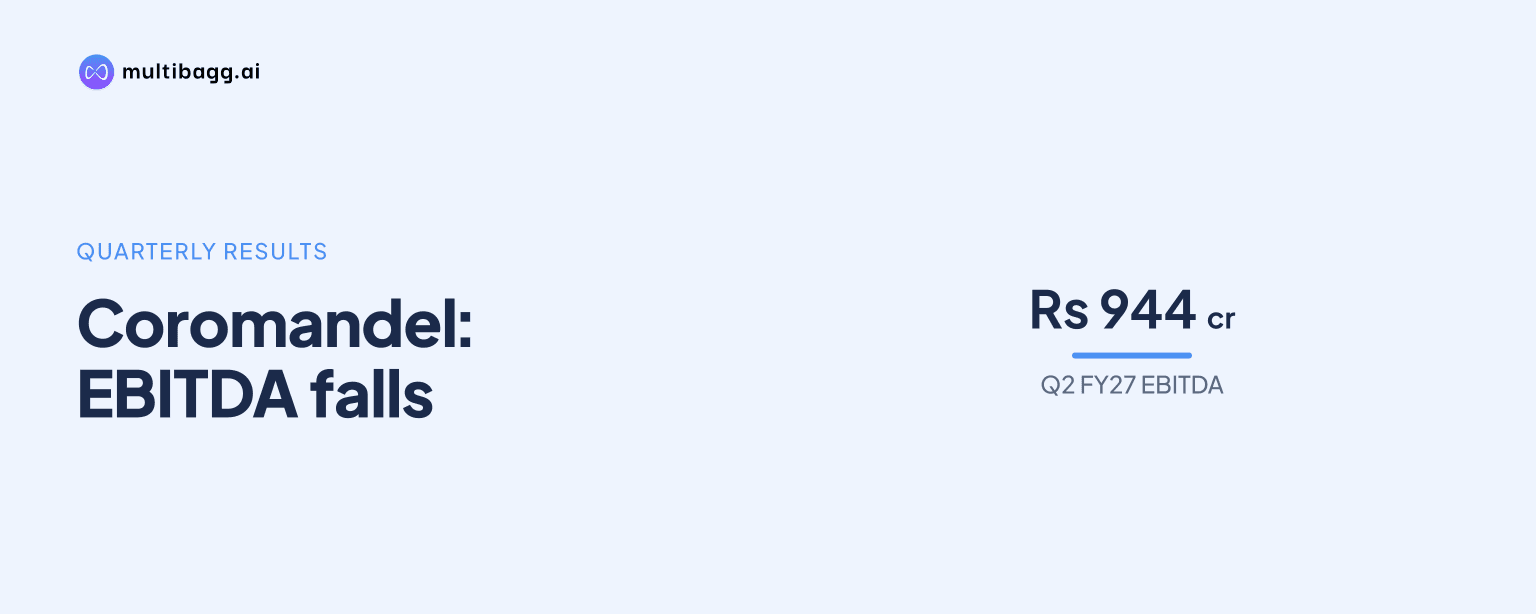
Coromandel International Limited reported Q2 FY27 consolidated total income of ₹10,348 crore, up 6% year-on-year, but EBITDA fell 18% to ₹944 crore as NPK fertilizer margins narrowed amid higher input costs, rainfall deficits and weaker demand. Net profit after tax declined to ₹523 crore from ₹793 crore a year earlier.
Know Coromandel International inside out
Results, valuation, peers and who's buying, in one view.
Why did Coromandel International's Q2 FY27 profit fall?
Coromandel International said its Q2 FY27 profitability declined primarily because higher raw-material prices and adverse weather conditions compressed margins in its nutrient business. While total income increased from ₹9,771 crore in the comparable prior-year quarter, EBITDA decreased from ₹1,147 crore and profit after tax fell by ₹270 crore year-on-year.
Management attributed the pressure to rainfall deficits in key markets, rupee depreciation, elevated input costs and Kharif nutrient-based subsidy support that did not adequately offset the cost increase. These factors affected fertilizer demand and the economics of NPK production during the quarter.
The company said fertilizer primary sales declined 30% in the period. It moderated production by 15% to 7.7 lakh tonnes as demand softened. Industry-wide NPK production and consumption fell by about 40% during the quarter, according to management's comments on the call.
What were Coromandel International's Q2 and H1 FY27 financial results?
Coromandel International recorded Q2 FY27 consolidated total income of ₹10,348 crore and EBITDA of ₹944 crore, while H1 FY27 total income rose 10% to ₹18,563 crore and EBITDA declined 12% to ₹1,705 crore. H1 profit after tax was ₹905 crore, compared with ₹1,295 crore in the previous-year period.
The subsidy business accounted for 81% of Q2 total income and 58% of profitability, compared with 83% and 72%, respectively, a year earlier. For the first half, the subsidy business represented 79% of income and 53% of profitability, versus 83% and 70% in H1 FY26. The mix indicates that the business remained important to revenue, while its contribution to earnings reduced during a period of lower nutrient margins.
Which businesses supported Coromandel International during the quarter?
Coromandel International said crop protection revenue grew 22% in Q2 FY27, supported by a 44% rise in exports, which contributed more than 40% of the segment's revenue. The company also launched 10 new products across its nutrients and crop-protection segments during the quarter.
Its retail network added 80 stores and reached 1,300 outlets. Management said newer stores were reaching break-even faster than expected and outlined a plan to expand the network to 2,000 stores over two years. The retail expansion is part of the company's effort to widen farmer access to products and services.
However, crop-protection demand was also described as soft in the quarter, with customer purchases deferred in some markets. NACL, the company's subsidiary, reported revenue of ₹374 crore, down 18%, and EBITDA of ₹12 crore. Management cited high-cost carryover inventory and margin pressure at NACL.
Got a follow-up? Ask IRIS
How could revised Rabi subsidy rates affect Coromandel International?
Management said the government's announcement of nutrient-based subsidy rates for the Rabi 2026-27 season was a timely intervention that could improve the viability of domestic fertilizer manufacturing. The government also announced a special sulfur subsidy, which management said could help restore pricing balance between DAP and complex fertilizers.
The company expects revised Rabi support, moderating input costs and seasonal demand recovery to support a better second half. Management described its outlook as cautiously optimistic, while noting continuing volatility in international fertilizer and raw-material markets.
Coromandel International also said its new phosphoric acid and sulfuric acid plant at Kakinada was back on track and operating at full capacity after the sulfur subsidy notification. The project is relevant to its integrated manufacturing operations and input-cost management.
What does the Q2 performance mean for investors and the fertilizer industry?
The Q2 result shows that revenue growth did not protect profitability when fertilizer margins came under pressure from input costs, subsidy timing and weaker demand. The decline in the subsidy business's share of profitability to 58% from 72% illustrates the scale of the margin impact on the company's largest revenue contributor.
For the wider fertilizer sector, the 40% fall in NPK production and consumption cited by management reflects the difficult operating environment during the quarter. Coromandel International said channel inventory was only 5% to 7% higher than a year earlier and expected inventories to moderate as Rabi consumption revives.
The earnings call, hosted by Systematix Institutional Equities on November 12, 2026, lasted about 62 minutes and included questions from five analysts. The call was held during market hours, and management's key focus was the effect of Rabi subsidy revisions, input-cost movements and the seasonal demand outlook.
Conclusion
Coromandel International delivered 6% Q2 FY27 income growth, but earnings weakened as high input costs, rainfall deficits and subdued fertilizer demand reduced NPK margins. The company's crop-protection exports, retail expansion and product launches provided operational support, though NACL and the core nutrient business faced clear profitability pressure.
Investors will watch the effect of revised Rabi subsidy rates on fertilizer demand and manufacturing economics, along with input-cost trends and the recovery in seasonal consumption. Management's disclosed retail plan to reach 2,000 outlets within two years and the Kakinada plant's full-capacity operation are additional operating milestones to monitor.