










Coromandel targets 20%-25% specialty growth with captive MAP
Key highlights
- Coromandel said specialty fertilizers are delivering sustainable 20%-25% volume growth.
- Coromandel is setting up a captive MAP plant to supply its own WSF manufacturing.
- Management said many key specialty-fertilizer raw materials are imported from China.
- Coromandel has crop-protection reach across 80-90 countries for possible nano and bio-product cross-selling.
powered by IRIS
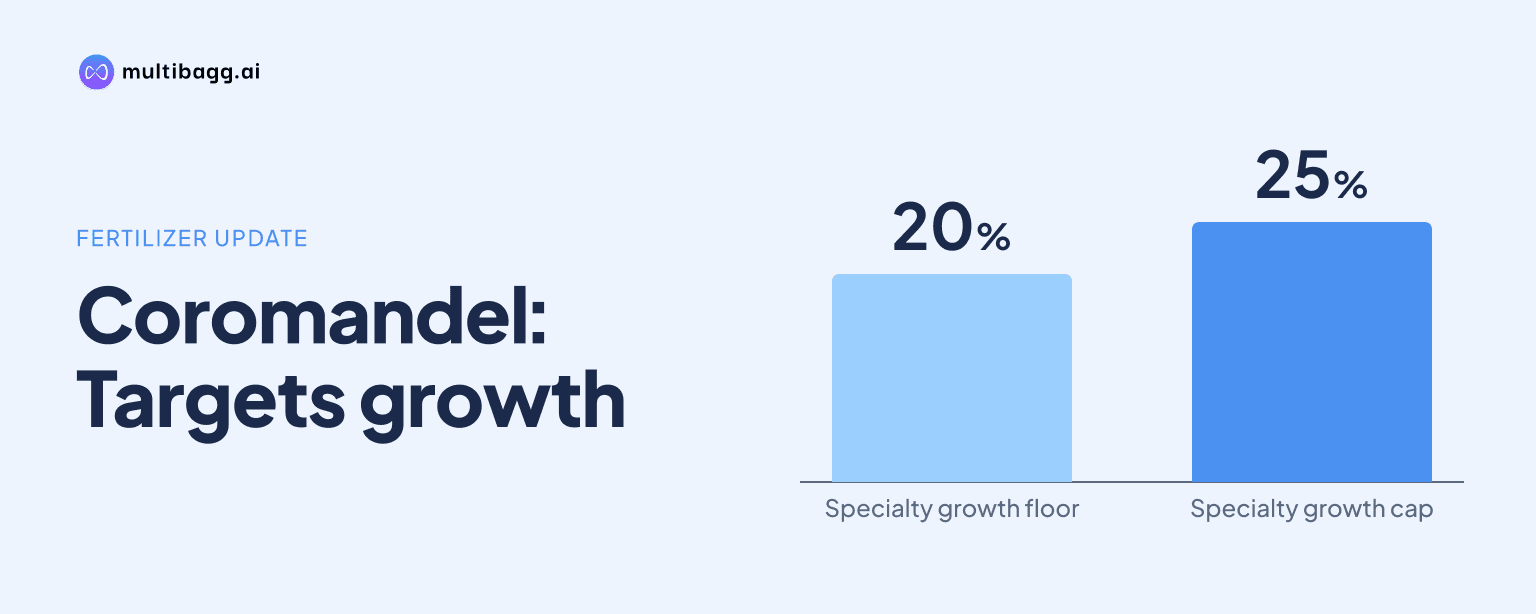
On November 12, 2026, Coromandel said specialty fertilizers were delivering sustainable 20%-25% volume growth and that it was setting up a captive monoammonium phosphate (MAP) plant to supply water-soluble fertilizer (WSF) manufacturing, with the aim of reducing imports of key raw materials from China.
Know Coromandel International inside out
Results, valuation, peers and who's buying, in one view.
What specialty-fertilizer growth is Coromandel targeting?
Coromandel is targeting sustainable 20%-25% volume growth in specialty fertilizers. Management said the business maintained that growth even during the stressful period discussed on the November 12, 2026 call. It did not disclose specialty-fertilizer revenue, tonnage, operating profit or a separately reported margin, so the stated target is a volume-growth range rather than a sales or earnings forecast.
The 20%-25% specialty-fertilizer range contrasts with biological products, whose current contribution management described as relatively less. Coromandel identified neem-based biopesticides, biostimulants, microbials and organic fertilizers as biological-product verticals, while calling specialty fertilizers a larger business with global competitors. The comparison indicates that specialty nutrients have a more established scale within the company’s non-subsidy activities, while bio products are still being expanded.
Management did not quantify the annual size of the combined non-subsidy, non-agrochemical and biological activities when asked on the call. It said specialty nutrients and bio products had become significant and reached a size comparable with individual listed entities, but it did not provide a revenue figure. As a result, the disclosed 20%-25% growth range cannot be converted into a projected rupee contribution from the information provided.
How will Coromandel’s captive MAP plant reduce China-linked imports?
Coromandel plans to use captive MAP production as an input for its own WSF manufacturing. Management said the specialty-fertilizer business relies on imported raw materials, with many key materials imported from China, and described the MAP plant as an effort to reduce that dependence. The mechanism is upstream integration: internally produced MAP would feed Coromandel’s WSF output instead of relying solely on external material sourcing.
The November 12, 2026 call did not disclose MAP capacity, capital expenditure, plant location, construction timing or a commissioning date. Coromandel also did not quantify the proportion of specialty-fertilizer inputs currently imported from China, nor did it provide a target for import replacement or savings. The stated benefit is therefore reduced dependence on China-linked inputs, not a disclosed cost or profitability outcome.
The MAP proposal is part of a wider procurement and distribution strategy. Management said Coromandel’s larger fertilizer sourcing capability can have a positive effect on specialty businesses because they use similar raw materials. It also cited its infrastructure and dispatch supply chain as operating supports for moving specialty products to the market, alongside the proposed captive supply of MAP.
Got a follow-up? Ask IRIS
How does Coromandel plan to compete in specialty fertilizers?
Coromandel plans to compete through specialty offerings rather than a generic-product approach. Management said the category has many competitors, including global participants, but argued that its focus on specialties results in lower competition intensity than generic fertilizer markets. The company did not disclose market share, product-level pricing or individual specialty-fertilizer growth rates to measure that positioning.
Coromandel cited fertilizer sourcing, infrastructure and dispatch supply-chain capabilities as the practical foundations for the specialty strategy. The planned MAP plant would add an internal input source for WSF manufacturing, while the existing fertilizer platform provides procurement experience for similar materials. Management presented these factors as supports for maintaining the 20%-25% specialty-fertilizer volume-growth range.
The retail network has a related role in commercialising newer nutrient products. Management said high logistics costs make doorstep availability difficult for organic and biological products, particularly where volumes are distributed across farm locations. Retail centres allow Coromandel to serve farmers closer to consumption, a route-to-market approach that is particularly relevant for organic fertilizers made from press mud and municipal waste.
What could affect Coromandel’s specialty-nutrient execution?
Coromandel’s disclosed input risk is its dependence on imported specialty-fertilizer raw materials, including materials sourced from China. The captive MAP plant addresses part of that exposure, but the company gave no capacity or completion date showing when internal production could displace external purchases. Growth at 20%-25% therefore remains dependent on both execution of the project and access to other required inputs.
Competition is another disclosed consideration because management said specialty fertilizers are a larger field with both domestic and global participants. Coromandel’s stated response is differentiated specialty products, supported by sourcing and distribution capabilities, rather than a generic-product strategy. The call did not provide a comparison of Coromandel’s prices, market share or product portfolio against those competitors.
Biological products face a distinct scaling issue. Management said bio products are generally applied in low dosage and require concept selling, which takes time to develop at the farmer level from crop development through fruiting. Coromandel has used direct sales for these bio verticals over the last two quarters rather than depending only on the crop-protection channel, and management said it has a robust product pipeline.
Coromandel also said its crop-protection presence in 80-90 countries could support cross-selling of nano and bio products internationally. Management described in-house research, product registrations and the wider crop-protection portfolio as entry barriers in bio products, while acknowledging that volume expansion takes time. This differs from the MAP plan, which is designed around securing an upstream input for the WSF business.
Conclusion
Coromandel’s specialty-nutrient plan combines a stated 20%-25% sustainable volume-growth range with an attempt to secure a key WSF input through captive MAP production. Management’s case rests on reducing China-linked raw-material dependence while using the company’s existing fertilizer sourcing, infrastructure and dispatch network to support specialty products in a competitive market.
The next matter to watch is disclosure on MAP capacity, capital expenditure, location and commissioning timing, none of which management provided on November 12, 2026. Updates on those items, as well as any quantified estimate of imported material replacement, would show how the captive-MAP plan is expected to support the 20%-25% specialty-fertilizer growth target.