










Chennai Petroleum Corporation falls as margin concerns build
Key highlights
- CPCL was reported down 7.75% in one high-volatility trading session.
- June-quarter revenue rose 43.5% sequentially to ₹27,370 crore, while net profit fell 27% to ₹1,017 crore.
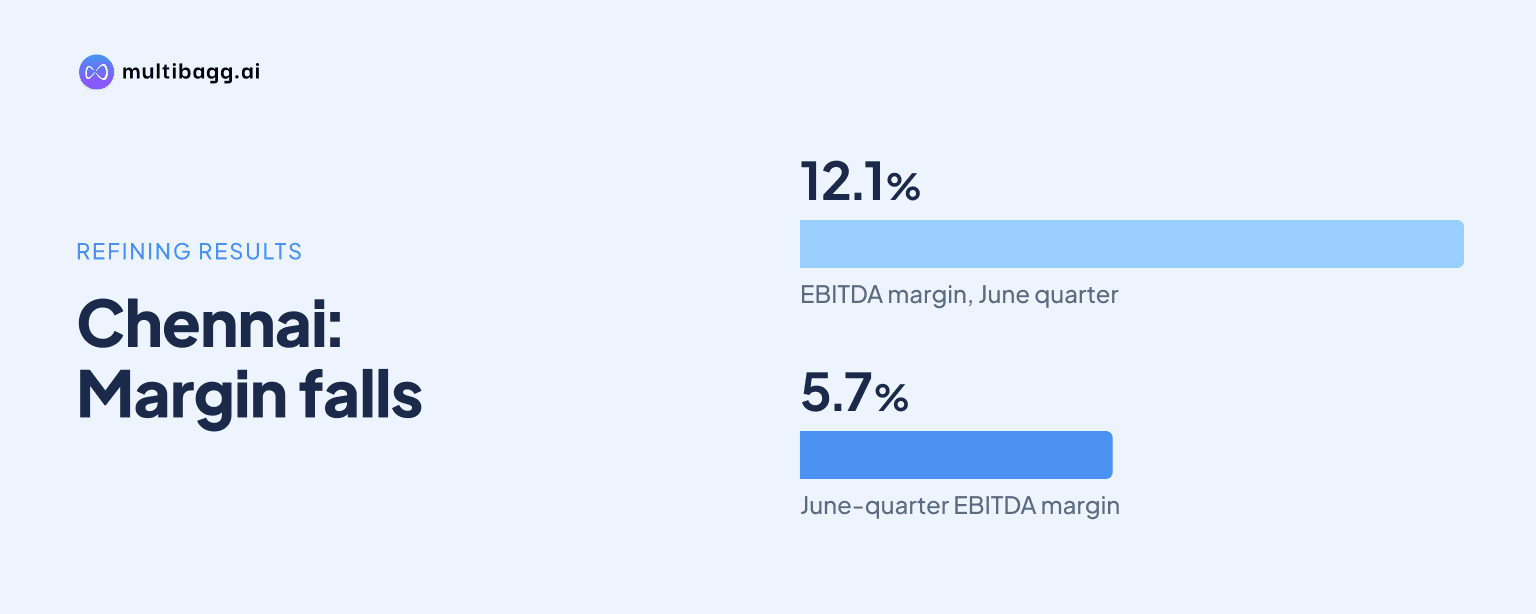
- June-quarter EBITDA declined 23.6% to ₹1,555 crore and margin narrowed to 5.7% from 12.1%.
- CPCL recommended a final FY26 dividend of ₹54 per share, subject to shareholder approval.
powered by IRIS
Chennai Petroleum Corporation Ltd fell 7.75% in one volatile trading session, as sharp crude-price moves, concern over refining margins and wider market risk aversion combined to pressure sentiment around the refiner's shares. The supplied market discussion also points to a 27% sequential decline in June-quarter net profit despite higher revenue.
Why has CPCL stock fallen?
CPCL stock has fallen because investors are assessing the effect of crude-price volatility on refining profitability alongside signs of weaker sequential operating performance. A rapid rise in crude can squeeze margins when the cost of feedstock increases before prices for refined products adjust. Social-media discussion linked one 3.75% fall to Brent moving towards $76 a barrel amid US-Iran tensions and concerns about shipping through the Strait of Hormuz.
The stock has also reacted when crude prices moved in the other direction. In a separate reported session, CPCL fell as much as 5.9% to an intraday low of ₹1,455.30 when Brent cooled to about $104.9 a barrel. These episodes underline that the market is focused not simply on the direction of crude, but on what changing prices may mean for refinery economics, inventory effects and product cracks.
How did CPCL's June-quarter numbers affect sentiment?
CPCL's June-quarter results showed higher revenue but lower sequential profit and operating margin, reinforcing concern about the variability of refinery earnings. Revenue from operations rose 43.5% quarter on quarter to ₹27,370 crore from ₹16,817 crore in the March quarter. However, net profit declined 27% sequentially to ₹1,017 crore from ₹1,400 crore.
Operating profitability weakened as EBITDA fell 23.6% to ₹1,555 crore from ₹2,036 crore, while EBITDA margin narrowed to 5.7% from 12.1%. The figures indicate that revenue growth did not translate into a similar improvement in earnings during the period. CPCL also recommended a final dividend of ₹54 per share for FY26, subject to shareholder approval.
Are refining margins the main risk for CPCL?
Refining margins are the central earnings risk for CPCL because the business is cyclical and depends on crude availability, demand for petroleum products, inventories and geopolitical developments. The market discussion flagged sluggish demand in major markets such as the US and UK as a factor behind low refining margins in the current quarter.
Margins can weaken if product cracks decline, crude costs rise, demand slows or inventory gains reverse. Earlier commentary noted that corrections in CPCL and MRPL had reflected a reversal of FY23 inventory gains and a subsequent decline in gross refining margins. This sensitivity means investors may reassess CPCL quickly when global energy conditions change, even without a company-specific announcement.
Got a follow-up? Ask IRIS
Is the decline also linked to profit-booking and the market mood?
Yes, CPCL's decline has also been linked to profit-booking after a strong rally and to a broader risk-off market environment. The stock had touched ₹1,677 before falling, and market commentary described possible short-term corrective levels of ₹1,250-₹1,230 or even ₹1,160. Those levels are market views, not company forecasts.
In another volatile session, CPCL touched an intraday low of ₹931.85 and was down 7.75% for the day. The reported decline came as the Sensex had fallen 6.43% over three weeks and the INDIA VIX reached a new 52-week high. CPCL underperformed the oil sector and the Sensex in that session, showing how sector sentiment and broader volatility can amplify stock-specific concerns.
What should investors track in CPCL next?
Investors should track crude-price movements, product demand, refining margins and the relationship between revenue growth and operating profit. The December-quarter comparison also illustrates the need to monitor top-line trends: revenue from operations was reported at ₹11,458.32 crore, compared with ₹11,965.01 crore a year earlier.
CPCL's expansion execution is another issue to follow. The supplied discussion identifies risks from higher capital costs, delays and lower refining economics after new capacity is added. For a cyclical refiner, the sustainability of any share-price recovery will depend on whether margins stabilise and whether future capacity delivers returns under prevailing market conditions.
Conclusion
CPCL's share-price weakness reflects a combination of oil-market uncertainty, concern about gross refining margins, softer sequential operating performance and selling after a prior rally. The June-quarter numbers showed that higher revenue alone did not prevent lower profit, EBITDA and margin, keeping attention on the quality of earnings rather than headline sales growth.
The next focus is whether crude and product-market conditions allow refining margins to improve, and whether CPCL can manage the execution risks associated with its expansion plans. Investors will also watch upcoming quarterly revenue, profit and margin trends for evidence that the recent pressure is easing or becoming more persistent.