










Indian Renewable Energy Development Agency Ltd loan growth slows to 19%
Key highlights
- IREDA’s loan book reached Rs 94,936 crore in Q1 FY27, up 19% year on year.
- Q1 FY27 loan-book growth slowed from 26% year on year in Q1 FY26.
- ICICI Securities reduced its IREDA target price to Rs 150 from Rs 180 on August 4, 2026.
- ICICI Securities forecasts 23-25% advances CAGR for IREDA over FY26E-FY28E.
powered by IRIS
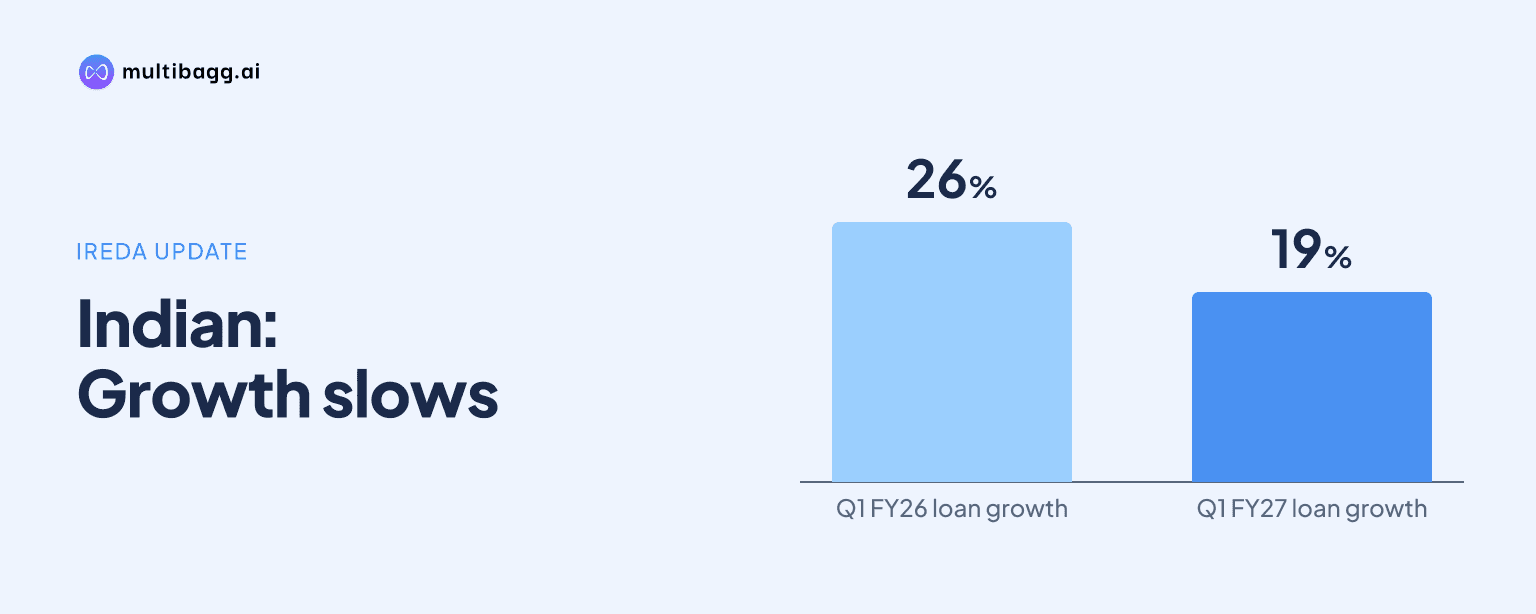
Indian Renewable Energy Development Agency Ltd reported a Rs 94,936 crore loan book in Q1 FY27, up 19% year on year, but the pace was below the 26% growth recorded in Q1 FY26. The moderation led ICICI Securities to reduce its target price to Rs 150 from Rs 180 while retaining its Buy rating.
Why has IREDA’s loan-growth outlook moderated?
IREDA’s near-term growth outlook has moderated because the loan book expanded 19% year on year in Q1 FY27, compared with 26% in the corresponding quarter of FY26. On a sequential basis, the loan book was up 2% in Q1 FY27. The comparison is central to the broker’s revised assumptions, even as the absolute scale of advances continued to increase.
The supplied Q2 FY27 update also reported a 4.3% quarter-on-quarter increase in consolidated revenue and 14.0% year-on-year growth. These figures indicate continued expansion, but they do not remove the concern that business growth may be slower than earlier expectations. For a lender such as IREDA, the pace of advances, margins, asset quality and funding conditions remain important to the outlook.
What supports IREDA’s longer-term growth case?
IREDA’s longer-term case rests on its role as a renewable-energy financier and the planned increase in India’s non-fossil fuel capacity to 500 GW by 2030. ICICI Securities cited an increase from 297 GW to 500 GW as a multi-year financing opportunity. Separately, the supplied material says the Ministry of New and Renewable Energy reported around 299.25 GW of installed renewable capacity, including large hydro, as of September 30, 2026.
IREDA is described as a systemically important non-deposit-taking NBFC with renewable-sector term loans across 23 states and four union territories. Its funding profile includes domestic borrowings and external commercial borrowings. The broad financing requirement created by new renewable capacity is the structural basis for the positive brokerage view, rather than a guarantee of any specific lending outcome.
Which new businesses could drive IREDA’s next expansion phase?
IREDA is seeking to diversify beyond traditional renewable financing through manufacturing, battery energy storage systems, green hydrogen, storage and other energy-transition infrastructure. ICICI Securities expects this broader opportunity set to support the company’s next stage of expansion. ICICI Direct similarly linked its positive view to financing beyond solar and utility projects.
The forecast range reflects that opportunity. ICICI Securities expects advances to grow at a 23-25% compound annual rate over FY26E-FY28E, while ICICI Direct had projected roughly 24-25% growth over the same period. ICICI Securities also forecast medium-term return on assets of about 1.9-2.0%, supported by healthy margins and stable asset quality. The forecasts remain estimates, and their delivery depends on loan growth, funding and credit performance.
Got a follow-up? Ask IRIS
What does the revised Rs 150 target mean for IREDA shares?
The revised Rs 150 target means ICICI Securities has retained a Buy rating but lowered its valuation expectation because of anticipated moderation in business growth. The August 4, 2026 update cut the target from Rs 180 and based the new target on about 2.3 times FY28E book value. That is a broker assessment, not a stated market outcome.
Earlier ICICI Direct research had maintained a Rs 180 target, based on about 2.6 times FY28E book value, alongside its 24-25% advances-growth expectation. The supplied social-media discussion also refers to a Rs 300 technical scenario, but explicitly characterises it as a scenario rather than cited analyst consensus. It also states that IREDA closed at Rs 119.65 on November 9, 2026, while another supplied item cites an analyst target of Rs 120.
What are the main risks to IREDA’s outlook?
IREDA’s main disclosed risks are slower loan growth, deterioration in asset quality and valuation compression toward peer NBFCs. The Q1 FY27 growth deceleration shows why the rate of balance-sheet expansion is receiving close attention. Large project exposures can also make earnings periodically volatile, according to the supplied discussion.
The next assessment will depend on reported gross and net NPAs, recoveries, credit costs, lending spreads and the relationship between price-to-book valuation and sustainable return on equity. Funding costs and net interest margins also matter because management expects operating leverage to support return on assets despite some moderation in spreads and margins.
Conclusion
IREDA retains a structural link to India’s renewable-energy build-out, with diversification into storage, manufacturing and green hydrogen potentially widening its lending opportunity. However, the 19% year-on-year Q1 FY27 loan-book growth, versus 26% a year earlier, explains why ICICI Securities reduced its target price to Rs 150 despite keeping its Buy rating.
Investors will next watch whether advances move toward the 23-25% FY26E-FY28E CAGR projected by the broker and whether Q2 FY27 revenue growth is followed by stable asset quality, margins and recoveries. Progress toward the 500 GW non-fossil capacity objective by 2030 remains the longer-term demand backdrop cited in the research.