










Hero MotoCorp Q2 Profit Miss Sends Shares 4% Lower After Results
Key highlights
- Hero MotoCorp's standalone net profit rose 5% year-on-year to Rs 1,456 crore in Q2 FY27.
- Hero MotoCorp's standalone revenue grew 21% to Rs 14,687 crore in Q2 FY27.
- Hero MotoCorp's EBITDA margin fell 160 basis points to 13.4% from 15%.
- Hero MotoCorp shares fell 4% on October 29 after the quarterly results.
powered by IRIS
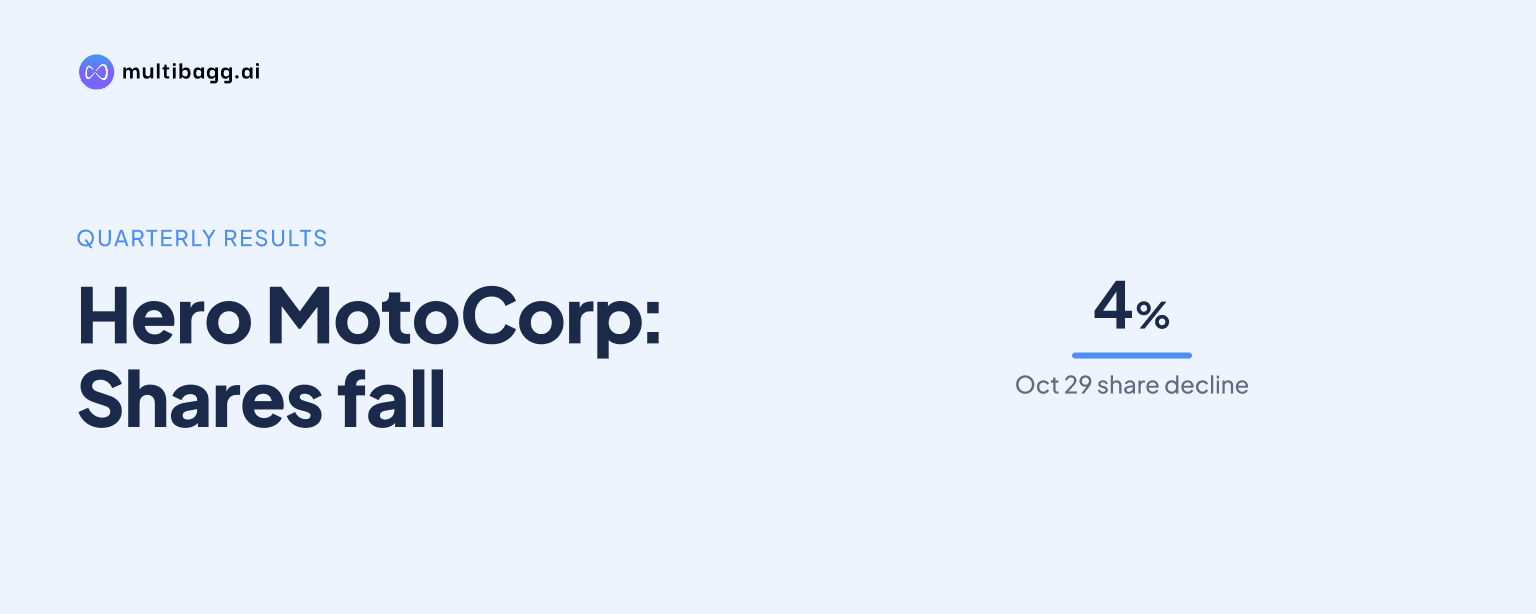
Hero MotoCorp Limited shares fell 4% on October 29 after Q2 FY27 standalone net profit rose 5% year-on-year to Rs 1,456 crore but trailed market estimates, while EBITDA margin narrowed by 160 basis points to 13.4%. Revenue growth and higher vehicle sales did not offset investor concern over rising raw-material costs and slower profit growth.
Why did Hero MotoCorp shares fall after Q2 FY27 results?
Hero MotoCorp shares fell because the company’s standalone profit growth was modest relative to revenue growth, and reported profit was below consensus expectations. The stock settled at Rs 5,107.50 on October 29 after slipping more than 4%, with the intraday low reported at Rs 5,095 on the NSE.
The market response centred on operating profitability rather than the top line. Standalone net profit of Rs 1,456 crore was up around 5% from Rs 1,392 crore a year earlier, but below estimates of Rs 1,531 crore in one set of market expectations. Another estimate had put profit at Rs 1,527 crore. Revenue was broadly in line with, or slightly ahead of, estimates.
The immediate reaction also compared poorly with broader market benchmarks. The shares were down 4% from the pre-results close, while the 2/3 Wheelers industry median rose 0.8% and the Nifty Midcap 150 gained 0.9% on the reaction day.
What were Hero MotoCorp's key Q2 FY27 numbers?
Hero MotoCorp reported solid revenue growth in Q2 FY27, but EBITDA and standalone profit grew at a much slower pace. The company sold 18.68 lakh two-wheelers in the July-September quarter, a 10% year-on-year increase, supported by higher sales volumes, product mix and pricing.
Consolidated revenue from operations rose 23% to Rs 14,971 crore from Rs 12,218 crore in the year-ago quarter. Consolidated profit after tax increased 42% to Rs 1,861 crore from Rs 1,308 crore. The sharper consolidated profit growth contrasted with the lower standalone profit growth that investors focused on during the trading session.
Why did Hero MotoCorp's operating margin decline?
Hero MotoCorp’s EBITDA margin declined because raw-material costs increased faster than operating earnings. The standalone margin fell to 13.4% from 15% a year earlier, despite an 8% rise in EBITDA to Rs 1,967 crore.
Market commentary identified precious metals, aluminium and specialty battery components among the areas of input-cost pressure. Revenue rose 21%, considerably faster than EBITDA growth, indicating that higher sales and improved realisations did not fully protect profitability from the cost increase.
This margin movement was central to the earnings miss. While the company delivered higher revenue and volumes, the September-quarter result marked its slowest net profit growth in five quarters, according to the market reports provided. For investors, the result showed that stronger dispatches alone were not enough to sustain prior operating-margin levels.
Got a follow-up? Ask IRIS
How did Hero MotoCorp stock perform around the announcement?
Hero MotoCorp stock weakened progressively after the result filing, moving from a small initial gain to a larger decline by the close. The company filed its disclosures with BSE India and NSE on October 29, and the shares were 0.3% higher five minutes after the filing before turning 0.4% lower after 15 minutes and 0.8% lower after 30 minutes.
By the next day’s close, the stock was down 2.9% from its pre-results close, compared with a 1% decline in the industry median. That represented a 1.9 percentage-point underperformance. Reports also cited a share price of about Rs 5,197 during the session, down 2.36% from the previous close.
The price action suggests that investors weighed the profit miss and margin compression more heavily than the revenue beat. The reaction was not driven by a fall in reported sales, as both quarterly revenue and two-wheeler volumes increased year-on-year.
What should investors take from the Q2 FY27 result?
Hero MotoCorp’s Q2 FY27 result showed a split between healthy demand-led growth and pressure on the profitability of that growth. Revenue rose 21% on a standalone basis and volumes increased 10%, but net profit rose only 5% and missed estimates as the EBITDA margin contracted to 13.4%.
The consolidated figures were stronger, with profit after tax rising 42% to Rs 1,861 crore. However, the share-price decline showed that investors were assessing the standalone operating trend and the effect of higher input costs. The result therefore leaves margin performance as the key issue alongside sales growth.
Conclusion
Hero MotoCorp delivered higher revenue, volumes and consolidated profit in Q2 FY27, but the market focused on the 160-basis-point standalone margin decline and standalone profit that came in below expectations. The 4% share-price fall reflected concern that rising raw-material costs had limited the earnings benefit of stronger sales.
The next area to watch is whether input costs in precious metals, aluminium and specialty battery components continue to pressure margins. Investors will also track whether higher volumes, product mix and pricing can support revenue growth while improving the gap between top-line growth and operating-profit growth.