










Eternal Limited Q2 Revenue Reaches ₹24,138 Crore as Blinkit Leads
Key highlights
- Eternal reported Q2 FY27 revenue of ₹24,138 crore, up 77.6% year on year.
- Eternal's Q2 FY27 net profit rose 92% year on year to ₹125 crore.
- Blinkit generated FY26 revenue of ₹37,779 crore after the inventory-led model change.
- Food delivery generated ₹606 crore of adjusted EBITDA in Q1 FY27 versus Blinkit's ₹102 crore.
powered by IRIS
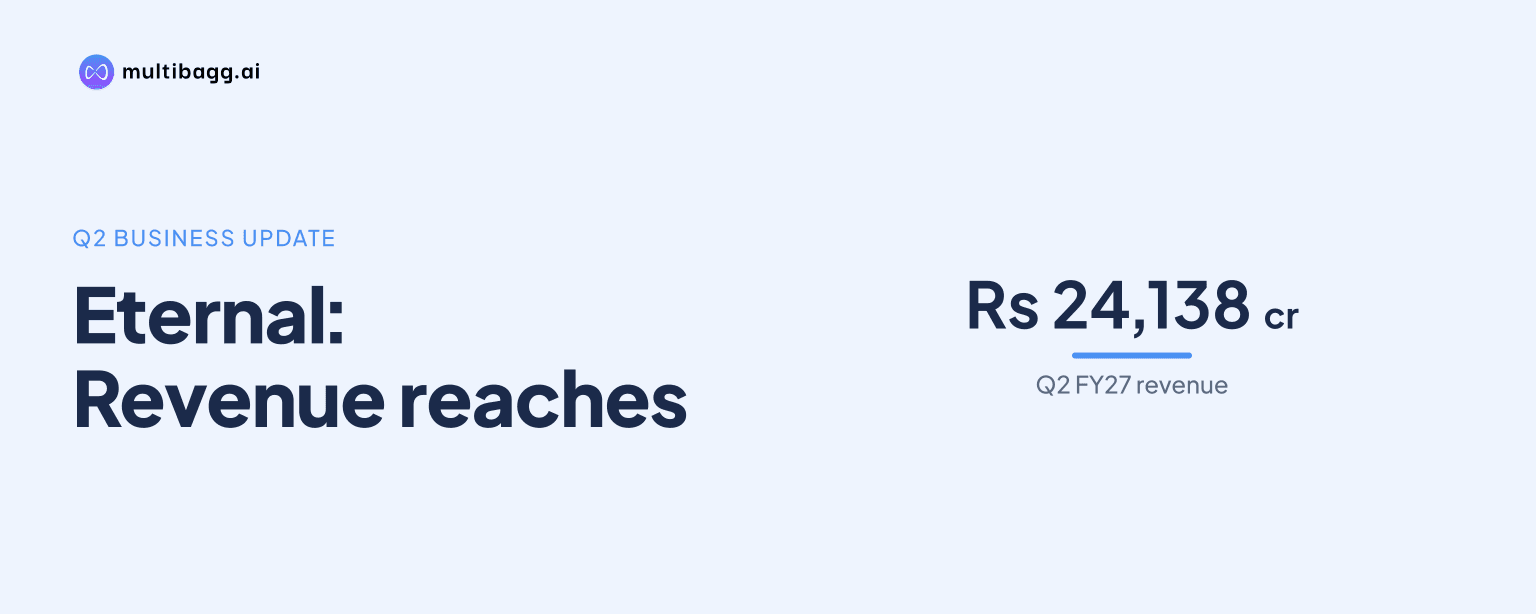
Eternal Limited reported revenue of ₹24,138 crore in Q2 FY27 ended September 2026, up 77.6% year on year, with Blinkit contributing most of the topline while food delivery remained the larger source of operating profit. Consolidated net profit rose 92% to ₹125 crore during the quarter.
How does Eternal make money?
Eternal earns through four operating businesses: food delivery, quick commerce, B2B supplies and going-out. Its food delivery brand, Zomato, receives commissions and advertising income from restaurant partners, while customers contribute through platform fees, delivery charges and Zomato Gold memberships.
Food delivery has a broad restaurant network, with social-media discussions citing about 297,000 restaurant partners across more than 800 cities. The business has also sought to reach more price-sensitive customers by lowering the free-delivery minimum order value for Gold members to ₹99 and using targeted activations. Management said these measures supported growth in monthly transacting customers through new users and higher order frequency.
Blinkit, the quick-commerce business, delivers groceries, staples and electronics. Hyperpure supplies ingredients and products to restaurants, while District covers dining-out discovery, ticketing and live events. These businesses give Eternal revenue sources beyond the restaurant-ordering model.
Which Eternal business contributes the most revenue?
Blinkit contributes the largest share of Eternal's revenue because its inventory-led model records the full value of goods sold. This accounting change is central to interpreting the sharp reported growth in quick-commerce revenue, since a marketplace model typically records only commission income.
The FY26 segment data shows the scale of that change. Quick commerce accounted for ₹37,779 crore of consolidated revenue, compared with ₹5,206 crore in FY25. Food delivery, though smaller in revenue terms, expanded 26% to ₹10,159 crore.
The reported quick-commerce revenue increase therefore does not represent only higher commissions or platform income. It also reflects Blinkit's transition from a marketplace structure to a hybrid inventory-ownership model from Q1 FY26, under which the value of merchandise sold is included in revenue.
Got a follow-up? Ask IRIS
Why did Eternal's Q2 FY27 revenue rise to ₹24,138 crore?
Eternal's Q2 FY27 revenue rose to ₹24,138 crore primarily on growth in its food delivery and quick-commerce businesses. The company reported a 77.6% year-on-year increase in revenue and a 20% sequential increase in consolidated adjusted EBITDA to ₹666 crore.
Quick commerce remained the main driver of the group topline, consistent with the inventory-led revenue recognition model at Blinkit. Its operating performance also improved: Blinkit reported adjusted EBITDA of ₹37 crore in the March quarter, its second consecutive quarter of operating profitability, compared with an adjusted EBITDA loss of ₹178 crore a year earlier.
Food delivery continued to grow alongside the expansion in quick commerce. Zomato's net order value rose 19% year on year to ₹9,757 crore in the March quarter. Management described the recent acceleration as structural and linked it to efforts aimed at expanding demand among budget-conscious consumers.
How profitable is Eternal's food delivery business?
Food delivery remains Eternal's principal profit contributor even though Blinkit generates more reported revenue. In Q1 FY27, food delivery contributed ₹3,100 crore, or 15.3%, of consolidated revenue of ₹20,211 crore, but generated adjusted EBITDA of ₹606 crore compared with Blinkit's ₹102 crore.
The contrast illustrates the different stages of the two businesses. Food delivery is the more mature operation, with revenue from restaurant commissions, advertising, consumer charges and memberships. Blinkit is scaling rapidly and has improved its operating performance, but its revenue mix and inventory model make a simple comparison with food-delivery revenue less meaningful.
At the consolidated level, Eternal's Q2 FY27 net profit was ₹125 crore, up 92% from ₹65 crore a year earlier and 35.8% from ₹92 crore in Q1 FY27. FY26 profit after tax, however, declined to ₹366 crore from ₹527 crore in FY25 despite revenue growth, with higher depreciation and amortisation in quick commerce cited as a key factor.
Conclusion
Eternal's financial profile is increasingly shaped by Blinkit's inventory-led quick-commerce model, which has made it the largest contributor to reported revenue. Food delivery remains important for profitability, supported by restaurant commissions, consumer fees, advertising and Zomato Gold, while Hyperpure and District provide additional but smaller revenue engines.
The next focus is whether quick commerce can sustain operating profitability as it expands and whether competitive intensity eases. Investors will also watch the pace of food-delivery order growth, the contribution from price-sensitive customers, and the effect of further investment, depreciation and amortisation on consolidated profit.