










HDFC Bank Ltd. Shares Fall 30% as Margin Pressure Persists
Key highlights
- HDFC Bank's Q2 FY27 standalone profit rose 4.7% year on year to Rs 19,510 crore.
- HDFC Bank's Q2 FY27 net interest margin slipped to 3.16%, while treasury gains fell 67%.
- HDFC Bank shares were down about 30% in 2026 in the cited October market update.
- Motilal Oswal forecasts HDFC Bank PAT growth of 14.2% in FY28E, versus about 9% average growth over FY24-FY27E.
powered by IRIS
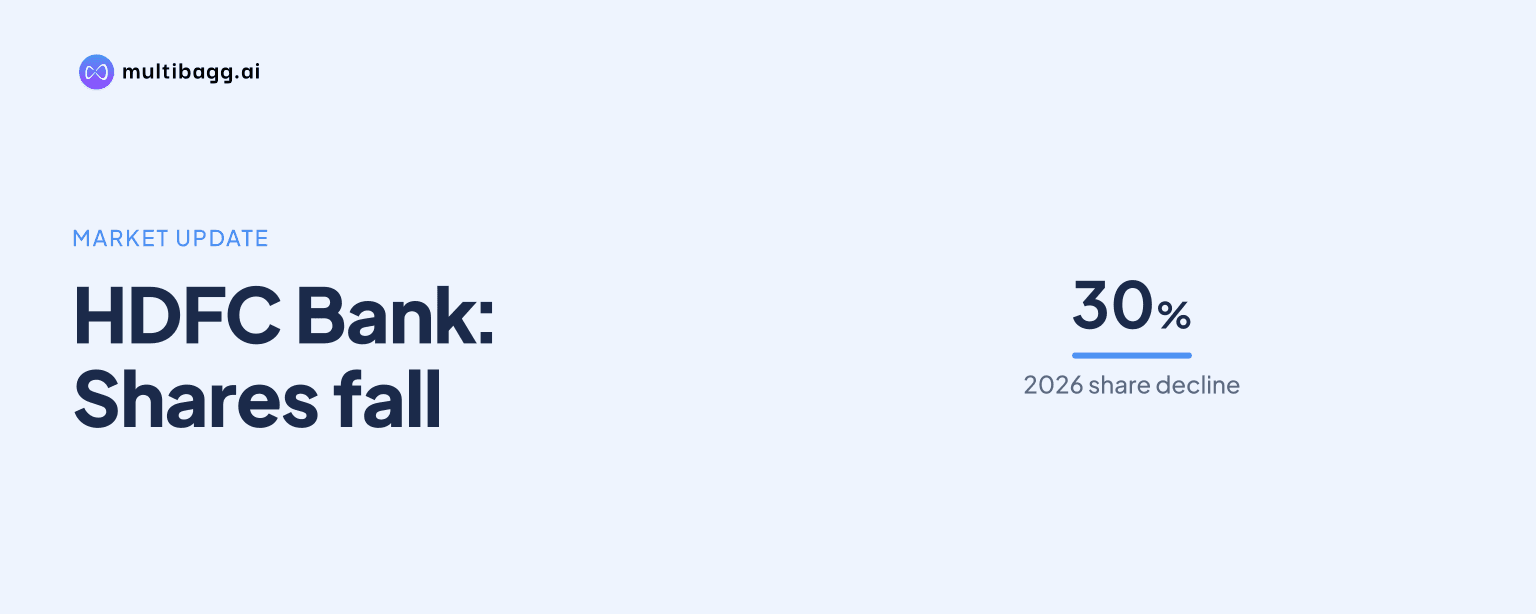
HDFC Bank shares had fallen about 30% in 2026 after Q2 FY27 standalone profit rose 4.7% to Rs 19,510 crore, as a 3.16% net interest margin, weaker treasury gains and leadership concerns kept investor sentiment subdued. The stock remained near its 52-week low despite largely positive brokerage ratings.
Why have HDFC Bank shares declined so sharply?
HDFC Bank shares have weakened because investors remain concerned about margin pressure, slower-than-expected earnings growth and operating challenges after the 2023 merger with HDFC Ltd. Leadership-transition and governance-related concerns have added to uncertainty, while a broader market downturn has intensified selling pressure.
The decline has been substantial across several reported periods. The stock was down about 30% year to date and 31% over one year in an October market update. Another assessment as of 10 November put its one-year return at minus 19%, versus a marginal 0.08% decline in the BSE500. While the precise return varies with the observation date, the common point is pronounced underperformance.
What did HDFC Bank's Q2 FY27 results show?
HDFC Bank reported a modest improvement in quarterly profit, but the result did not fully address the market's concerns over core profitability. Standalone net profit for Q2 FY27 increased 4.7% year on year to Rs 19,510 crore, while the net interest margin slipped to 3.16%.
Treasury gains fell 67%, adding to the pressure on reported profitability and sentiment. Market commentary also pointed to post-merger structural challenges and earnings growth that fell short of expectations. The available data nevertheless cited robust capital, improving asset quality and consistent profit growth as counterpoints to the weak share-price action.
Which HDFC Bank technical levels matter now?
HDFC Bank's technical setup remains cautious because the stock has not decisively moved out of its downtrend and has traded below its longer-term moving averages. It was reported above its 5-day and 20-day averages at one point, indicating short-term momentum, but remained below its 50-day, 100-day and 200-day averages.
The stock touched a fresh 52-week low of Rs 668.90 on 28 October. Technical commentary identified Rs 680 to Rs 690 as an immediate support zone, with a close below Rs 680 potentially exposing Rs 600 to Rs 640. On the upside, Rs 730 to Rs 740 was seen as an area that could attract selling, while a decisive weekly close above Rs 745 was cited as necessary to improve the medium-term outlook.
Got a follow-up? Ask IRIS
What are brokerages expecting from HDFC Bank?
Brokerage sentiment remains broadly constructive even as the share price has weakened. Of 50 brokerage firms cited, 48 had Buy ratings and two had Hold ratings. Targets referenced in market reports ranged from Rs 1,050 at Kotak Institutional Equities and Emkay Global to Rs 1,270 at BNP Paribas.
Motilal Oswal expects leadership changes, improved growth and stronger earnings to reduce investor scepticism over the medium term. It expects operating performance to improve from the second half of FY27 and forecasts PAT growth of 14.2% in FY28E, compared with average growth of about 9% over FY24 to FY27E. These are projections, not realised results.
What could change HDFC Bank's outlook?
A durable recovery would require clearer evidence that growth and earnings are improving, alongside reduced uncertainty around leadership and post-merger execution. The cited risks are a delayed recovery in growth or earnings, continuing operating pressure after the merger and further leadership-transition uncertainty.
Broader factors also matter. Investors are watching interest-rate conditions, credit-growth trends, regulatory developments and the Nifty Bank's performance. Retail and SME lending were identified as potential support for banking-sector credit growth, but that sector view had not yet translated into sustained momentum for HDFC Bank shares.
Conclusion
HDFC Bank's sharp price decline reflects an unresolved gap between favourable long-term brokerage views and near-term concerns over margins, earnings delivery, merger-related pressures and leadership uncertainty. The Q2 FY27 profit increase offered some support, but the 3.16% margin and 67% decline in treasury gains left the market focused on execution rather than valuation targets.
The next key marker is the expected improvement in operating performance from the second half of FY27, followed by whether earnings can move toward Motilal Oswal's projected 14.2% PAT growth in FY28E. In the near term, investors will also watch whether the stock holds the Rs 680 support area and whether management provides greater clarity on strategy and leadership.