










CUMI targets Rhodius break-even in Q1 FY28 after costs ease
Key highlights
- CUMI targets Rhodius break-even in Q1 FY28, followed by a small profit.
- CUMI expects Rhodius FY27 sales to remain broadly flat, with slightly lower losses.
- Consolidated Abrasives PBIT rose 20.8% year on year to Rs 40 crore in Q2 FY27.
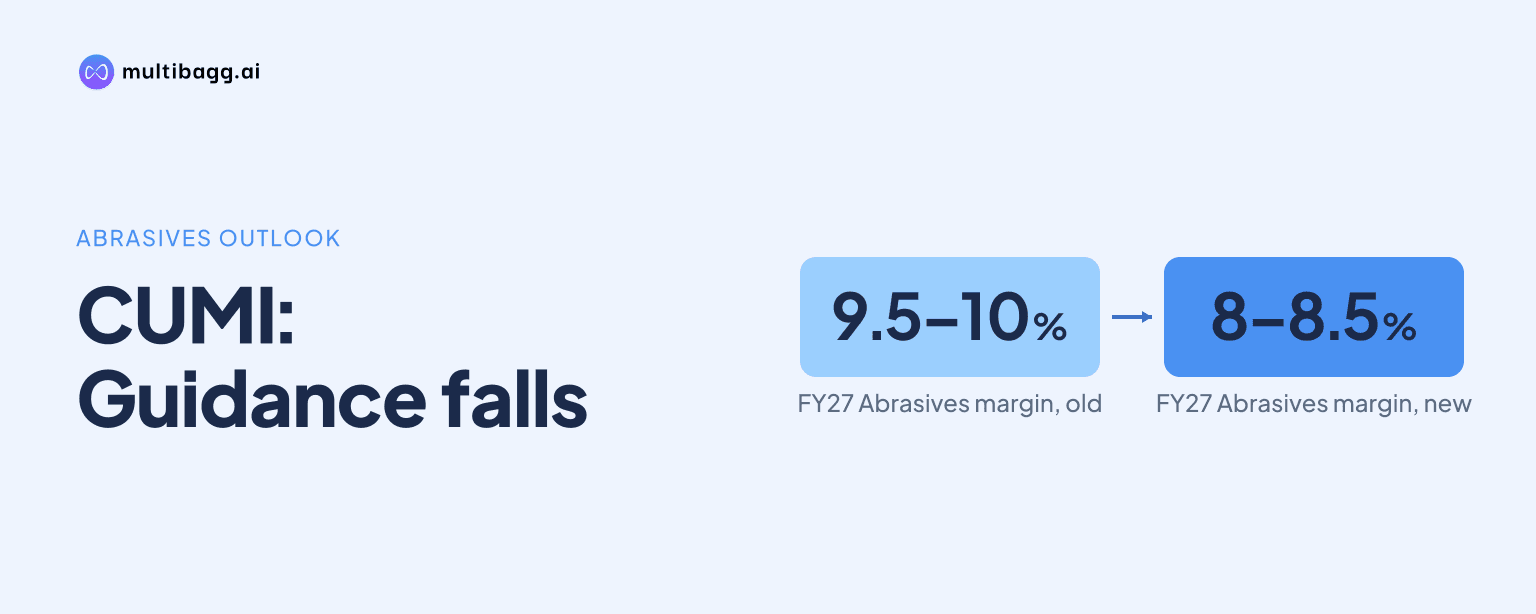
- CUMI reduced FY27 Abrasives margin guidance, excluding AWUKO, to 8% to 8.5% from 9.5% to 10%.
powered by IRIS
Carborundum Universal Limited targets Rhodius break-even in Q1 FY28 after resolving a warehouse move that caused a sales shortfall and higher costs; management expects FY27 sales to remain at the prior-year level with slightly lower losses and said a local-team and consultant-led programme is under way.
Know Carborundum Universal inside out
Results, valuation, peers and who's buying, in one view.
When does CUMI expect Rhodius to break even?
CUMI expects Rhodius to reach break-even in Q1 FY28, which management described as the first step before the business begins generating a small profit. The target was disclosed during the Q2 FY27 earnings call, when management said it had deployed a large programme involving the local team, management consultants and personnel on the ground.
Management did not provide a Rhodius revenue target, margin target or quarterly loss target for Q1 FY28. Its stated sequence is to reach break-even in the first quarter of the next financial year, generate a small profit thereafter and then build on that position through the broader turnaround programme.
For FY27, CUMI expects Rhodius sales to remain at roughly the prior-year level, while losses become slightly lower. The forecast indicates that the planned improvement depends primarily on the removal of warehouse-transition costs and a better margin outcome, rather than material sales growth during FY27.
Why are Rhodius losses expected to decline?
Rhodius losses are expected to decline because the warehouse move that caused a top-line shortfall and higher costs has been addressed, according to CUMI management. Management said the disruption-related effects were no longer present, allowing margins to improve and losses to decrease despite its forecast of broadly flat FY27 sales.
CUMI did not disclose the warehouse-transition cost, the date of its completion, Rhodius volumes or the business’s current loss amount. The disclosed recovery mechanism is operational normalisation: removing the logistics disruption from revenue and cost performance while pursuing the separate turnaround programme.
The Rhodius update came alongside differing standalone and consolidated Abrasives results in Q2 FY27. Consolidated Abrasives profit before interest and tax, or PBIT, increased year on year, while standalone Abrasives PBIT declined; management attributed the consolidated improvement to a lower AWUKO loss.
The comparison shows that the consolidated Abrasives result includes overseas operations and differs from the standalone business, where fuel, phenol and resin costs affected profitability. Management said consolidated Abrasives PBIT in Q2 FY27 was at a similar level to Q1 FY27, but it did not disclose a Rhodius-specific PBIT contribution.
Got a follow-up? Ask IRIS
What is CUMI doing to turn Rhodius profitable?
CUMI is working with the local Rhodius team, management consultants and personnel on the ground under a programme intended to speed the path to Q1 FY28 break-even. Management called it a large programme but did not disclose whether it includes plant changes, product rationalisation, pricing actions, workforce measures or additional capital expenditure.
The programme follows the resolution of the warehouse transition, which management identified as the direct cause of higher costs and a sales shortfall. CUMI’s plan has two stages: restore normal operations after the warehouse disruption, then use the wider programme to establish a small profit after the Q1 FY28 break-even target.
Management was asked in Q2 FY27 whether Rhodius could require an impairment or write-off. CUMI said it did not believe there were any current write-offs of the type raised by the analyst, though it did not provide a separate carrying value or impairment assessment for Rhodius.
CUMI gave a separate answer on AWUKO, saying it did not expect further write-offs, while it continued work on the Foskor Zirconia exit. The Rhodius plan differs from those actions because management’s stated objective for Rhodius is break-even followed by a small profit, rather than a closure or exit.
How does Rhodius fit into CUMI's FY27 Abrasives outlook?
Rhodius fits into an Abrasives outlook in which CUMI retained FY27 consolidated sales-growth guidance of 5.5% to 6%. Excluding AWUKO revenue of Rs 108 crore in FY26, management said comparable consolidated Abrasives growth could be 11% to 12%, indicating that other operations are expected to drive the portfolio’s reported growth.
CUMI reduced its FY27 consolidated Abrasives margin expectation, excluding AWUKO, to 8% to 8.5% from the previous 9.5% to 10% range. Management cited lower standalone margins in H1 FY27 after higher fuel prices and oil-linked input costs, including phenol and resins, of which only a small portion had been passed on to customers.
The standalone and consolidated H1 FY27 figures illustrate the difference in performance across the portfolio. Standalone Abrasives PBIT fell to Rs 72 crore from Rs 84 crore in H1 FY26, while consolidated Abrasives PBIT rose to Rs 80 crore from Rs 45 crore, helped by lower AWUKO losses.
Management said it was working to pass through the cost increase while balancing its cost pressure against what the market can absorb amid competition. For the second half of FY27, it expects demand from industrial activity, construction and infrastructure to continue, while Rhodius’s nearer-term recovery remains linked to the fading warehouse-move effects.
Conclusion
CUMI has set a defined operational milestone for Rhodius: break-even in Q1 FY28, followed by a small profit. Management expects FY27 sales to remain broadly flat and losses to be slightly lower as warehouse-transition disruption no longer affects revenue and costs, while a consultant-supported turnaround programme continues.
The next measure is whether Rhodius losses keep narrowing through the balance of FY27 and whether management retains the Q1 FY28 break-even target. CUMI also plans to pursue FY27 consolidated Abrasives margins of 8% to 8.5%, excluding AWUKO, while working to pass through higher phenol, resin and fuel costs.