










CUMI targets Rs 300-350 crore semiconductor revenue by FY31
Key highlights
- CUMI targets Rs 300 crore to Rs 350 crore of semiconductor-equipment component revenue progressively around FY30 and FY31.
- CUMI has invested Rs 66 crore in the semiconductor programme for an anchor customer.
- Management said total semiconductor-programme investment could rise to about three to four times Rs 66 crore.
- Consolidated Ceramics PBIT rose 62.1% year on year to Rs 101 crore in Q2 FY27.
powered by IRIS
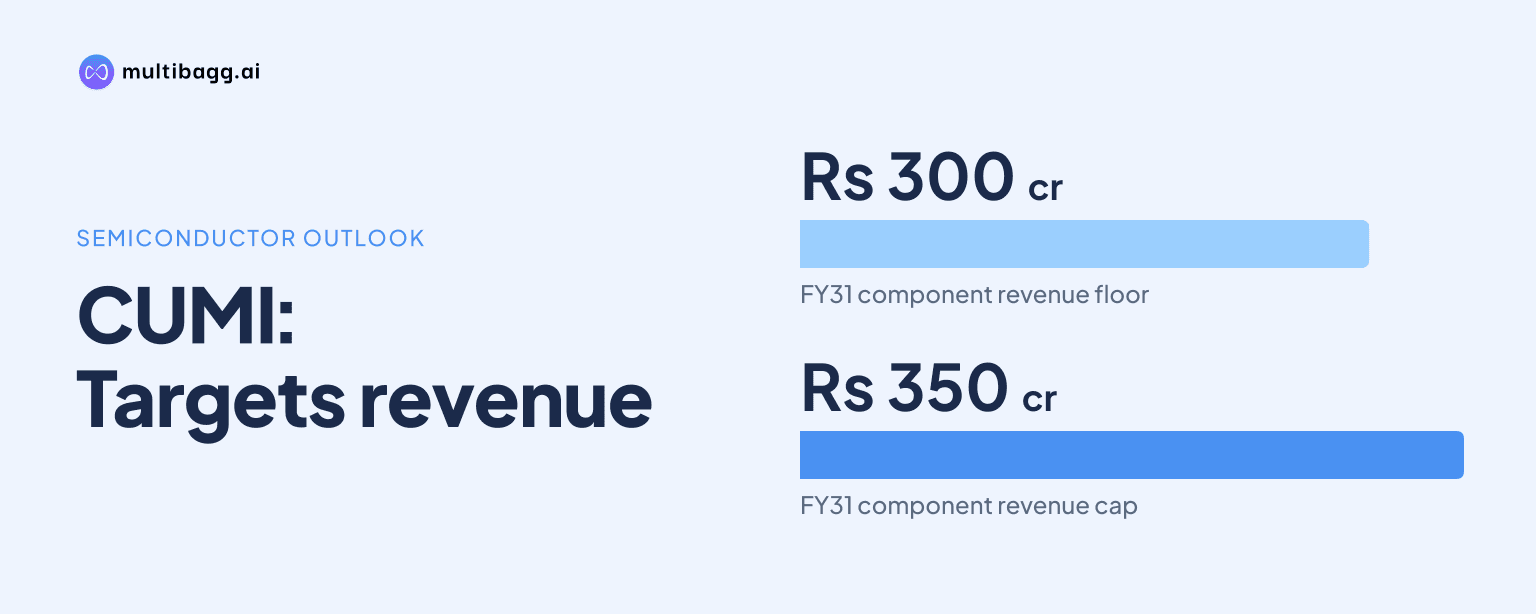
Carborundum Universal Limited expects semiconductor-equipment components to generate Rs 300 crore to Rs 350 crore of revenue progressively around FY30 and FY31, management said after Rs 66 crore had been invested for an anchor customer. CUMI said the programme will expand in phases, with the revenue ramp expected to begin from FY28.
Know Carborundum Universal inside out
Results, valuation, peers and who's buying, in one view.
What is CUMI's semiconductor-equipment component revenue target?
CUMI targets Rs 300 crore to Rs 350 crore of revenue from semiconductor-equipment components around FY30 and FY31. Managing Director Sridharan Rangarajan gave that range in response to a question on peak potential and said the outcome would occur progressively around those years rather than in a single period.
The Rs 300 crore to Rs 350 crore range applies to this specific semiconductor-equipment component programme, not to the whole Ceramics segment or the separate electronic-substrate initiative. CUMI did not disclose current programme revenue, production volumes, an order book or the identity of the anchor customer, so the range is a management expectation rather than reported FY27 sales.
The opportunity is part of CUMI's newer ceramics programmes, while its existing Ceramics business is already expanding. Management raised consolidated Ceramics sales-growth guidance for FY27 to 25% to 28%, from its previous 23% to 25% range, citing demand in industrial Engineered Ceramics, Bloom-related products and Metallized Cylinders.
When will CUMI's semiconductor component revenue increase?
CUMI expects the semiconductor-equipment component business to start picking up from FY28 and reach its peak potential progressively around FY30 and FY31. Management agreed with the analyst's description that the programme would be expanded in phases, but did not provide annual revenue milestones for FY28, FY29, FY30 or FY31.
This timing separates the new programme from CUMI's FY27 Ceramics momentum. Management said industrial Engineered Ceramics was the fastest-growing part of Ceramics, with Bloom-related products and Metallized Cylinders as two growth vectors; bare ceramics was also growing, but more slowly than those product areas.
Ceramics is also heavily export-oriented, although CUMI did not provide a geography split for semiconductor components. Management said Ceramics typically records exports of more than 85%, and that the same broad proportion was maintained in the first half of FY27. It did not say whether the new programme would have a similar export mix.
How much is CUMI investing in semiconductor components?
CUMI has invested Rs 66 crore in semiconductor-equipment components for an anchor customer, and management said total investment could rise to about three to four times that amount. That implies a potential cumulative investment range of about Rs 198 crore to Rs 264 crore, although CUMI did not commit to a final amount or specify the timing of each expansion phase.
The semiconductor investment sits within a wider capital-expenditure plan. CUMI spent Rs 127 crore of capital expenditure in H1 FY27, compared with Rs 162 crore in H1 FY26, and retained consolidated FY27 capital-expenditure guidance of Rs 400 crore. Management did not allocate that Rs 400 crore between semiconductor components, electronic substrates, other Ceramics projects and established businesses.
The call did not specify how future semiconductor spending would be funded. At the reported date, CUMI had consolidated debt of Rs 362 crore and cash of Rs 251 crore, excluding cash at VAW, resulting in net debt of Rs 111 crore. Its consolidated debt-to-equity ratio was 0.09, but management did not connect those figures to the phased expansion plan.
Got a follow-up? Ask IRIS
Will CUMI's semiconductor components earn higher margins?
CUMI said its newer areas, including semiconductor components, should generate profit before interest and tax, or PBIT, margins above the normal Ceramics baseline in a stable state. Management did not quantify the eventual margin, identify the point at which the business would become stable, or give a margin estimate for the initial FY28 ramp.
The company was responding to an analyst's reference to a usual Ceramics PBIT-margin baseline of 20% to 21%. For FY27, CUMI increased its consolidated Ceramics margin guidance to 22.5% to 23.5%, from the earlier expectation of 20.5% to 21%, alongside its higher sales-growth outlook of 25% to 28%.
Reported Ceramics earnings have already improved before the expected semiconductor ramp. Consolidated Ceramics PBIT rose 62.1% year on year to Rs 101 crore in Q2 FY27 from Rs 62 crore in Q2 FY26, and increased 36.5% sequentially from Rs 74 crore in Q1 FY27. For H1 FY27, Ceramics PBIT was Rs 176 crore, compared with Rs 137 crore a year earlier.
How do CUMI's other new ceramics programmes compare?
CUMI has not disclosed revenue targets for electronic substrates or other new Ceramics programmes comparable with the Rs 300 crore to Rs 350 crore semiconductor-component target. Management said the electronic-substrate programme was progressing to milestones, supported by anchor-customer work and technology support where required, but would need at least another year before completion.
The electronic-substrate initiative includes active metal brazed, or AMB, and direct bonded copper, or DBC, substrates for power electronics. CUMI said its metallized-products capability, developed over a couple of decades, and its acquired AMB capability support a plan to offer value-added substrates rather than a substrate alone.
Management said these programmes have different levels of disclosure and development. Semiconductor components have Rs 66 crore of investment, an anchor customer and an FY28-to-FY31 ramp framework, whereas electronics requires at least another year before CUMI shares further potential. The company also said it receives no specific tax benefit for these new businesses and operates at normal tax rates.
Conclusion
CUMI has set a defined medium-term target of Rs 300 crore to Rs 350 crore in semiconductor-equipment component revenue around FY30 and FY31, based on Rs 66 crore already invested and phased expansion for an anchor customer. The programme is distinct from the current Ceramics upswing, which lifted consolidated Ceramics PBIT to Rs 101 crore in Q2 FY27.
The next disclosures to watch are the FY28 start of the revenue ramp, the scale and timing of investment beyond Rs 66 crore, and progress on the electronic-substrate programme that management said needs at least another year. Management's FY27 targets of 25% to 28% Ceramics sales growth and 22.5% to 23.5% Ceramics margin provide the nearer-term operating benchmarks.