








Current Infraprojects targets BESS tenders above Rs 200 crore
MAX Plan at ₹4,999/yr

Find your next multibaggerBe a Pro Investor
Research stocks and track your picks on the go. Download the app.
Key highlights
- Current Infraprojects said its Lakshadweep BESS empanelment is worth roughly Rs 50 crore, although its allocation remains unspecified.
- Uttarakhand and Haryana each have active BESS tenders costing more than Rs 200 crore.
- Current Infraprojects reported an order book of Rs 329 crore and a solar and electrical pipeline of around Rs 400 crore to Rs 500 crore.
- Management reported consolidated revenue of around Rs 53 crore for September 2026, including around Rs 35 crore to Rs 40 crore from standalone electrical and solar activities.
powered by IRIS
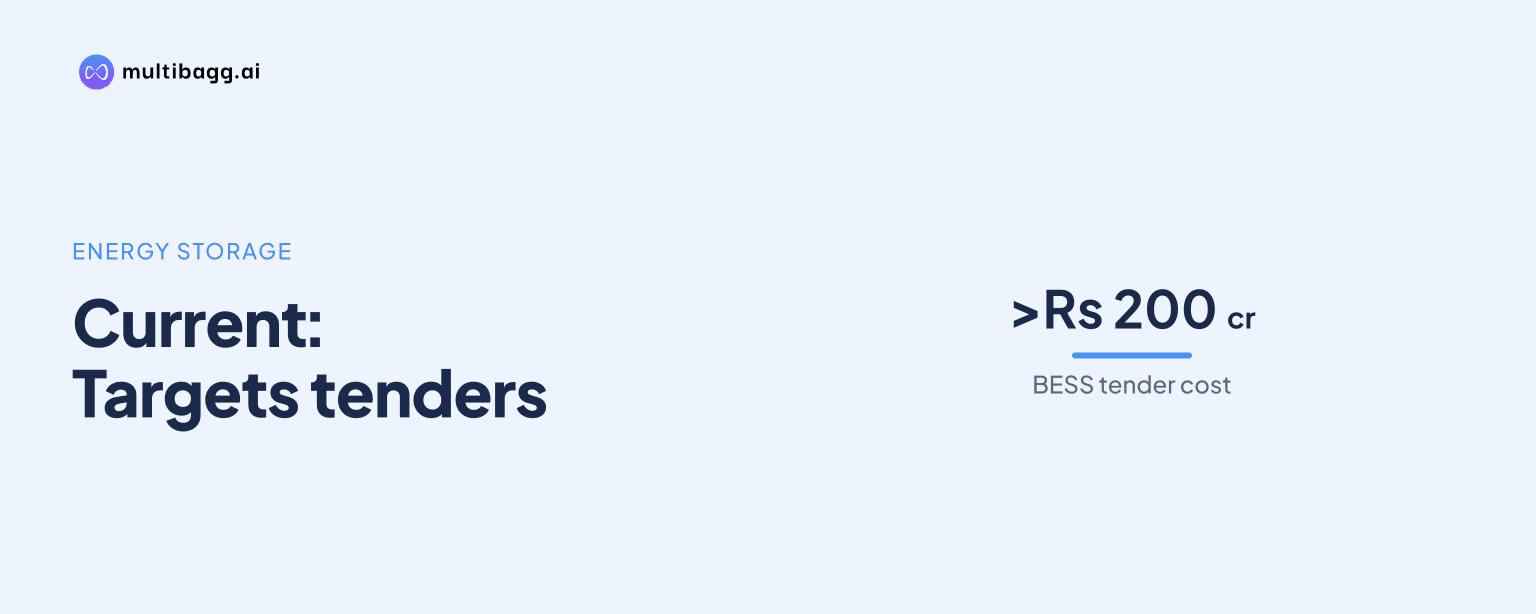
Current Infraprojects Limited is evaluating at least one of two active battery energy storage system, or BESS, tenders in Uttarakhand and Haryana, each costing more than Rs 200 crore, while awaiting its allocation under a roughly Rs 50 crore Lakshadweep empanelment. Management did not disclose a BESS award, bid date or revenue forecast.
Know Current Infraprojects inside out
Results, valuation, peers and who's buying, in one view.
What BESS opportunities is Current Infraprojects pursuing?
Current Infraprojects is pursuing a Lakshadweep BESS empanelment and is assessing active BESS tenders in Uttarakhand and Haryana. Management said the Lakshadweep empanelment was for roughly Rs 50 crore and termed it a confirmed order, but also said the company would have to see how much work was awarded to it. The call did not disclose the allocated value, execution period, billing terms or margin for Lakshadweep.
The Uttarakhand and Haryana opportunities are larger but less advanced. Management said each was an active tender costing more than Rs 200 crore and that it hoped to bid for at least one. It did not say that Current Infraprojects had submitted bids for either project, nor did it give qualification requirements, partnership arrangements or tender decision dates.
What is the difference between the three BESS opportunities?
The Lakshadweep item is at an empanelment stage, while the Uttarakhand and Haryana opportunities remain prospective tenders. Management’s statement that it must wait to see how much Lakshadweep work is awarded means the roughly Rs 50 crore figure does not establish Current Infraprojects’ eventual contract value. No BESS revenue, order-book addition or commissioning schedule was disclosed.
The two larger tenders together exceed Rs 400 crore in stated project cost, compared with Current Infraprojects’ disclosed order book of Rs 329 crore. However, management said it hoped to bid for at least one tender, rather than confirming participation in both. The combined tender value is therefore an indication of available opportunity size, not secured work or expected company revenue.
How does BESS compare with Current Infraprojects’ existing pipeline?
BESS is a new opportunity category alongside Current Infraprojects’ solar and electrical pipeline, which management placed at around Rs 400 crore to Rs 500 crore. More than Rs 200 crore of that broader pipeline was attributed to solar projects. Management did not say whether the Uttarakhand, Haryana or Lakshadweep BESS opportunities were included in the Rs 400 crore to Rs 500 crore figure, so the amounts cannot be added.
Management cited a 15% to 20% conversion rate from its last tender pipeline, but did not identify that rate as applicable to BESS. Separately, it said around 100 megawatts of solar projects were in bidding pipelines or expected to be bid in coming weeks, with a targeted success rate of 20% to 30%. Current Infraprojects provided no BESS-specific conversion target, capacity target or order-win probability.
Got a follow-up? Ask IRIS
What financial context did management provide for BESS expansion?
Current Infraprojects reported consolidated revenue of around Rs 53 crore for September 2026, comprising around Rs 50 crore from standalone books and around Rs 3 crore from consolidation. Management said around Rs 35 crore to Rs 40 crore of the standalone amount came from electrical and solar activities. A project costing more than Rs 200 crore would be sizable relative to that disclosed revenue period, although project cost does not indicate its duration or revenue-recognition pattern.
Management said its working-capital limits were around Rs 25 crore to Rs 30 crore, within combined limits of around Rs 50 crore that included fund-based and non-fund-based facilities. It said limits had increased by around Rs 16 crore for new projects. The call did not link those facilities to BESS, identify BESS funding requirements, or say whether battery-storage projects would be executed through engineering, procurement and construction, or EPC, contracts or a renewable energy service company model.
What BESS discussions does Current Infraprojects have with private companies?
Current Infraprojects said it was in touch with Hindustan Zinc and Vedanta regarding BESS installation at mines, as well as other private parties exploring BESS investment opportunities. Management did not disclose the capacity, value, project location, contracting route or timetable of these discussions. It also did not identify a private BESS order, letter of intent or bid submission.
Management named JSW, Suzlon, Vedanta and Meghmani among companies involved in BESS manufacturing or EPC partnerships, but did not disclose any contract or formal partnership between them and Current Infraprojects. Management also referred to BESS activity by Solar Energy Corporation of India, National Thermal Power Corporation and other public-sector entities. No award from those organisations to Current Infraprojects was disclosed on the call.
What could determine whether BESS becomes revenue for Current Infraprojects?
BESS could contribute revenue only if Lakshadweep allocates work to Current Infraprojects or if the company submits and wins a tender in Uttarakhand or Haryana. Management gave no date for Lakshadweep allocation and no award timetable for either tender. Its disclosed FY27 bidding framework was a profit after tax margin of 8% to 10% and a gross-margin range of 17% to 20%, but it did not assign these ranges to BESS.
Execution conditions and collections would also matter after any award. Management said its roughly Rs 100 crore rural distribution system scheme, or RDSS, orders were 23% to 25% complete and targeted around 60% completion by the end of March, subject to government funding availability and land access. That statement concerned RDSS rather than BESS, but it identifies funding and site availability as factors affecting parts of Current Infraprojects’ government-project execution.
Conclusion
Current Infraprojects has identified BESS as a potential growth avenue through a roughly Rs 50 crore Lakshadweep empanelment, two active public tenders above Rs 200 crore each, and private-sector discussions. The opportunity values are significant against the Rs 329 crore order book, but the disclosed stages range from empanelment to possible bidding, not fully allocated or awarded contracts.
The next items to watch are Lakshadweep’s allocation decision and whether management bids for, and wins, either the Uttarakhand or Haryana tender. Management also plans to complete its Rs 44 crore JVVNL rooftop-solar project by around April 10, 2027, targeting about 1,500 installations a month after already installing around 100 systems; future disclosures could show whether BESS awards become a separately identified part of the pipeline or order book.

