








Current Infraprojects FY26 revenue: 77.76% from Rajasthan
MAX Plan at ₹4,999/yr

Find your next multibaggerBe a Pro Investor
Research stocks and track your picks on the go. Download the app.
Key highlights
- Rajasthan contributed 77.76% of CAPL’s Rs 160.39 crore FY26 consolidated revenue.
- CAPL’s top five customers accounted for 75% of FY26 revenue, while its top 10 customers accounted for 90%.
- Rajasthan represented 59.15% of CAPL’s Rs 330 crore order book, while Kerala represented 27.66%.
- Solar EPC supplied 60% of FY26 revenue, while Water EPC made up 53.47% of the order book.
powered by IRIS
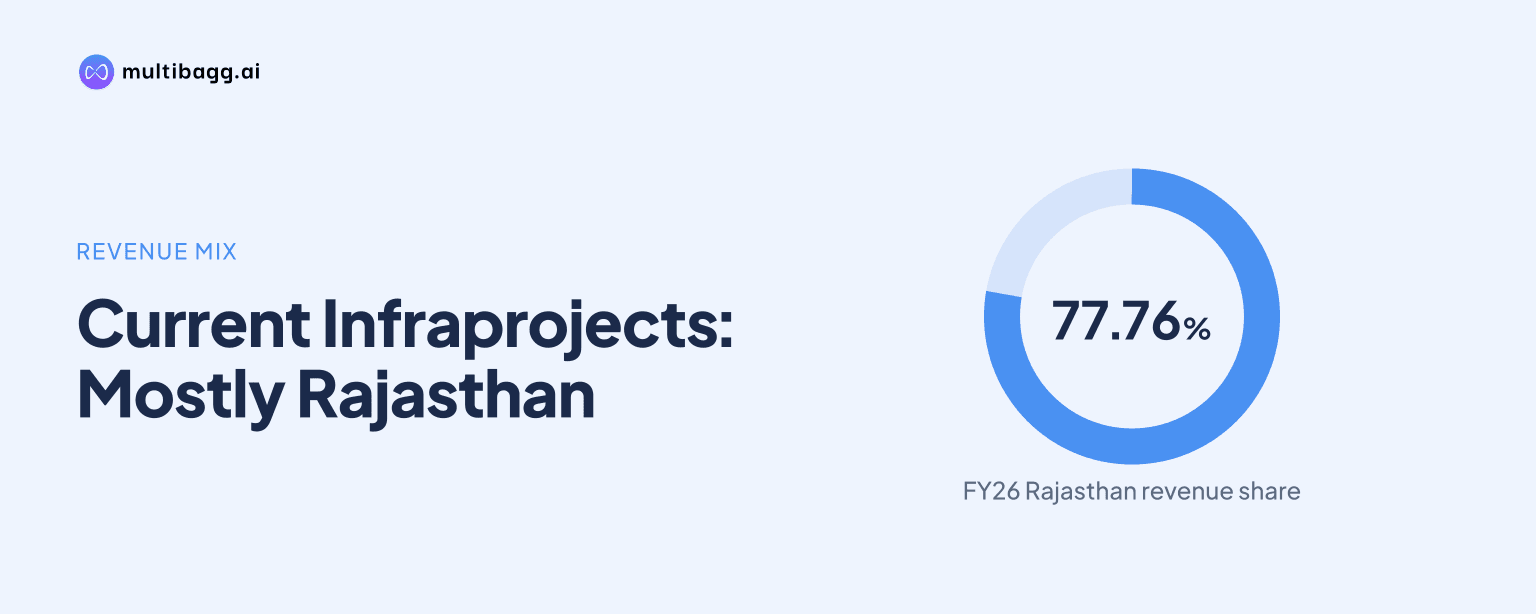
Current Infraprojects (CAPL) derived 77.76% of its Rs 160.39 crore FY26 consolidated revenue from Rajasthan, despite stating operations across 12 states. The concentration also extended to customers, with the top five accounting for 75% of FY26 revenue, while Rajasthan represented 59.15% of CAPL’s Rs 330 crore order book.
Know Current Infraprojects inside out
Results, valuation, peers and who's buying, in one view.
How dependent was CAPL on Rajasthan in FY26?
CAPL was highly dependent on Rajasthan in FY26, when the state contributed 77.76% of consolidated revenue, or about Rs 124.70 crore based on the reported Rs 160.39 crore total. Rajasthan’s contribution rose from 48.07% of Rs 90.88 crore FY25 consolidated revenue and 14.10% of Rs 77.57 crore FY24 standalone revenue.
The shift coincided with a rise in total reported revenue from Rs 90.88 crore in FY25 to Rs 160.39 crore in FY26. Rajasthan’s share increased by 29.69 percentage points from FY25, while Kerala’s contribution fell by 14.12 percentage points to 10.69% and West Bengal’s fell by 1.16 percentage points to 2.02%.
Kerala accounted for an implied Rs 17.14 crore of FY26 revenue, compared with an implied Rs 22.55 crore in FY25, despite the increase in total revenue. Gujarat was the only separately listed non-Rajasthan state whose share increased from FY25, reaching 5.56% in FY26 from 4.03%.
CAPL’s FY26 “Others” category was 3.97% and included Tripura, Haryana, Odisha, Karnataka, Jharkhand, Madhya Pradesh, Punjab and Andhra Pradesh. Uttar Pradesh and Maharashtra had separately reported shares of 8.33% and 2.26%, respectively, in FY25, but no separate FY26 percentage in the presentation.
Does CAPL’s reported footprint match its revenue spread?
CAPL states that it operates across 12 states, but the geographic-presence page lists 13 names: Punjab, Haryana, Rajasthan, Gujarat, Madhya Pradesh, Uttar Pradesh, Jharkhand, West Bengal, Maharashtra, Orissa, Andhra Pradesh, Karnataka and Tamil Nadu. The presentation does not reconcile the difference between the stated count and the list, or the use of “Orissa” there and “Odisha” in the FY26 revenue note.
Its completed-project examples span more than one geography, including a 1.9-megawatt ground-mounted solar photovoltaic plant, highway lighting on the Ramanbore-to-Garamore section of National Highways 8A and 8B in Gujarat, a toll-plaza building in Gujarat, and pipeline replacement work in Uttar Pradesh. CAPL does not disclose contract values or completion dates for those examples.
CAPL says it owns more than 100 equipment units across categories, including 172 testing-equipment units and 27 tools-and-machinery units. It reports that more than 80% of equipment is owned and says this supports parallel execution across states; management also cites 15% to 20% faster execution versus peers, without supplying a period-specific comparison.
The presentation therefore documents activity outside Rajasthan but not a proportionate revenue contribution from those markets in FY26. The eight states grouped in “Others” together supplied 3.97% of revenue, while Rajasthan alone supplied 77.76%.
Got a follow-up? Ask IRIS
How concentrated are CAPL’s customers and order book?
CAPL’s customer base was concentrated in FY26: its top five customers contributed 75% of revenue and its top 10 customers contributed 90%. The presentation identifies clients including the Ministry of Railways, National Hydroelectric Power Corporation, Jaipur Vidyut Vitran Nigam Limited, THDC India Limited, Welspun, GR Infraprojects and Shivalaya, but does not disclose each customer’s revenue share.
Business-to-business, or B2B, revenue represented 85.48% of FY26 revenue, compared with 83.50% in FY25 and 91.64% in FY24. Business-to-government, or B2G, contributed 14.25% in FY26 versus 16.21% in FY25, while business-to-consumer, or B2C, was 0.26%, compared with 0.29% a year earlier.
Rajasthan accounted for 59.15% of the Rs 330 crore order book, equivalent to about Rs 195.20 crore, and Kerala represented 27.66%, or about Rs 91.28 crore. Tamil Nadu accounted for 3.44%, while 9.75% was classified as others, including Maharashtra, Tamil Nadu, Goa, Uttar Pradesh and Gujarat; the presentation does not explain Tamil Nadu appearing both separately and in that note.
The order book had 60.79% unexecuted orders and 39.21% executed orders. Water engineering, procurement and construction, or Water EPC, was the largest order-book segment at 53.47%, whereas solar engineering, procurement and construction, or Solar EPC, was CAPL’s largest FY26 revenue segment at 60%.
What changed in CAPL’s revenue mix and stated plans?
CAPL’s FY26 revenue mix moved decisively toward Solar EPC, which contributed 60%, up from 27.04% in FY25 and 12.99% in FY24. Electrical EPC declined to 20.44% from 56.50%, while Water EPC declined to 9.31% from 13.15%; other activities represented 10.25% in FY26.
This revenue mix differed from the pipeline composition, where Water EPC represented 53.47% of the Rs 330 crore order book and Solar EPC represented 32.59%. That difference shows that the disclosed order book was more weighted to water projects than the FY26 revenue base, although CAPL gives no execution or revenue-recognition schedule for individual orders.
CAPL says 98% of FY26 revenue was driven by engineering, procurement and construction, or EPC, contracts. Management describes EPC revenue as project-based and working-capital intensive, and states that it plans to expand Renewable Energy Service Company, or RESCO, operations to build an annuity-based revenue model through asset ownership.
CAPL incorporated four special purpose vehicles, or SPVs, for RESCO projects in FY25: Ompura, Bolnada, Talabera and Dhanbad. The first three have 2,520 kilowatts each and power purchase agreements dated September 25, 2024 with Rajasthan Urja Vikas and IT Services Ltd, at tariffs of Rs 3.357, Rs 3.357 and Rs 3.363, respectively; the 1,800-kilowatt Dhanbad project has a March 12, 2025 agreement with Indian Institute of Technology, Indian School of Mines, at Rs 4 per unit.
Management says Rs 5.85 crore of initial public offering utilisation is allocated to wholly owned subsidiary Current Infra Dhanbad Solar Private Limited for the 1,800-kilowatt Dhanbad plant. CAPL also lists an Rs 44.76 crore Jaipur Vidyut Vitran Nigam Limited order for 8,000 rooftop solar plants and an Rs 100 crore Revamped Distribution Sector Scheme order for electrical utility and shifting works.
Conclusion
CAPL’s FY26 disclosures show geographic and customer concentration alongside a wider reported operating footprint. Rajasthan supplied 77.76% of Rs 160.39 crore revenue and represented 59.15% of the Rs 330 crore order book, while five customers supplied 75% of revenue; meanwhile, the order book’s 53.47% Water EPC weighting differed from Solar EPC’s 60% FY26 revenue share.
The next points to watch are execution of the 60.79% unexecuted order book, including the Rs 100 crore distribution-sector order and Rs 44.76 crore rooftop-solar order. Management’s stated plan to reduce regional dependency and add recurring RESCO income will depend on delivery through its four SPVs, including the 1,800-kilowatt Dhanbad project supported by Rs 5.85 crore of planned initial public offering utilisation.

