








Current Infraprojects has 9.36 MW solar PPAs, targets annuities
MAX Plan at ₹4,999/yr

Find your next multibaggerBe a Pro Investor
Research stocks and track your picks on the go. Download the app.
Key highlights
- CAPL has four RESCO SPVs with solar PPAs totalling 9.36 MW.
- Three Rajasthan RESCO projects total 7.56 MW and have PPAs dated September 25, 2024.
- CAPL allocated Rs 5.85 crore of IPO utilisation to the 1.80 MW IIT (ISM) Dhanbad solar project.
- EPC contracts contributed 98% of CAPL’s FY26 revenue of Rs 160.39 crore.
powered by IRIS
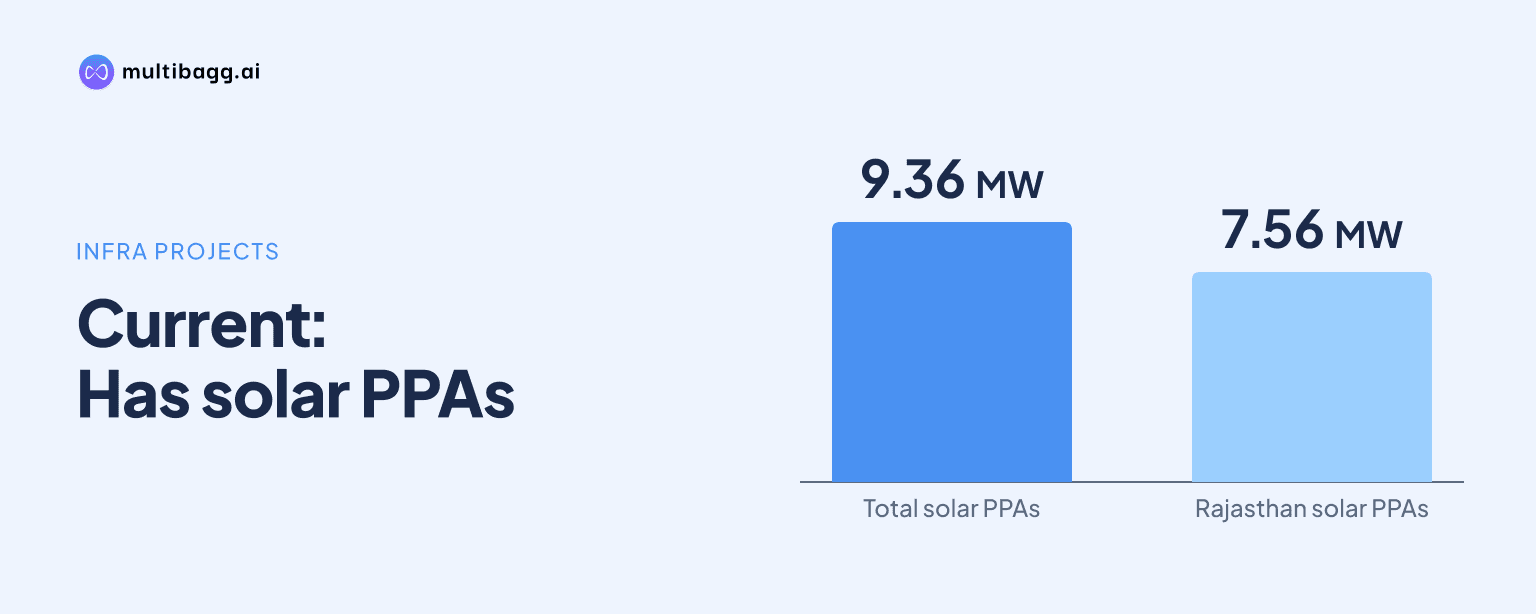
Current Infraprojects has four Renewable Energy Service Company, or RESCO, special-purpose vehicles holding 9.36 megawatts of solar power-purchase agreements, or PPAs, as it targets annuity-based income alongside EPC contracts that contributed 98% of FY26 revenue. The portfolio includes a 1.80 MW IIT (ISM) Dhanbad project allocated Rs 5.85 crore of IPO proceeds.
Know Current Infraprojects inside out
Results, valuation, peers and who's buying, in one view.
How large is CAPL’s RESCO solar portfolio?
CAPL’s four RESCO special-purpose vehicles, or SPVs, hold PPAs for 9,360 kilowatts, equivalent to 9.36 MW, according to the presentation. Three SPVs, Ompura, Bolnada and Talabera, each have 2,520 KW projects awarded by Rajasthan Urja Vikas and IT Services Ltd, while Dhanbad has a 1,800 KW project awarded by Indian Institute of Technology (Indian School of Mines), or IIT (ISM).
The three Rajasthan projects account for 7.56 MW, or about 81% of the stated 9.36 MW capacity. Their PPAs are dated September 25, 2024, while the Dhanbad PPA is dated March 12, 2025. CAPL says the four SPVs were incorporated in FY25 to execute and hold RESCO assets, under a structure in which it handles investment, procurement, installation and operations and maintenance.
How does CAPL’s RESCO model differ from EPC work?
CAPL describes RESCO as an asset-ownership model intended to provide annuity-based, recurring revenue and long-term cash-flow visibility. In contrast, its engineering, procurement and construction, or EPC, business recognises revenue project by project and is described by management as working-capital intensive, with margins dependent on execution efficiency.
The change remains at an early stage in the disclosed revenue mix because CAPL says EPC contracts generated 98% of FY26 revenue. The company had FY26 revenue of Rs 160.39 crore, of which solar EPC contributed Rs 95.90 crore, or 60%, while electrical EPC contributed Rs 32.72 crore, or 20.44%. The RESCO SPVs therefore add an ownership model to an operating base still dominated by project execution.
The four PPAs show tariff rates from Rs 3.36 to Rs 4.00, with Dhanbad carrying the highest stated rate. However, the presentation does not disclose PPA tenure, annual electricity generation, commissioning dates, financing terms or expected revenue for any SPV. Those omissions mean the annual income from the 9.36 MW portfolio cannot be calculated from the presentation.
What does the IIT (ISM) Dhanbad project involve?
CAPL has allocated Rs 5.85 crore of IPO utilisation to a wholly owned subsidiary identified as Current Infra Dhanbad Solar Private Limited for development of an 1,800 KW solar plant under the RESCO model at IIT (ISM), Dhanbad. The SPV table identifies the related project entity as Current Infraprojects Dhanbad Solar Private Limited and gives its PPA date as March 12, 2025.
At 1.80 MW, Dhanbad is 0.72 MW smaller than each of the three 2.52 MW Rajasthan projects. Its stated PPA tariff rate is Rs 4.00, compared with Rs 3.36 for Ompura, Bolnada and Talabera. CAPL does not state whether the Rs 5.85 crore allocation represents the full development cost, the remaining funding need, or the plant’s operating status.
The project also gives the portfolio one named institutional counterparty, while the other 7.56 MW is awarded by Rajasthan Urja Vikas and IT Services Ltd. The disclosed concentration remains substantial: three projects have identical 2.52 MW capacities and the same September 2024 PPA date, whereas Dhanbad is the sole 1.80 MW project with a March 2025 PPA.
Got a follow-up? Ask IRIS
How dependent is CAPL on EPC revenue?
CAPL remains primarily dependent on EPC work, with 98% of FY26 revenue attributed to EPC contracts. Solar EPC became the largest reported segment, contributing 60% of FY26 consolidated revenue of Rs 160.39 crore, ahead of electrical EPC at 20.44%, water EPC at 9.31% and other activities at 10.25%.
The segment mix changed sharply from FY25, when solar EPC was 27.04% of consolidated revenue of Rs 90.88 crore and electrical EPC was 56.50%. By FY26, solar EPC’s share had increased by 32.96 percentage points while electrical EPC’s share had declined by 36.06 percentage points. This change reflects reported solar EPC execution rather than disclosed income from owned RESCO assets.
CAPL also reported an order book of Rs 330 crore, with 60.79% unexecuted when presented. Water EPC represented 53.47% of the order book, ahead of solar EPC at 32.59%, electrical EPC at 10.22% and civil EPC, including gas pipeline, at 3.71%. That pipeline indicates that EPC activity remains central even as the company develops owned solar assets.
What operational base supports CAPL’s solar expansion?
CAPL cites 10 MW of installed solar power plants and an ongoing Rs 44.76 crore JVVNL order for 8,000 rooftop solar plants under the PM Surya Ghar Yojana. These disclosures demonstrate solar project-delivery activity, but the presentation does not say how much of the 9.36 MW RESCO portfolio has been installed, commissioned or started supplying electricity.
CAPL’s FY26 revenue was geographically concentrated in Rajasthan, which contributed 77.76%, up from 48.07% in FY25. Kerala’s share fell to 10.69% from 24.81% over the same period. The concentration overlaps with the RESCO portfolio because three of four SPVs, representing 7.56 MW, were awarded by Rajasthan Urja Vikas and IT Services Ltd.
Management says it plans to scale solar operations across states using the RESCO model, while also reducing regional dependency through geographic diversification. It also plans to strengthen roads and highways EPC work, enhance in-house integration and upgrade ERP-SAP systems. The presentation provides no stated target for future RESCO capacity, number of SPVs or timetable for expansion.
Conclusion
CAPL has established a defined initial solar-ownership platform through four SPVs with 9.36 MW of PPA-backed capacity and stated tariff rates between Rs 3.36 and Rs 4.00. The strategy adds potential recurring income to an EPC-led business, but reported FY26 activity remained overwhelmingly based on contract execution, with EPC contributing 98% of Rs 160.39 crore revenue.
The next disclosed milestones to watch are development of the 1.80 MW IIT (ISM) Dhanbad project supported by Rs 5.85 crore of IPO allocation and progress on the three 2.52 MW Rajasthan projects. Management has stated an intention to scale RESCO solar operations across states, but commissioning dates, generation estimates, PPA terms and a future capacity target remain undisclosed.

