










Dabur Q2 FY27 revenue rises 11.6% as international sales grow
Key highlights
- Dabur’s Q2 FY27 consolidated revenue rose 11.6% to Rs 3,563 crore.
- Dabur’s international portfolio grew 20.0% to Rs 1,091 crore in Q2 FY27.
- Dabur’s food and beverages revenue increased 17.4% to Rs 379 crore.
- Dabur’s consolidated operating-profit margin declined by 60 basis points while operating profit grew 7.5%.
powered by IRIS
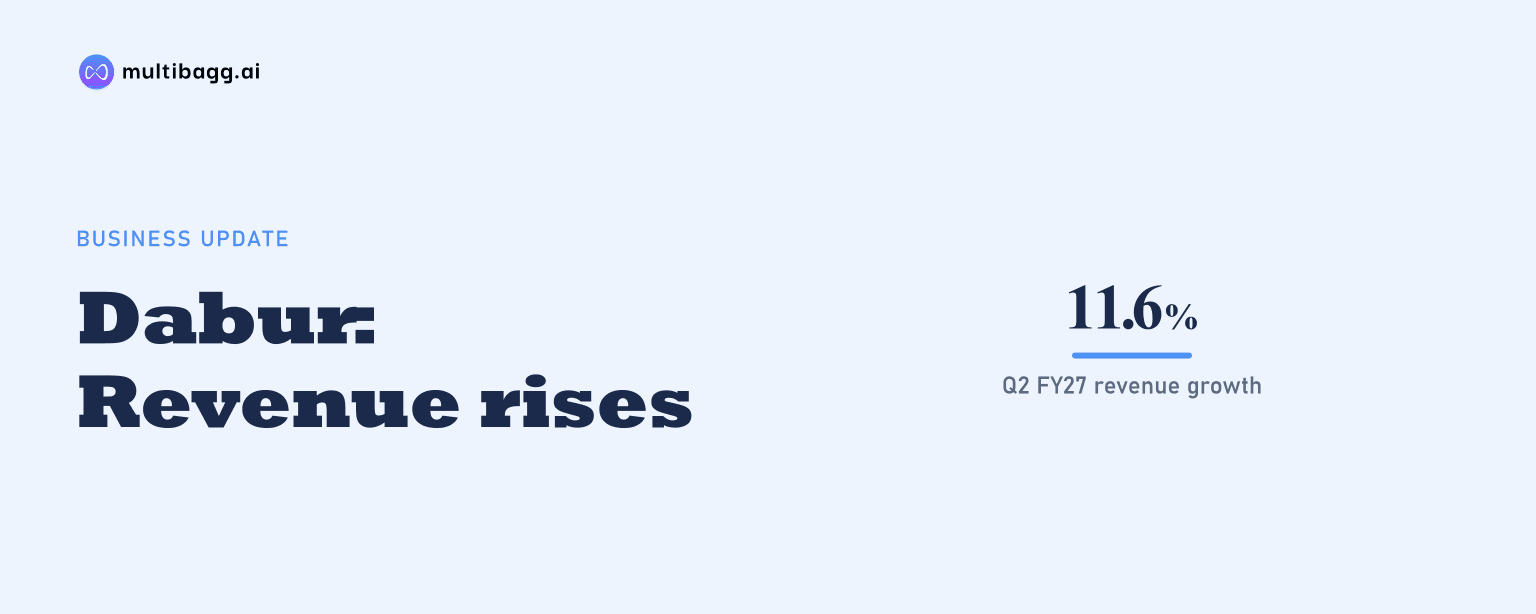
Dabur reported Q2 FY27 consolidated revenue of Rs 3,563 crore, up 11.6%, with international portfolio revenue rising 20.0% to Rs 1,091 crore. Consolidated operating profit increased 7.5% to Rs 632 crore, but operating-profit margin declined by 60 basis points, while profit after tax rose 11.7% to Rs 505 crore.
Know Dabur India inside out
Results, valuation, peers and who's buying, in one view.
What were Dabur’s Q2 FY27 consolidated results?
Dabur’s consolidated revenue rose 11.6% to Rs 3,563 crore in Q2 FY27, while operating profit increased 7.5% to Rs 632 crore and profit after tax rose 11.7% to Rs 505 crore. The company reported that consolidated operating-profit margin declined by 60 basis points, meaning operating-profit growth trailed revenue growth during the quarter.
Dabur’s India standalone revenue increased 8.9% to Rs 2,433 crore, below the consolidated revenue growth rate of 11.6%. India standalone operating profit rose 8.2% to Rs 459 crore and profit after tax grew 11.2% to Rs 388 crore; its operating-profit margin declined by 10 basis points, compared with the 60-basis-point decline reported on a consolidated basis.
Which businesses drove Dabur’s Q2 FY27 growth?
Dabur’s international portfolio was the fastest-growing reported business, with revenue up 20.0% to Rs 1,091 crore in Q2 FY27. The presentation identifies international business as 30% of the reported business mix, and its growth rate was 8.4 percentage points above the 11.6% rise in consolidated revenue.
Dabur’s food and beverages business was the fastest-growing disclosed domestic segment, rising 17.4% to Rs 379 crore. Home and personal care generated the largest domestic segment revenue at Rs 1,245 crore and grew 10.9%, while healthcare generated Rs 645 crore and grew 6.9%.
India fast-moving consumer goods revenue increased 10.7%, including volume growth of 5.5%. Dabur said this represented sequential improvement, but the presentation does not disclose prior-quarter India fast-moving consumer goods revenue or volume figures, and it does not provide a separate price or mix contribution.
Got a follow-up? Ask IRIS
How did Dabur’s profit growth compare with revenue growth?
Dabur’s consolidated operating profit grew 7.5%, which was slower than its 11.6% revenue growth, alongside the reported 60-basis-point operating-profit margin decline. Profit after tax grew 11.7% to Rs 505 crore, but the presentation does not disclose gross margin, tax rate, operating-profit margin percentage or the cost items behind the margin movement.
Dabur’s India standalone business showed a narrower gap between revenue and operating-profit growth than the consolidated business. Revenue rose 8.9% and operating profit increased 8.2%, with a 10-basis-point margin decline; profit after tax rose 11.2% to Rs 388 crore, although the presentation does not explain why profit after tax grew faster than operating profit.
The reported segment comparison shows that international portfolio growth of 20.0% exceeded India fast-moving consumer goods growth of 10.7% by 9.3 percentage points. Food and beverages growth of 17.4% also exceeded home and personal care growth of 10.9% and healthcare growth of 6.9%, while the presentation provides no segment-level profit figures.
What operating actions did Dabur outline under IGNITE?
Dabur presented four IGNITE focus areas: accelerate growth, execution excellence, a future-ready portfolio and operational efficiencies. The framework displays a 23% premium portfolio, 1.5 times cost savings and a 150-basis-point AdPro measure, but it does not provide a base period, rupee savings value, definition of AdPro or completion date for these measures.
Dabur named Saksham as an initiative to lower cost to serve, Samriddhi as an effort to increase cost savings and operating efficiencies, and IRIS as a supply-chain efficiency programme. It said general trade recorded mid- to high-single-digit growth on the back of continued Saksham efforts, without disclosing an exact growth rate or a quantified saving from the programme.
Dabur also reported a sequential recovery in the beverage category, which recorded mid-teens growth, while alternate channels continued to deliver double-digit growth. Its digital initiatives include a social-listening dialogue hub, artificial-intelligence-led influencer discovery intended to reduce cost per view in line with industry, and artificial-intelligence-led media planning and execution; no financial effect was disclosed for these initiatives.
Conclusion
Dabur’s Q2 FY27 performance combined 11.6% consolidated revenue growth with 20.0% growth in international portfolio revenue and 17.4% growth in food and beverages. India fast-moving consumer goods revenue rose 10.7%, including 5.5% volume growth, but consolidated operating-profit growth of 7.5% lagged revenue growth and operating-profit margin declined by 60 basis points.
The next update can show whether Dabur’s stated IGNITE agenda delivers progress on the displayed 1.5 times cost-savings measure, 23% premium portfolio and 150-basis-point AdPro measure. It can also clarify whether the reported mid-teens beverage recovery, mid- to high-single-digit general-trade growth and double-digit alternate-channel growth continue, as Q2 FY27 included no quantified future targets or dates for those operating trends.