










Dabur India operating cash flow drops to Rs 709.37 crore
Key highlights
- Dabur India’s operating cash flow was Rs 709.37 crore in the half year ended 30 September 2026, down from Rs 756.59 crore a year earlier.
- Trade receivables absorbed Rs 344.52 crore of cash and closed at Rs 1,060.30 crore on 30 September 2026.
- Inventories used Rs 63.19 crore of cash and rose to Rs 2,384.82 crore from Rs 2,321.63 crore at 31 March 2026.
- Dabur India’s outstanding debt was Rs 1,444.67 crore at 30 September 2026, compared with Rs 2,328.71 crore in the preceding quarter.
powered by IRIS
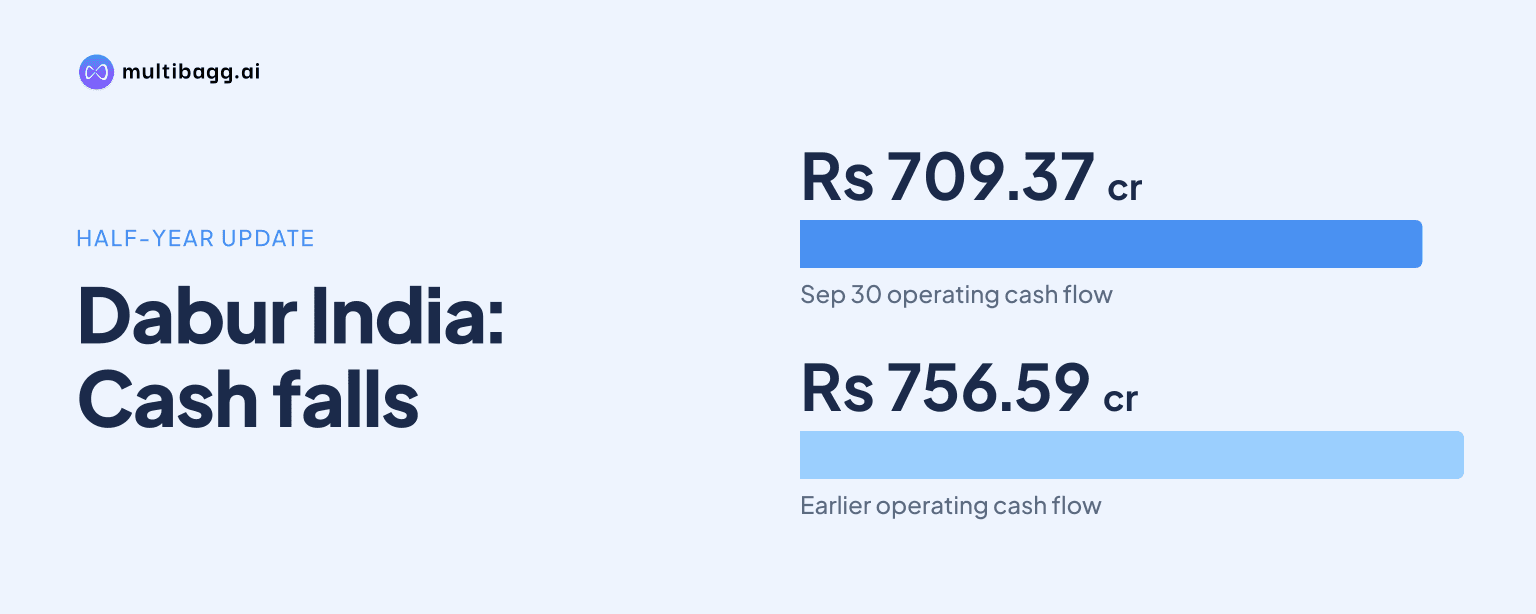
Dabur India Limited reported net cash flow from operating activities of Rs 709.37 crore for the half year ended 30 September 2026, down from Rs 756.59 crore a year earlier, as trade receivables absorbed Rs 344.52 crore, inventories used Rs 63.19 crore and direct taxes paid rose to Rs 251.85 crore.
Know Dabur India inside out
Results, valuation, peers and who's buying, in one view.
Why did Dabur India’s operating cash flow decline?
Dabur India’s operating cash flow declined because higher working-capital outflows and tax payments outweighed profit growth. Operating profit before working-capital changes was Rs 1,365.26 crore in the half year ended 30 September 2026, marginally below Rs 1,367.59 crore in the corresponding 2025 half year, while cash flow after working-capital changes increased to Rs 961.22 crore from Rs 954.29 crore.
Direct taxes paid, net of refunds, rose to Rs 251.85 crore from Rs 197.70 crore, reducing net operating cash flow to Rs 709.37 crore. Consolidated profit before tax increased to Rs 1,401.17 crore from Rs 1,235.64 crore, showing that the decline in cash flow occurred despite a Rs 165.53 crore increase in reported pre-tax profit.
The company prepared the consolidated cash-flow statement using the indirect method under Indian Accounting Standard 7, or Ind AS 7. Under this approach, non-cash items and changes in assets and liabilities are adjusted against profit, which is why the Rs 344.52 crore receivables movement and Rs 63.19 crore inventory movement affected operating cash generation.
How did receivables and inventories affect Dabur India’s cash flow?
Trade receivables were Dabur India’s largest identified working-capital cash use, absorbing Rs 344.52 crore during the September 2026 half year compared with Rs 323.72 crore in the previous corresponding period. Trade receivables on the balance sheet increased to Rs 1,060.30 crore at 30 September 2026 from Rs 715.41 crore at 31 March 2026.
The debtors turnover ratio was 12.15 at 30 September 2026, compared with 15.84 in the preceding quarter ended 30 June 2026 and 11.53 in the corresponding quarter a year earlier. The filing defines this measure as sales of products divided by average trade receivables, providing a separate reported indicator alongside the closing receivables balance.
Inventories consumed Rs 63.19 crore of cash in the September 2026 half year, whereas they generated Rs 22.91 crore in the corresponding 2025 half year. Closing inventories rose to Rs 2,384.82 crore at 30 September 2026 from Rs 2,321.63 crore at 31 March 2026, while inventory turnover increased to 15.20 from 13.83 a year earlier.
Other current and non-current assets used Rs 108.90 crore of cash, against a Rs 47.77 crore source of cash in the prior-year half. Other current assets stood at Rs 723.25 crore at 30 September 2026, up from Rs 643.86 crore at 31 March 2026, and current and non-current financial assets absorbed a further Rs 23.72 crore.
Got a follow-up? Ask IRIS
Did profit growth translate into higher cash generation for Dabur India?
No, Dabur India’s higher reported profit did not result in higher net operating cash flow during the half year. Net profit rose to Rs 1,084.73 crore from Rs 953.08 crore, while operating cash flow fell by Rs 47.22 crore to Rs 709.37 crore as receivables, inventories, other assets and taxes absorbed cash.
Several indirect-method adjustments also changed year on year. Depreciation and amortisation added back to operating cash flow increased to Rs 240.09 crore from Rs 229.54 crore, while interest income deducted from the cash-flow calculation rose to Rs 210.38 crore from Rs 184.43 crore. Share-based payment expense was Rs 26.03 crore, compared with a Rs 1.65 crore reversal in the previous corresponding half year.
Dabur India generated Rs 138.21 crore from investing activities, compared with an outflow of Rs 18.43 crore a year earlier. It purchased investments and bank deposits worth Rs 6,979.34 crore and received Rs 7,036.68 crore from sales of investments and bank deposits; expenditure on property, plant and equipment, capital work-in-progress and intangible assets was Rs 159.82 crore.
Financing activities used Rs 972.50 crore, including Rs 975.67 crore of dividend payments and a net Rs 128.63 crore repayment of current borrowings. Cash and cash equivalents in the consolidated cash-flow statement ended at Rs 48.99 crore, compared with Rs 203.70 crore at 30 September 2025, after a Rs 124.92 crore decrease during the half year.
What changed in Dabur India’s debt and liquidity position?
Dabur India’s disclosed outstanding debt was Rs 1,444.67 crore at 30 September 2026, down from Rs 2,328.71 crore in the preceding quarter and Rs 1,537.03 crore at 31 March 2026. The debt-equity ratio was 0.13, compared with 0.20 at 30 June 2026 and 0.14 at the March 2026 year-end.
The total-debt-to-total-assets ratio declined to 8.08% from 12.19% in the June quarter, though it was above 7.80% in the corresponding September 2025 quarter. Non-current borrowings fell to Rs 6.17 crore at 30 September 2026 from Rs 15.96 crore at 31 March 2026, while current borrowings increased to Rs 1,235.73 crore from Rs 1,046.72 crore.
Current assets increased to Rs 9,178.03 crore at 30 September 2026 from Rs 8,885.96 crore at 31 March 2026. Current liabilities also rose, to Rs 5,615.49 crore from Rs 5,239.08 crore, and the current ratio, defined as current assets divided by current liabilities, was 1.63 compared with 1.70 at 31 March 2026.
Total equity was Rs 11,863.97 crore at 30 September 2026, compared with Rs 11,802.75 crore at the March year-end. Consumer care accounted for Rs 6,453.59 crore of segment assets, food accounted for Rs 1,837.78 crore and unallocated assets were Rs 9,380.81 crore, taking total assets to Rs 17,869.03 crore.
Conclusion
Dabur India’s September-half cash flow shows that profit growth and operating cash generation moved in different directions. Pre-tax profit increased to Rs 1,401.17 crore and net profit reached Rs 1,084.73 crore, but operating cash flow declined to Rs 709.37 crore as receivables, inventories, other assets and higher tax payments consumed cash. The disclosed debt measures improved from the preceding quarter, with outstanding debt at Rs 1,444.67 crore and the debt-equity ratio at 0.13.
The next disclosed cash event is an interim dividend of Rs 3.50 per share, aggregating Rs 620.88 crore, declared by the board on 4 November 2026 with 10 November 2026 set as the record date. Dabur India also disclosed that the National Company Law Tribunal approved the amalgamation of Sesa Care Private Limited with the company on 24 September 2026; the amalgamation becomes effective when the certified order is filed with the Registrar of Companies, with an appointed date of 1 April 2026.