










Dabur food outgrew consumer care but margin remained lower
Key highlights
- Dabur food revenue rose 14.1% year on year to Rs 531.38 crore in the quarter ended 30 September 2026.
- Dabur consumer care revenue increased 11.4% year on year to Rs 2,953.29 crore in the September 2026 quarter.
- Dabur food’s calculated segment margin was 12.0%, compared with 22.3% for consumer care.
- Dabur food revenue fell 19.4% from Rs 659.33 crore in the preceding quarter.
powered by IRIS
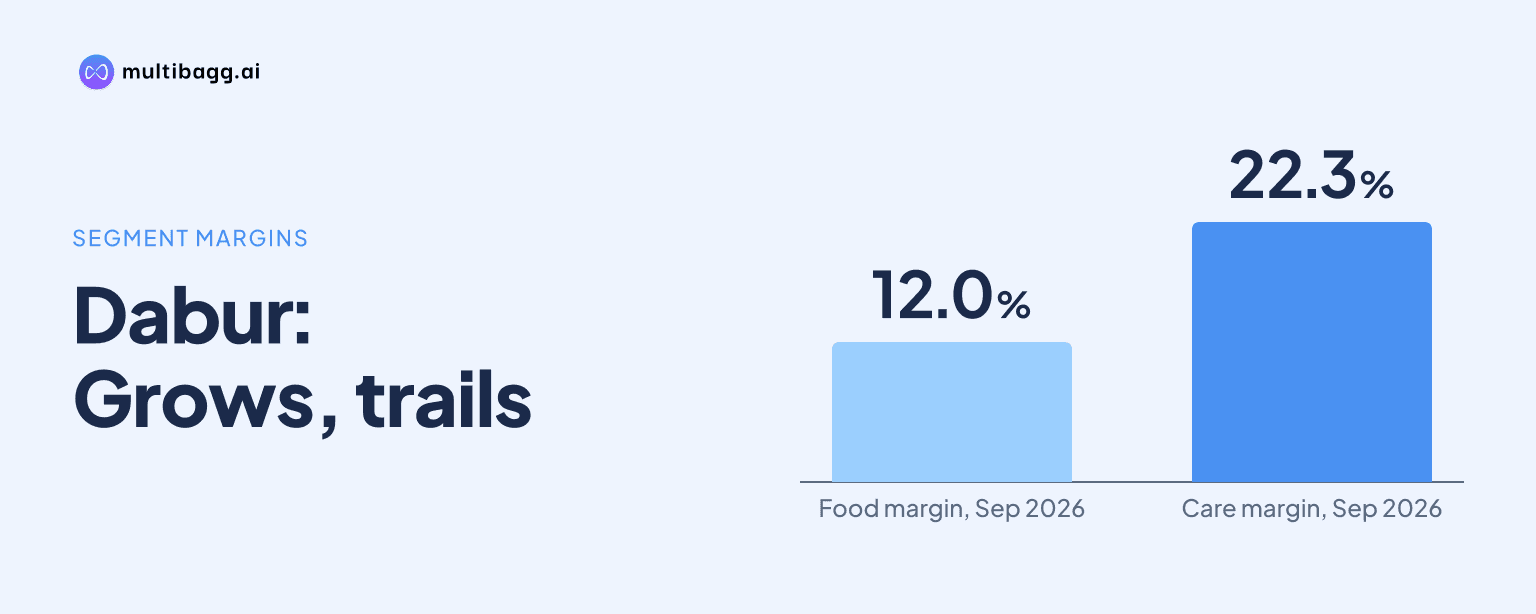
Dabur’s food business revenue rose 14.1% year on year to Rs 531.38 crore in the quarter ended 30 September 2026, exceeding consumer care’s 11.4% growth, but its calculated segment profit margin was 12.0%, compared with 22.3% for consumer care.
Know Dabur India inside out
Results, valuation, peers and who's buying, in one view.
How fast did Dabur’s food business grow in the September quarter?
Dabur’s food business grew faster than consumer care year on year in the quarter ended 30 September 2026. Food revenue increased by Rs 65.54 crore to Rs 531.38 crore from Rs 465.84 crore in the corresponding quarter of 2025, a 14.1% rise. Consumer care revenue increased by Rs 302.48 crore to Rs 2,953.29 crore from Rs 2,650.81 crore, or 11.4%.
Food remained substantially smaller than consumer care despite the faster percentage growth. Dabur’s total revenue from operations rose 11.6% to Rs 3,563.07 crore from Rs 3,191.32 crore. Food represented 14.9% of operating revenue in the September 2026 quarter, up from 14.6% a year earlier, while consumer care represented 82.9%, compared with 83.1% in the corresponding quarter.
Did Dabur food revenue fall from the previous quarter?
Yes, Dabur food revenue declined sequentially to Rs 531.38 crore in the quarter ended 30 September 2026 from Rs 659.33 crore in the preceding quarter ended 30 June 2026. The Rs 127.95 crore decrease was 19.4%, whereas consumer care revenue fell 1.6%, or Rs 47.45 crore, to Rs 2,953.29 crore from Rs 3,000.74 crore.
Dabur’s total revenue from operations also declined sequentially, to Rs 3,563.07 crore from Rs 3,764.39 crore. Food’s share of operating revenue consequently decreased to 14.9% from 17.5% in the June 2026 quarter. The filing reports the movement in food revenue but does not disclose an operational reason for the quarter-on-quarter decline.
For the half year ended 30 September 2026, food revenue rose 9.6% to Rs 1,190.71 crore from Rs 1,086.70 crore in the corresponding half year. Consumer care revenue rose 11.2% to Rs 5,954.03 crore from Rs 5,355.73 crore. Food therefore outgrew consumer care in the September quarter, but not across the six-month period.
What was Dabur food’s calculated segment margin?
Dabur food’s calculated segment margin was 12.0% in the quarter ended 30 September 2026, based on its reported segment result of Rs 63.86 crore divided by revenue of Rs 531.38 crore. Consumer care’s calculated margin was 22.3%, based on a Rs 658.86 crore segment result and Rs 2,953.29 crore of revenue, leaving a 10.3-percentage-point difference.
Food’s segment result increased 12.8% from Rs 56.62 crore in the corresponding 2025 quarter, below its 14.1% revenue increase. Its calculated margin was therefore slightly below the 12.2% implied by the prior-year result and revenue. Consumer care’s segment result rose 10.7% from Rs 595.18 crore, while its calculated margin decreased from 22.5% to 22.3%.
Got a follow-up? Ask IRIS
How did food profitability compare with Dabur’s consolidated results?
Dabur reported total segment results of Rs 726.06 crore for the September 2026 quarter, up from Rs 655.46 crore a year earlier. Consumer care contributed Rs 658.86 crore, or 90.7% of the segment-result subtotal, while food contributed Rs 63.86 crore, or 8.8%. Retail reported a Rs 1.86 crore segment loss, improved from a Rs 2.70 crore loss a year earlier.
The segment subtotal was reduced by finance costs of Rs 39.59 crore, unallocable expenditure net of unallocable income of Rs 18.78 crore, and Rs 21.87 crore of amortisation of intangible assets recognised on consolidation. Profit before share of loss from the joint venture, exceptional items and tax was Rs 645.82 crore, compared with Rs 573.12 crore a year earlier, while net profit was Rs 498.57 crore versus Rs 444.79 crore.
Dabur’s consolidated operating margin, under the filing’s stated definition, was 17.75% in the September 2026 quarter, down from 18.43% a year earlier and 19.69% in the preceding quarter. This measure is not directly comparable with the calculated food and consumer-care margins because the segment-result subtotal is presented before specified finance, unallocable and consolidation-related items.
What changed in Dabur food assets and liabilities?
Dabur reported food segment assets of Rs 1,837.78 crore at 30 September 2026, down from Rs 1,904.33 crore a year earlier and Rs 1,919.26 crore at 30 June 2026. The balance was therefore Rs 66.55 crore lower year on year and Rs 81.48 crore lower sequentially. Consumer care assets rose to Rs 6,453.59 crore from Rs 5,859.40 crore a year earlier.
Food segment liabilities were Rs 908.06 crore at 30 September 2026, compared with Rs 848.20 crore a year earlier and Rs 987.03 crore at 30 June 2026. Consumer care liabilities were Rs 2,696.06 crore, up from Rs 2,272.39 crore in the corresponding 2025 quarter. The segment disclosures identify assigned assets and liabilities but do not state the operational drivers of the food balance movements.
Conclusion
Dabur’s September-quarter segment disclosure shows food delivering faster year-on-year revenue growth than consumer care, while retaining a substantially lower calculated segment margin. Food added Rs 65.54 crore of revenue and Rs 7.24 crore of segment result from the corresponding quarter, but its 12.0% calculated margin remained below consumer care’s 22.3%.
The next item to watch is whether subsequent segment disclosures explain or reverse food’s sequential revenue decline of Rs 127.95 crore from the June 2026 quarter, and whether segment result growth again trails revenue growth. The filing provides no food revenue or margin target and no stated explanation for the quarterly revenue movement, leaving future reported segment figures as the disclosed basis for assessing those trends.