










Dabur Q2 FY27 revenue rises 11.6%, margin falls 60 basis points
Key highlights
- Dabur's Q2 FY27 consolidated revenue rose 11.6% to Rs 3,563.1 crore.
- Dabur's Q2 FY27 operating margin declined 60 basis points to 17.8%.
- Dabur's reported Q2 FY27 net profit increased 11.7% to Rs 505.5 crore.
- Dabur's international portfolio grew 20.0%, while Food & Beverages grew 17.4% in Q2 FY27.
powered by IRIS
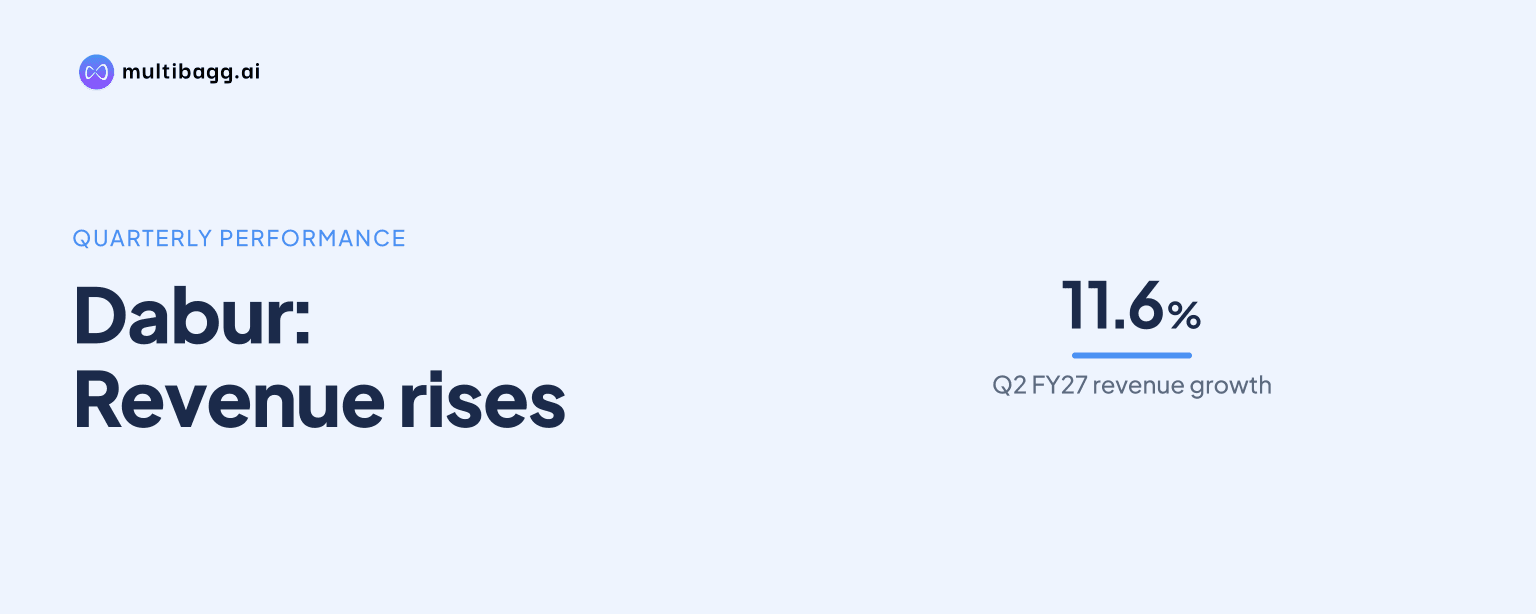
Dabur India Ltd reported consolidated revenue growth of 11.6% to Rs 3,563.1 crore in the second quarter of fiscal year 2027 (Q2 FY27), while operating margin declined 60 basis points year on year to 17.8%. Material cost and other expenses grew faster than sales, although reported net profit rose 11.7% to Rs 505.5 crore.
Know Dabur India inside out
Results, valuation, peers and who's buying, in one view.
What drove Dabur's operating-margin decline in Q2 FY27?
Dabur's operating margin declined because material cost and other expenses rose faster than its Q2 FY27 revenue. Material cost increased 13.0% year on year to Rs 1,822.7 crore, above the 11.6% increase in revenue from operations, while other expenses rose 23.6% to Rs 504.6 crore. Employee expense increased 8.3% to Rs 376.8 crore.
Operating profit rose 7.5% to Rs 632.5 crore in Q2 FY27, slower than revenue growth, reducing the operating-profit share of revenue to 17.8% from 18.4% in Q2 FY26. Advertisement and publicity was the exception among the main expense lines, falling 3.0% to Rs 226.6 crore from Rs 233.6 crore a year earlier.
The first-half trend showed a smaller margin contraction. In H1 FY27, revenue grew 11.1% to Rs 7,327.5 crore and operating profit increased 9.4% to Rs 1,373.8 crore, resulting in an operating margin of 18.7%, compared with 19.0% in H1 FY26.
Which businesses contributed most to Dabur's Q2 FY27 growth?
Dabur's international portfolio was the fastest reported business, growing 20.0% in Q2 FY27, while Food & Beverages was the fastest domestic segment at 17.4%. International business represented 30% of the business and generated Rs 1,091 crore of revenue, while the domestic business represented 70%.
Home & Personal Care, Dabur's largest listed domestic segment, grew 10.9% to Rs 1,245 crore. Healthcare grew 6.9% to Rs 645 crore, while Food & Beverages generated Rs 379 crore. Food & Beverages growth exceeded the 10.7% revenue growth reported for India fast-moving consumer goods (FMCG) and the 5.5% India FMCG volume growth.
Hair oils and shampoo each recorded high-teen growth, while oral care grew in the mid-single digits. Digestives reported strong double-digit growth and over-the-counter (OTC) and ethical products grew in the mid-teens. Health Supplements, however, posted a low-single-digit decline as honey fell in the mid-single digits on a high base and was partly affected by temporary trade-sentiment disruption following a labeling-related order.
How did Dabur's profit measures change in Q2 FY27?
Dabur's reported net profit grew faster than operating profit in Q2 FY27, increasing 11.7% to Rs 505.5 crore while operating profit rose 7.5% to Rs 632.5 crore. Net profit after minority interest remained 14.2% of revenue, unchanged from Q2 FY26, even as operating margin contracted by 60 basis points.
Earnings before interest, tax, depreciation and amortisation (EBITDA), including other income, rose 10.5% to Rs 804.3 crore. EBITDA margin declined 20 basis points to 22.6% from 22.8%, meaning this measure also expanded more slowly than the 11.6% increase in revenue.
The half-year comparison differed at the net-profit level. H1 FY27 reported net profit increased 13.4% to Rs 1,096.4 crore, and net-profit margin improved 30 basis points to 15.0% from 14.7% in H1 FY26, despite the 30-basis-point decline in operating margin.
Got a follow-up? Ask IRIS
How did Dabur's standalone performance compare with consolidated results?
Dabur's standalone revenue growth was lower than consolidated revenue growth in Q2 FY27, at 8.9% versus 11.6%, but its operating-margin decline was limited to 10 basis points. Standalone revenue was Rs 2,432.9 crore, operating profit was Rs 458.7 crore and operating margin was 18.9%, compared with 19.0% in Q2 FY26.
Consolidated revenue of Rs 3,563.1 crore was Rs 1,130.2 crore above the standalone figure, while consolidated operating margin was 1.1 percentage points lower at 17.8%. Standalone material cost rose 11.4% to Rs 1,313.7 crore and other expenses increased 12.7% to Rs 276.7 crore, compared with consolidated increases of 13.0% and 23.6%, respectively.
Standalone reported net profit rose 11.2% to Rs 387.8 crore, and standalone net-profit margin improved 30 basis points to 15.9%. In H1 FY27, standalone revenue grew 8.8% to Rs 5,120.2 crore and operating margin increased 10 basis points to 19.4%, unlike the 30-basis-point contraction in consolidated H1 operating margin.
What should readers watch in Dabur's business mix next?
Dabur's next reported growth mix will show whether its fastest-growing businesses maintain their momentum. International revenue rose 20.0% in Q2 FY27 and Food & Beverages grew 17.4%; within the international portfolio, Turkey grew 42.4% and the sub-Saharan Africa region grew 43.2%, while the United Kingdom declined 33.3% in value terms.
The presentation also identifies category activity that may affect future sales. Foods growth was supported by brand building, consumer activations and increased investment in quick commerce, while recently launched Odonil car fresheners and automatic diffusers received what management described as a positive response. The presentation does not provide a revenue or margin target for these launches, leaving their financial contribution unresolved.
Conclusion
Dabur delivered double-digit consolidated revenue and net-profit growth in Q2 FY27, with revenue of Rs 3,563.1 crore and reported net profit of Rs 505.5 crore. However, operating profit grew 7.5%, below sales growth, as material cost increased 13.0% and other expenses rose 23.6%, resulting in a 60-basis-point operating-margin reduction.
The next results will indicate whether 20.0% international growth and 17.4% Food & Beverages growth continue, and whether expense growth moves closer to revenue growth. Management also cited persistent commodity inflation and a volatile geopolitical environment, while the revenue contribution from quick-commerce investment and recent product launches remains unresolved.