








Dalmia Bharat sets Rs 700 crore buyback ceiling at Rs 1,850
MAX Plan at ₹4,999/yr

Find your next multibaggerBe a Pro Investor
Research stocks and track your picks on the go. Download the app.
Key highlights
- Dalmia Bharat approved an open-market buyback of up to Rs 700 crore on November 23, 2026.
- Dalmia Bharat must deploy at least Rs 525 crore, equal to 75% of the maximum buyback size.
- The Rs 1,850-per-share ceiling implies 37.84 lakh shares at full Rs 700 crore deployment.
- Dalmia Bharat must deploy at least Rs 280 crore in the first half of the buyback period.
powered by IRIS
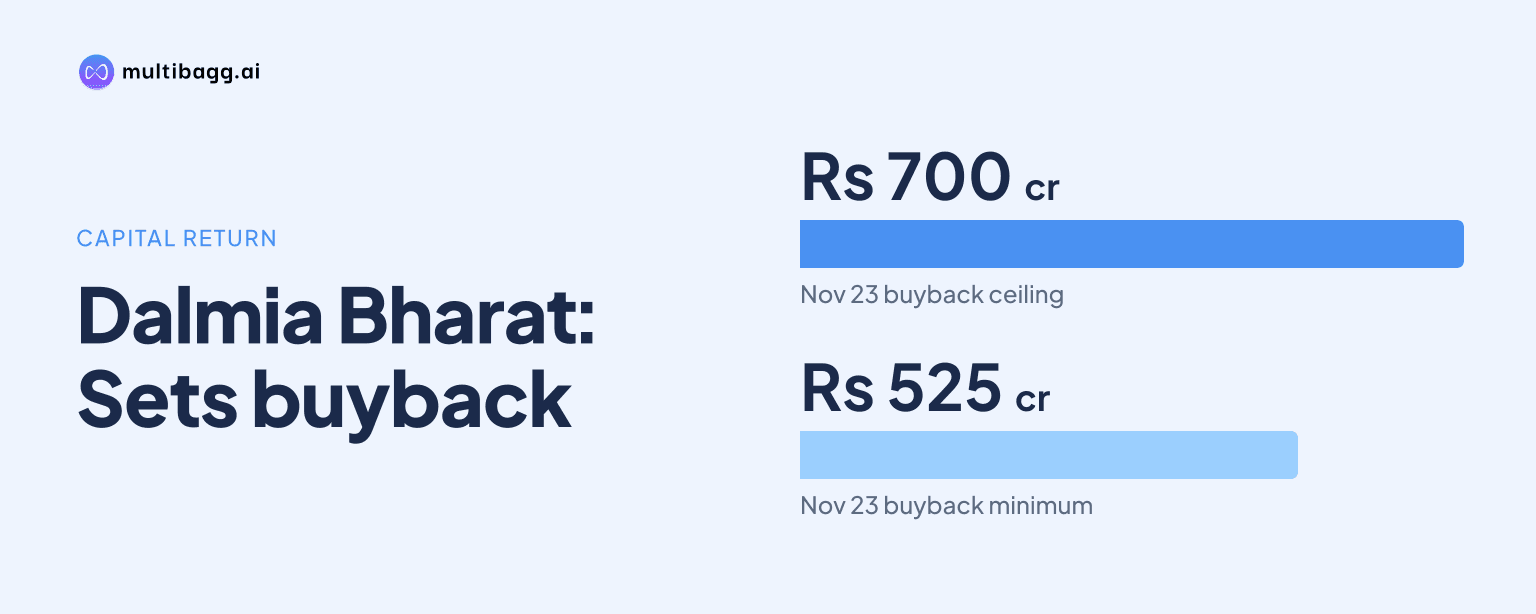
Dalmia Bharat Limited has approved an open-market buyback of up to Rs 700 crore at a maximum price of Rs 1,850 per equity share, with a mandatory minimum deployment of Rs 525 crore. Approved on November 23, 2026, the programme could repurchase 37.84 lakh shares at the ceiling price.
Know Dalmia Bharat inside out
Results, valuation, peers and who's buying, in one view.
What are Dalmia Bharat's buyback terms?
Dalmia Bharat will repurchase fully paid equity shares with a face value of Rs 2 each for up to Rs 700 crore, excluding transaction costs, through the stock exchanges. The maximum buyback price is Rs 1,850 per share, while the minimum buyback size is Rs 525 crore, or 75% of the maximum amount, under the Securities and Exchange Board of India buyback regulations.
At the maximum amount and the maximum price, Dalmia Bharat has indicated that it could buy 37,83,783 shares, equal to about 2.02% of its paid-up equity share capital as of March 31, 2026. At the Rs 525 crore minimum deployment and the Rs 1,850 ceiling, the indicative minimum purchase is 28,37,837 shares. If purchases occur below the ceiling, the number of shares bought may exceed 37.84 lakh, but the aggregate consideration cannot exceed Rs 700 crore.
The Rs 700 crore maximum equals 9.64% of Dalmia Bharat's standalone paid-up equity capital and free reserves and 4.49% of the consolidated amount, based on audited financial statements as of March 31, 2026. The proposal is below the lower standalone limit of Rs 726 crore, which is 10% of paid-up capital and free reserves, so shareholder approval is not required under the board-approval route.
How will Dalmia Bharat conduct the buyback?
Dalmia Bharat will conduct the buyback through electronic trading facilities on BSE and the National Stock Exchange of India, using a price-time priority order-matching mechanism rather than an all-or-none system. Axis Capital Limited has been appointed as the company's broker and will place buy orders in the normal trading segment at prices not exceeding Rs 1,850 per share.
Only beneficial owners holding shares in dematerialised form can participate in the buyback. Promoters, promoter-group entities and persons in control are excluded, while locked-in, non-transferable, partly paid shares and shares with calls in arrears cannot be bought. Shareholders with physical certificates need to complete dematerialisation before the buyback closes, according to the November 25, 2026 public announcement.
The programme is scheduled to open on or before December 2, 2026, following the public announcement published on November 26, 2026. It must close by March 5, 2027 at the latest, being 66 working days from opening, although the board may close it earlier after deploying the Rs 525 crore minimum and giving notice.
Dalmia Bharat must deploy at least Rs 280 crore, equal to 40% of the maximum buyback size, during the first half of the maximum buyback period. It has also established an escrow arrangement requiring at least Rs 17.50 crore, or 2.5% of the Rs 700 crore maximum, to remain in the escrow account at all times under the disclosed terms.
How does Dalmia Bharat's Rs 1,850 ceiling compare with market prices?
Dalmia Bharat's Rs 1,850 ceiling was 33.13% above the one-month volume-weighted average market price on BSE and 28.25% above the comparable National Stock Exchange of India price before the November 18, 2026 intimation date. The company said it considered market-price trends and the potential impact on price-earnings ratio, net worth, earnings and book value in determining the maximum price.
The ceiling was also 32.51% above BSE's two-week volume-weighted average market price and 29.58% above the National Stock Exchange of India equivalent before November 18. Against the closing price on the intimation date, the Rs 1,850 ceiling represented premiums of 22.81% on BSE and 22.72% on the National Stock Exchange of India, narrower than the one-month comparisons.
The maximum price is not a fixed or uniform sale price for shareholders. Each transaction will be completed at the price at which Dalmia Bharat's order matches a shareholder's sell order, and the company is not obliged to place a buy order on every trading day during the programme.
On November 25, 2026, the first trading day after the November 23 board meeting, Dalmia Bharat closed at Rs 1,585 on BSE and Rs 1,586.80 on the National Stock Exchange of India. Both closing prices were below the Rs 1,850 ceiling, while actual purchase prices will depend on exchange order matching and prevailing market prices.
Got a follow-up? Ask IRIS
What could change in Dalmia Bharat's capital and ownership?
Dalmia Bharat had 18,75,65,953 issued, subscribed and fully paid-up equity shares before the proposed buyback. If it purchases the indicative maximum of 37.84 lakh shares at Rs 1,850 each, the outstanding share count would fall to 18,37,82,170 shares, and the repurchased shares would be extinguished within the prescribed regulatory timelines.
The promoter group held 10,47,31,548 shares, or 55.84%, as of November 23, 2026. Assuming the maximum indicated share count is bought from public shareholders, the promoter group's share count would remain unchanged but its percentage holding would rise to 56.99%, as promoters cannot participate in the open-market buyback.
Management said the buyback is intended to reduce the number of outstanding shares, use available cash and potentially improve earnings per share, book value per share and return on equity, assuming similar profits. These are management expectations, not assured outcomes, and Dalmia Bharat said the funds deployed, including transaction costs, will reduce the cash available to the company.
What funding and compliance conditions apply to Dalmia Bharat?
Dalmia Bharat will fund the buyback from free reserves, securities premium or other legally permitted sources, and it will not use borrowings from banks or financial institutions. The company will transfer an amount equal to the nominal value of repurchased shares to its capital redemption reserve account, with the transfer to be disclosed in subsequent audited financial statements.
Walker Chandiok & Co LLP, Dalmia Bharat's statutory auditor, reported on November 23, 2026 that the permissible capital payment was properly determined from audited standalone and consolidated financial statements for the year ended March 31, 2026. The auditor also reported that the board had formed its opinion on reasonable grounds that Dalmia Bharat would not be rendered insolvent within one year of the board meeting.
Dalmia Bharat has said it will not issue equity shares or other specified securities from the November 23, 2026 board meeting until the buyback period expires, except to meet subsisting obligations including conversions, stock options or sweat equity. It also cannot raise further capital for one year after the buyback period expires, except for subsisting obligations, and cannot make another buyback offer for one year from closure.
Conclusion
Dalmia Bharat has authorised a shareholder-return programme of up to Rs 700 crore with a ceiling of Rs 1,850 per share and a mandatory Rs 525 crore deployment. The programme will operate through market purchases, so shareholders who sell may receive matched prices below the ceiling, while promoters holding 55.84% cannot participate.
The next disclosed milestones are the opening on or before December 2, 2026, the requirement to deploy at least Rs 280 crore in the first half of the buyback period, and the latest closing date of March 5, 2027. Dalmia Bharat will provide daily disclosures on shares bought, purchase prices and cumulative deployment through the stock exchanges and its website.

