








Dalmia Bharat reports Rs 13 crore first-half consolidated loss
MAX Plan at ₹4,999/yr

Find your next multibaggerBe a Pro Investor
Research stocks and track your picks on the go. Download the app.
Key highlights
- Dalmia Bharat reported a Rs 13 crore consolidated loss after tax for the six months ended September 30, 2026.
- Exceptional expenses were Rs 521 crore in the first half, compared with Rs 26 crore for the year ended March 31, 2026.
- Consolidated debt rose by Rs 2,830 crore to Rs 9,582 crore at September 30, 2026.
- Dalmia Bharat approved an open-market buyback of up to Rs 700 crore at a maximum Rs 1,850 per share.
powered by IRIS
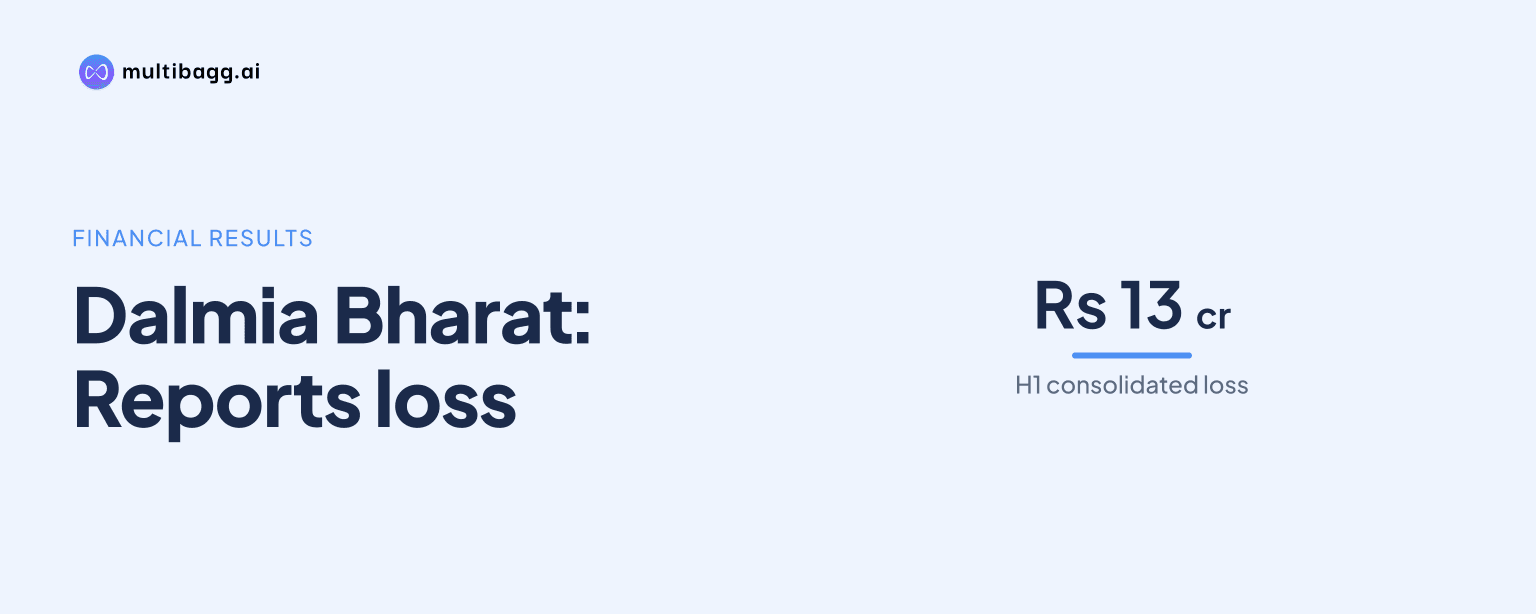
Dalmia Bharat Limited reported a Rs 13 crore consolidated loss after tax for the six months ended September 30, 2026, despite Rs 7,453 crore of revenue from operations, as exceptional expenses reached Rs 521 crore. Consolidated debt rose to Rs 9,582 crore from Rs 6,752 crore at March 31, 2026.
Know Dalmia Bharat inside out
Results, valuation, peers and who's buying, in one view.
What were Dalmia Bharat’s first-half consolidated results?
Dalmia Bharat recorded total income of Rs 7,638 crore in the six months ended September 30, 2026, comprising Rs 7,453 crore of revenue from operations and Rs 185 crore of other income. Total expenses excluding finance costs, depreciation, amortisation, tax and exceptional items were Rs 6,155 crore, while finance costs were Rs 277 crore and depreciation and amortisation were Rs 724 crore.
Dalmia Bharat reported a Rs 39 crore loss before tax from continuing operations for the six-month period, compared with a Rs 1,450 crore profit before tax in the full year ended March 31, 2026. A Rs 23 crore tax credit reduced the loss after tax from continuing operations to Rs 16 crore, while discontinued operations contributed a Rs 3 crore profit after tax, resulting in the Rs 13 crore consolidated loss after tax.
The Rs 13 crore loss included a Rs 19 crore loss attributable to Dalmia Bharat equity holders and a Rs 6 crore profit attributable to non-controlling interests. Basic and diluted earnings per share, or EPS, from continuing and discontinued operations were negative Rs 1.01 for the six-month period, against Rs 60.73 for the year ended March 31, 2026.
How did exceptional expenses affect Dalmia Bharat’s result?
Exceptional expenses of Rs 521 crore were a major contributor to Dalmia Bharat’s first-half loss, compared with Rs 26 crore of exceptional expense for the full year ended March 31, 2026. The public announcement does not break down the nature of the Rs 521 crore charge, so it establishes the amount but not the underlying transaction or event.
Before exceptional items, Dalmia Bharat reported Rs 6,155 crore of expenses, Rs 277 crore of finance costs and Rs 724 crore of depreciation and amortisation. Those amounts, combined with the Rs 521 crore exceptional expense, exceeded total income of Rs 7,638 crore and produced the Rs 39 crore pre-tax loss from continuing operations.
Other comprehensive loss, net of tax, was Rs 56 crore in the six months ended September 30, 2026, compared with other comprehensive loss of Rs 371 crore in the year ended March 31, 2026. Total comprehensive loss was therefore Rs 69 crore for the first half, compared with total comprehensive income of Rs 786 crore in the preceding full year.
What changed in Dalmia Bharat’s debt and equity position?
Dalmia Bharat’s total debt increased by Rs 2,830 crore to Rs 9,582 crore at September 30, 2026 from Rs 6,752 crore at March 31, 2026. The filing defines total debt as current borrowings, non-current borrowings and the current portion of long-term borrowings, rather than a net-debt measure.
The debt-equity ratio rose to 0.54 times at September 30, 2026 from 0.38 times at March 31, 2026 and 0.30 times at March 31, 2025. Total equity was Rs 17,861 crore at the first-half date, down from Rs 17,979 crore at March 31, 2026, as other equity declined to Rs 17,823 crore from Rs 17,941 crore while paid-up equity capital remained Rs 38 crore.
Book value per equity share was Rs 952.23 at September 30, 2026, compared with Rs 958.52 at March 31, 2026. Return on total equity was negative 0.11% for the six-month period, compared with 6.34% for the preceding financial year; the filing defines this measure as profit after tax attributable to equity holders divided by total equity at period end.
Got a follow-up? Ask IRIS
How did Dalmia Bharat’s standalone result differ from the group result?
Dalmia Bharat’s standalone entity reported a Rs 38 crore profit after tax for the six months ended September 30, 2026, in contrast to the group’s Rs 13 crore consolidated loss. Standalone revenue from operations was Rs 219 crore and total income was Rs 237 crore, compared with consolidated revenue of Rs 7,453 crore and total income of Rs 7,638 crore.
The standalone result included Rs 164 crore of expenses before finance costs, depreciation, tax and exceptional items, finance costs of Rs 12 crore, and depreciation and amortisation of Rs 20 crore. Profit before tax was Rs 41 crore and tax expense was Rs 3 crore, producing the Rs 38 crore standalone profit after tax; the standalone table showed no exceptional item for the six-month period.
Standalone total debt was nil at September 30, 2026, unchanged from the financial years ended March 31, 2026, March 31, 2025 and March 31, 2024. Standalone total equity was Rs 7,839 crore, with other equity of Rs 7,801 crore, and basic EPS was Rs 2.05, compared with consolidated EPS of negative Rs 1.01.
What does Dalmia Bharat’s proposed buyback involve?
Dalmia Bharat’s board approved an open-market buyback of up to Rs 700 crore on November 23, 2026, funded from free reserves, securities premium or other legally permitted sources rather than bank or financial-institution borrowings. The maximum buyback price is Rs 1,850 per equity share, and the indicative maximum number of shares is 37,83,783, equal to about 2.02% of paid-up equity share capital.
The Rs 700 crore maximum size is 9.64% of standalone paid-up equity capital and free reserves and 4.49% of the consolidated equivalent, based on audited March 31, 2026 balances. Dalmia Bharat must deploy at least Rs 525 crore, or 75% of the maximum size, with at least Rs 280 crore to be used in the initial half of the permitted buyback period.
Management stated that the buyback is intended to reduce the number of outstanding shares, use available cash and potentially improve EPS and return on equity through a lower equity base. Dalmia Bharat also confirmed that its lender covenants would not be breached by the buyback and that lender consent was not required for the transaction.
Conclusion
Dalmia Bharat’s filing shows that Rs 521 crore of exceptional expenses coincided with a shift to a Rs 13 crore consolidated first-half loss, even as revenue reached Rs 7,453 crore. The accounts also show total debt rising by Rs 2,830 crore from the March 2026 year-end and the debt-equity ratio moving to 0.54 times from 0.38 times.
The next disclosed event is the buyback, scheduled to open on or before December 2, 2026 and to close by March 5, 2027 at the latest. Investors can watch Dalmia Bharat’s daily disclosures of shares bought back, actual cash deployment against the Rs 525 crore minimum requirement, and whether the Rs 700 crore maximum is reached.

