










DCW Expects Double-Digit EBITDA Margin in FY27 Second Half
Key highlights
- DCW said it is confident of a double-digit EBITDA margin in H2 FY27 after an analyst cited about 7% in recent quarters.
- DCW said SIOP margins have been around 40% over the past four to five years.
- DCW plans about 15 KT of added SIOP capacity, taking total capacity to 45 KT.
- DCW estimates SIOP capital expenditure of around Rs 250 crore and expects a three- to four-year payback.
powered by IRIS
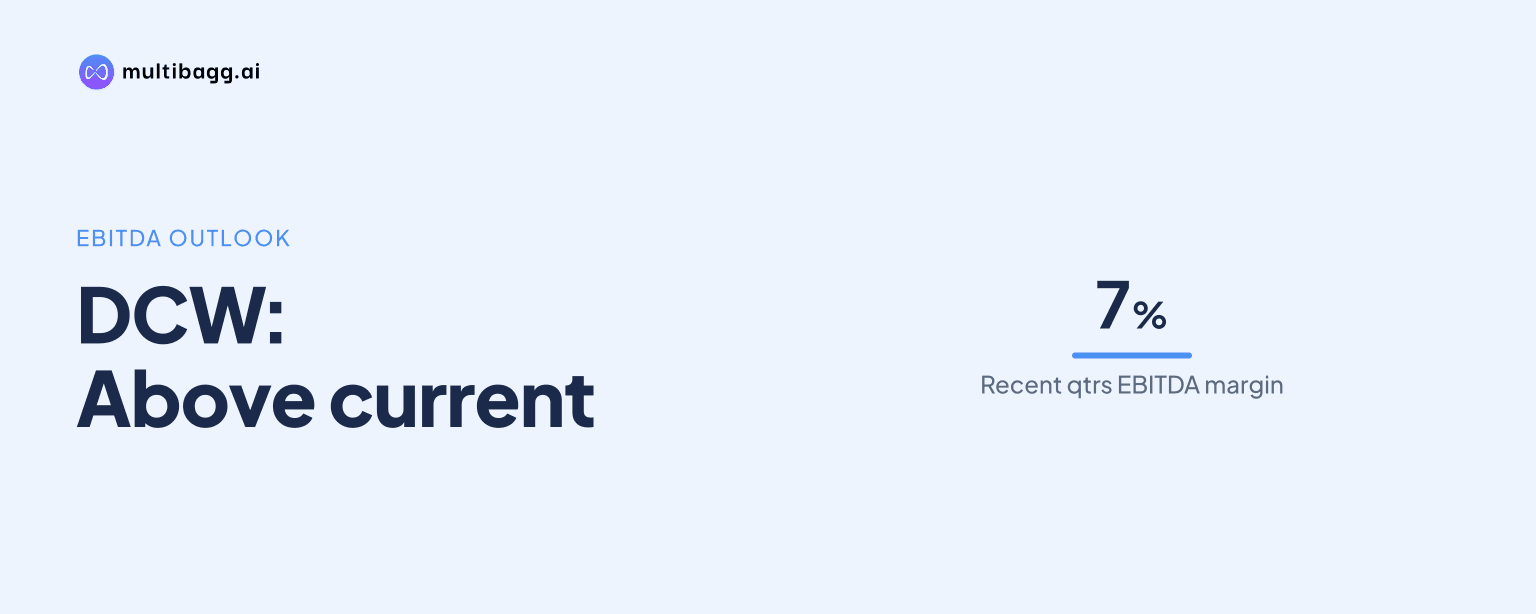
DCW expects a double-digit earnings before interest, tax, depreciation and amortisation (EBITDA) margin in the second half of FY27, after an analyst described margins in the preceding couple of quarters as about 7%. Management’s clearest supporting figure was SIOP margins of around 40%, although it also identified commodity, supply and freight volatility as risks.
Know DCW inside out
Results, valuation, peers and who's buying, in one view.
What EBITDA margin does DCW expect in H2 FY27?
DCW is confident of achieving a double-digit EBITDA margin from the second half of FY27. Pradipto Mukherjee made that commitment after an analyst asked whether EBITDA margin could cross 10%, saying there was “no question of shying away” from it. The analyst had characterised margins in each of the preceding couple of quarters as about 7%, implying an improvement of more than 3 percentage points if DCW exceeds 10%.
DCW did not provide a precise EBITDA-margin percentage, revenue forecast or quarterly profit target for H2 FY27. Management instead pointed to specialty chemicals, a higher-spread Japanese sales mix for SIOP, and an expected normalisation in polyvinyl chloride (PVC) to chlorinated PVC (CPVC) economics. It said the company had remained resilient through the volatility, while acknowledging that specialty chemicals had not supplied the anticipated uplift to overall profitability in the first half.
Why were DCW's first-half margins below expectations?
DCW said wild swings in its basic-chemicals businesses were the main constraint on profitability. Management identified caustic soda and PVC as the affected product markets, saying it had tried to balance the movements across the portfolio. It described the basic-chemicals segment, rather than a shortage of specialty capacity, as the principal obstacle to lifting overall EBITDA margin above the roughly 7% level cited by the analyst.
DCW said CPVC economics were disrupted by events across the first two quarters. A West Asia crisis caused force majeure conditions for vinyl chloride monomer (VCM) supplies in the first quarter, according to management, while the government removed duties on petrochemical products near the quarter-end. PVC prices then declined when DCW contracted CPVC prices for the second quarter, which management described as a rainy season with weaker demand.
DCW said PVC prices subsequently rose, causing a significant contraction in the PVC-to-CPVC spread. Management expects the spread available in the first quarter, around Rs 25 to Rs 30 per tonne, to be restored under steady conditions, but said another crisis could alter that outcome. It also said freight rose three to four times from one quarter to the next, illustrating the external logistics risk attached to the H2 FY27 margin commitment.
How can specialty chemicals support DCW's margin outlook?
DCW expects specialty chemicals to make its earnings base more stable because the segment has increased annually and its expanded capacity has reached a scale that can be assessed for profitability. Management said it would also have liked the specialty portfolio to provide a greater profitability top-up in the first half. That contribution was held back while basic-chemical markets experienced the swings in caustic soda, PVC and VCM conditions.
SIOP is the clearest disclosed specialty-margin contributor. DCW said SIOP margins have been around 40% over the past four to five years, including periods of volatile markets, and management expects that level to continue. It also said SIOP was not a product affected by the US tariff matter discussed on the call, distinguishing its stated performance from the more volatile PVC and caustic-soda businesses.
DCW also expects customer mix to influence the profit and loss account from the third quarter. Management said Japanese customer sales began in the second quarter and that the sales mix toward Japan would be higher from the third quarter. It said those sales carry a higher spread, but did not disclose Japanese volumes, the share of SIOP revenue involved, or a separate margin for those contracts.
Got a follow-up? Ask IRIS
What capacity plans could influence DCW's future profitability?
DCW has announced a first SIOP phase of about 7 kilotonnes (KT), together with a power-efficiency project, and a subsequent 8 KT phase that would take total SIOP capacity to 45 KT. Management put estimated capital expenditure in the public domain at around Rs 250 crore. It said DCW intends to borrow around Rs 150 crore for the plan, of which Rs 50 crore had already been borrowed and was invested in mutual funds.
DCW expects the additional SIOP capacity to be on board in the fourth quarter of the next financial year. Management said historical customer validation and ramp-up have taken six to 12 months, but it hopes the higher output can be placed in about six months because domestic customers already use the product. This timetable means the H2 FY27 target depends primarily on existing operations, sales mix and market spreads rather than the full contribution from the expansion.
DCW expects a three- to four-year payback on the announced SIOP investment, compared with an eight- to nine-year payback on its initial investment in the product. Management attributed the shorter expected period to completed product validation and a better understanding of customer requirements. It said SIOP volumes have grown from 10,000 to 12,000 tonnes in earlier years to 25,000 to 26,000 tonnes in the current year.
Which costs and external factors could affect DCW's target?
DCW said its SIOP-related power project is designed to optimise costs rather than increase renewable-power allocation. The co-generation project is intended to provide more steam for iron oxide production and lower both power and steam costs. Management said 75% of power cost is captive, while 25% is externally sourced, with renewable power forming the majority of that remaining share.
DCW has deferred a decision on further renewable-power expansion pending the outcome of court challenges to recent Tamil Nadu government amendments. Management said the amendments made the payback from such investment less advantageous and that it would decide its next step after the court outcome. This leaves the planned co-generation optimisation, rather than a renewable expansion, as the disclosed power-cost action linked to SIOP.
DCW said the average rate on two borrowings was about 9% to 9.25% and acknowledged a negative carry while borrowed funds are held before deployment. Management also said it seeks to maintain cash equal to 5% to 6% of top line under its internal policy. It does not plan basic-chemical capacity expansion, using capital expenditure there for efficiency improvements, while growth investment has so far focused on SIOP and CPVC.
Conclusion
DCW’s H2 FY27 outlook rests on an explicit management commitment to a double-digit EBITDA margin, SIOP margins of around 40%, and the expected benefit of a higher-spread Japanese sales mix from the third quarter. The first-half pressure came from basic-chemical volatility, including PVC and VCM disruption, a compressed PVC-to-CPVC spread and freight that rose three to four times quarter on quarter.
The next measures to watch are whether third-quarter Japanese sales produce the higher spread management expects and whether the PVC-to-CPVC spread returns toward the first-quarter range of Rs 25 to Rs 30 per tonne. DCW also expects added SIOP capacity in the fourth quarter of the next financial year, with a hoped-for six-month ramp-up, while the court outcome on Tamil Nadu renewable-power rules remains unresolved.