










Deccan Gold targets 2028 Mozambique lithium output with drilling
Key highlights
- Deccan Gold completed 2,000 metres of diamond drilling at Bhalukona and delineated about 4 million tonnes of ore at 0.24% nickel equivalent.
- Deccan Gold completed 5,400 metres of drilling at Logrosán, where it said every completed hole intersected tungsten and tin mineralisation.
- Deccan Gold plans 1,500 to 2,000 metres of drilling across its 150-square-kilometre Mozambique lithium-tantalum licence area.
- Deccan Gold plans a Bhalukona mining application in the first half of 2027, subject to further drilling results.
powered by IRIS
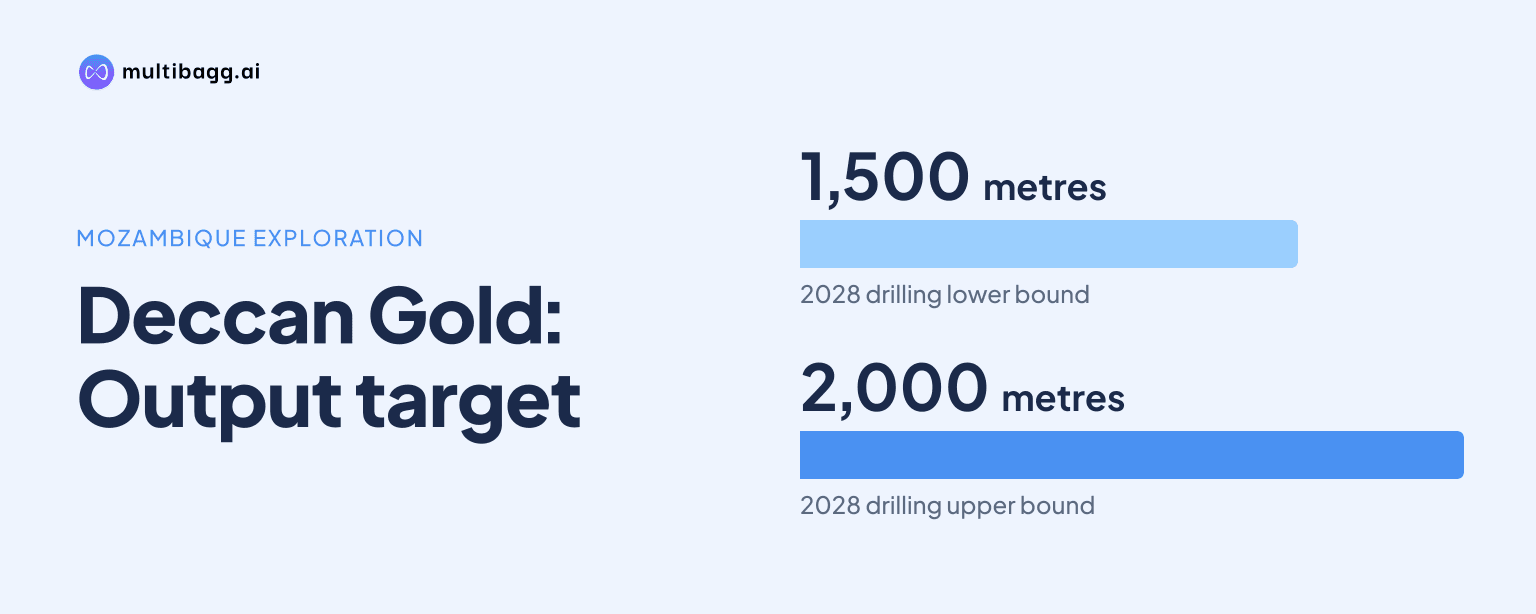
At its November 20, 2026 presentation, Deccan Gold Mines Limited said its Mozambique lithium-tantalum project could enter commercial production in 2028 after 1,500 to 2,000 metres of planned drilling, while it has completed 2,000 metres at Bhalukona and 5,400 metres at Logrosán.
Know Deccan Gold Mines inside out
Results, valuation, peers and who's buying, in one view.
What has Deccan Gold completed at Bhalukona?
Deccan Gold has completed 2,000 metres of diamond drilling across 15 holes at its Bhalukona nickel-copper-platinum-group elements project. Management said it has identified a mineralised zone extending 1.3 kilometres and has conservatively delineated about 4 million tonnes of economic ore at 0.24% nickel equivalent. The identified ore represents only part of the known mineralised zone, according to the company, which expects further repetitions beyond the initial 1.3-kilometre area.
Deccan Gold plans larger resource drilling after the rainy season, when crops no longer restrict access, while metallurgical process-flow-sheet work is under way. Its stated aim is to establish the resource categories required to seek a mining lease in India and to lodge a mining application in the first half of 2027 if results support that step. Management has also outlined a preliminary 3,000-tonnes-per-day processing-plant concept, roughly twice the size of the Jonnagiri plant, while noting that this scale would require capital.
How advanced is Deccan Gold's Spanish tungsten programme?
Deccan Gold has completed 5,400 metres of drilling at the Logrosán tungsten project in Spain, where it said every completed hole intersected potentially economic tungsten and tin mineralisation. Some holes reached depths of up to 600 metres. Management described an initial 2.3-million-tonne ore resource in a small part of the mineralised area, stressing that it sees this as an early indication rather than the project's full extent.
Deccan Gold said a 3,000-tonnes-per-day, or about 1-million-tonnes-per-year, plant would imply roughly two years of production from 2.3 million tonnes of ore; a fivefold resource increase could extend this illustrative mine life to about 10 years. Drilling at the adjoining Maria licence includes five planned holes targeting gold and antimony, with an initial antimony result of about 1,000 parts per million. At Dehesa, the company has completed eight holes, while Las Burjas has received 553 metres of drilling.
When could Deccan Gold's Mozambique project enter production?
Deccan Gold expects its Mozambique lithium-tantalum project could be the earliest of its exploration projects to enter commercial operations, with management indicating 2028 rather than the next few months. The project covers about 150 square kilometres and includes multiple pegmatite zones, rock formations that can host lithium and tantalum mineralisation. The company has identified drill targets and plans 1,500 to 2,000 metres of drilling during the current season.
The programme has been delayed by funding and approval timing, according to management. At Inchocha on the eastern side of the licence area, Deccan Gold plans to assess hard-rock lithium alongside potential tantalum recovery from regolith, or the near-surface soil profile. Management said regolith-hosted tantalum, if established, could make mining easier and speed a route to production. Mozambique's lithium royalty is below 3%, the company said, an element it views as relevant to longer-term project economics.
Got a follow-up? Ask IRIS
What must happen before Deccan Gold can make mine applications?
Deccan Gold needs additional drilling and resource definition before its proposed mine applications can proceed, making the programmes conditional rather than production commitments. The company presented Bhalukona as the most specifically timed application, targeting the first half of 2027 after comprehensive drilling of the 1.3-kilometre zone. At Logrosán, it plans to drill additional holes before lodging a mining application, but did not give a filing date.
Management linked the projects to price movements it cited over recent years: nickel had risen 10%, lithium 108% and tungsten 622%. Those changes do not establish future project revenue, particularly because Deccan Gold has yet to publish processing results for Bhalukona, further resource results for Logrosán or drill results from Mozambique. The company said it is preparing a metallurgical flow sheet at Bhalukona and will update the market once results from the Maria holes are available.
Why do Spain and Mozambique matter to Deccan Gold's processing plans?
Deccan Gold's overseas licences are intended to support a route in which concentrates can be exported to India for downstream processing. Spain has zero royalty on tungsten and allows concentrate exports, management said, while its corporate tax rate is around 25%. At Logrosán, tin could provide an additional credit alongside tungsten, although the company has not stated an expected output volume, sales value or production start date.
Mozambique serves a similar strategic purpose in management's plan because its project contains both lithium and tantalum, a material the company associated with semiconductor uses. The 150-square-kilometre licence area and identified pegmatite targets give Deccan Gold scope to test more than one mineralised zone, but the proposed 1,500-to-2,000-metre programme remains the immediate evidence-gathering step. Management also said drilling in Mozambique had not begun earlier because funding was delayed.
Conclusion
Deccan Gold is moving its critical-minerals portfolio from early exploration toward defined development steps: Bhalukona has about 4 million tonnes of delineated ore, Logrosán has 5,400 metres of completed drilling and Mozambique has a 2028 commercial-operation objective. The projects differ in maturity, with nickel closest to a stated mining-application timetable and Mozambique carrying the earliest production aspiration.
The next milestones are Bhalukona drilling after the rainy season and its planned first-half 2027 application, additional Logrosán drilling and Maria assay results, and the planned 1,500-to-2,000-metre Mozambique programme. Investors will also need to watch whether funding and regulatory approvals permit those plans to proceed, since management identified approval delays as a reason Mozambique work had slipped.