










Deccan Gold targets 1 tonne after 50% H1 PAT margin
Key highlights
- Swarnagiri produced 135 kg of gold in Q2 FY2027, compared with 89 kg in Q1 FY2027.
- Swarnagiri's H1 FY2027 standalone operations reported about Rs 80 crore of profit on around Rs 160 crore of sales.
- Swarnagiri held about 133 kg of doré plus bullion within Rs 134 crore of inventory at September-end.
- Management said new approvals could lift Swarnagiri production to at least 1,000 kg annually.
powered by IRIS
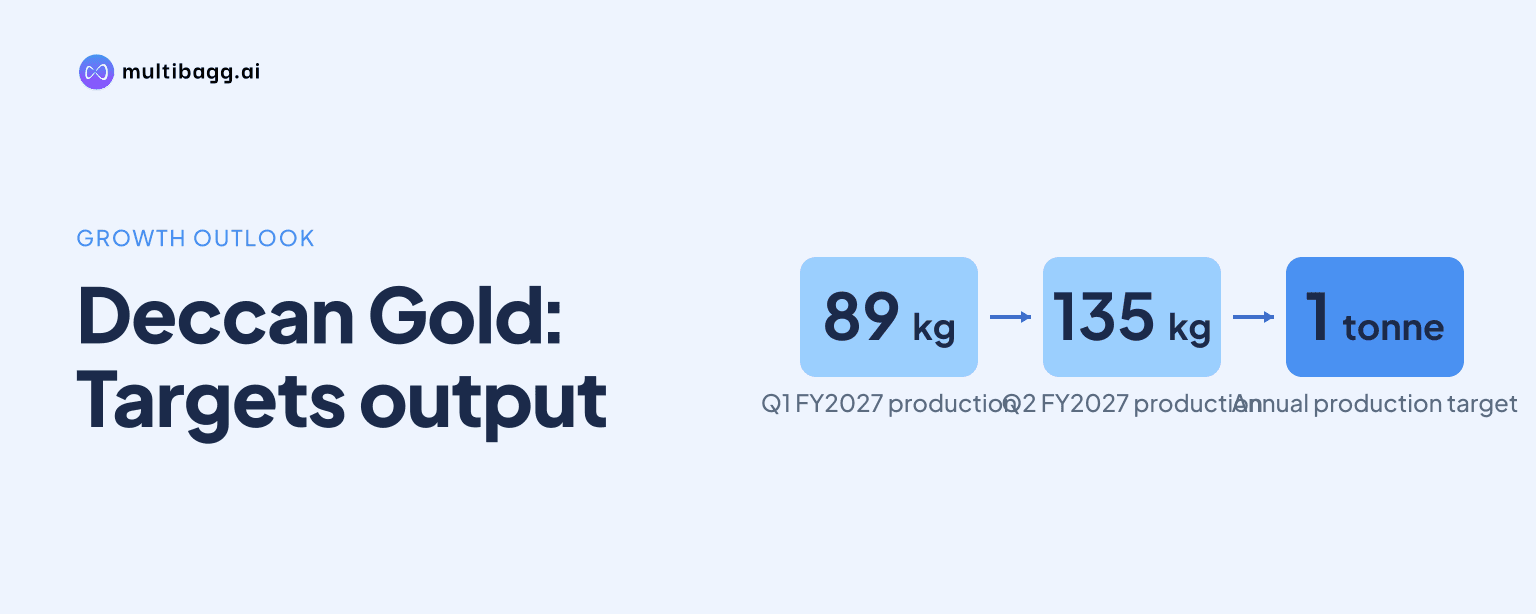
Deccan Gold said Swarnagiri produced 135 kg of gold in Q2 FY2027 and reported a 50% H1 FY2027 profit-after-tax margin on about Rs 160 crore of sales. Management said new approvals could raise the Andhra Pradesh mine's annual output to at least 1,000 kg from its current 40 kg to 45 kg monthly production rate.
Know Deccan Gold Mines inside out
Results, valuation, peers and who's buying, in one view.
How fast is Swarnagiri increasing gold production?
Swarnagiri increased gold production to 135 kg in Q2 FY2027 from 89 kg in Q1 FY2027, a 46 kg increase of about 52%. Management said the Q2 output translated into production of roughly 40 kg a month and demonstrated the scope to scale the Jonnagiri project.
The mine processed ore at grades of about 1.4 grams to 1.5 grams per tonne in Q2 FY2027, while gold recovery in the processing circuit was 90% to 95%. Deccan Gold attributed the recovery rate to test work undertaken over several years, which management said improved extraction from the operating system.
Swarnagiri sold about 50.4 kg of refined bullion in Q2 FY2027 and 109 kg in H1 FY2027. The difference between the 224 kg produced in the first half and bullion sales reflects material retained at different stages of production, including ore, doré and bullion inventory.
How profitable was Swarnagiri in H1 FY2027?
Swarnagiri's standalone operations generated about Rs 80 crore of profit on around Rs 160 crore of H1 FY2027 sales, equivalent to the 50% profit-after-tax, or PAT, margin cited by management. Management also reported a 70% earnings before interest, tax, depreciation and amortisation, or EBITDA, margin for the project.
At the company level, management said Q2 FY2027 PAT was Rs 13.91 crore, compared with about Rs 6 crore in Q1 FY2027. It also said first-half profit was close to Rs 20 crore, while separately identifying Deccan Gold's share of Swarnagiri profit as about Rs 20.57 crore.
The transcript does not provide a quarter-by-quarter cost bridge for the increase in Q2 PAT to Rs 13.91 crore. The 50% PAT margin and 70% EBITDA margin are reported H1 operating measures for Swarnagiri, rather than guidance for future periods or for Deccan Gold's other projects.
Got a follow-up? Ask IRIS
Why did Swarnagiri report Rs 134 crore of inventory?
The Rs 134 crore inventory reported at the end of September was valued at production cost rather than the potential sale value of bullion, Deccan Gold said. Management said inventory included about 133 kg of doré plus bullion, as well as run-of-mine, or ROM, ore and gold held in the processing circuit.
ROM refers to ore mined from the pit and kept for later processing, and it is valued at mining cost. Gold in circuit is material moving through equipment such as the ball mill and filter press, while doré carries accumulated production and processing costs before it is refined into bullion.
Swarnagiri has an attached refinery that converts doré into 24-carat bullion for sale to jewellers. Management said it retained gold inventory ahead of the festive season because it expected better pricing, and said sales made in October and November would appear in the next quarterly results.
The Rs 134 crore balance is therefore not a market-value measure for the 133 kg of doré and bullion. It also includes ROM ore, which management said may account for a large inventory value because a mine can hold thousands of tonnes of material awaiting processing.
What production milestones has management set for Swarnagiri?
Management said current approvals provide for a minimum target of 90 kg per quarter, and Swarnagiri's 135 kg output in Q2 FY2027 exceeded that level by 45 kg. The 89 kg produced in Q1 and 135 kg in Q2 totalled 224 kg, above the 180 kg implied by two quarters at the stated minimum target.
For FY2027, management said production of around 450 kg or more was possible. It said output could increase to at least 1,000 kg annually once new approvals are obtained, making the 1-tonne objective dependent on approvals rather than a currently approved production level.
Management also cited a longer-term target of 40 tonnes of gold for the mine and said annual production could eventually reach around 2 tonnes once resources are identified. Those figures are management's longer-range estimates of mine capacity and resource potential, not reported output or a confirmed production schedule.
The current run rate provides a nearer-term reference point: management described production as 40 kg to 45 kg a month after Q2 FY2027 output of 135 kg. Sustaining 45 kg monthly for a full year would equate to about 540 kg, above the indicated FY2027 output of around 450 kg but below the 1,000 kg annual target.
Conclusion
Deccan Gold's Q2 FY2027 disclosures show Swarnagiri moving above its 90 kg quarterly minimum, with production rising from 89 kg in Q1 to 135 kg in Q2. H1 standalone operations reported about Rs 80 crore of profit on around Rs 160 crore of sales, while the Rs 134 crore inventory balance represented accumulated production cost across ore, processing material, doré and bullion.
The next quarterly results are expected to include gold sales made in October and November from inventory held at the end of September. The key operational milestone remains the new approvals management says are required to move from the indicated FY2027 output of around 450 kg or more toward annual production of at least 1,000 kg.