










Delhi EV Policy sets April 2028 petrol two-wheeler registration ban
Key highlights
- Delhi EV Policy states that new petrol and CNG two-wheelers will be barred from registration from April 1, 2028.
- Year 1 electric-two-wheeler support is Rs 10,000 per kilowatt-hour, capped at Rs 30,000 for vehicles priced up to Rs 2.25 lakh.
- Delhi EV Policy is stated to take effect on July 1, 2026 and remain valid until March 31, 2030.
- The presentation cites about Rs 15,000 crore of policy support focused on battery electric vehicles.
powered by IRIS
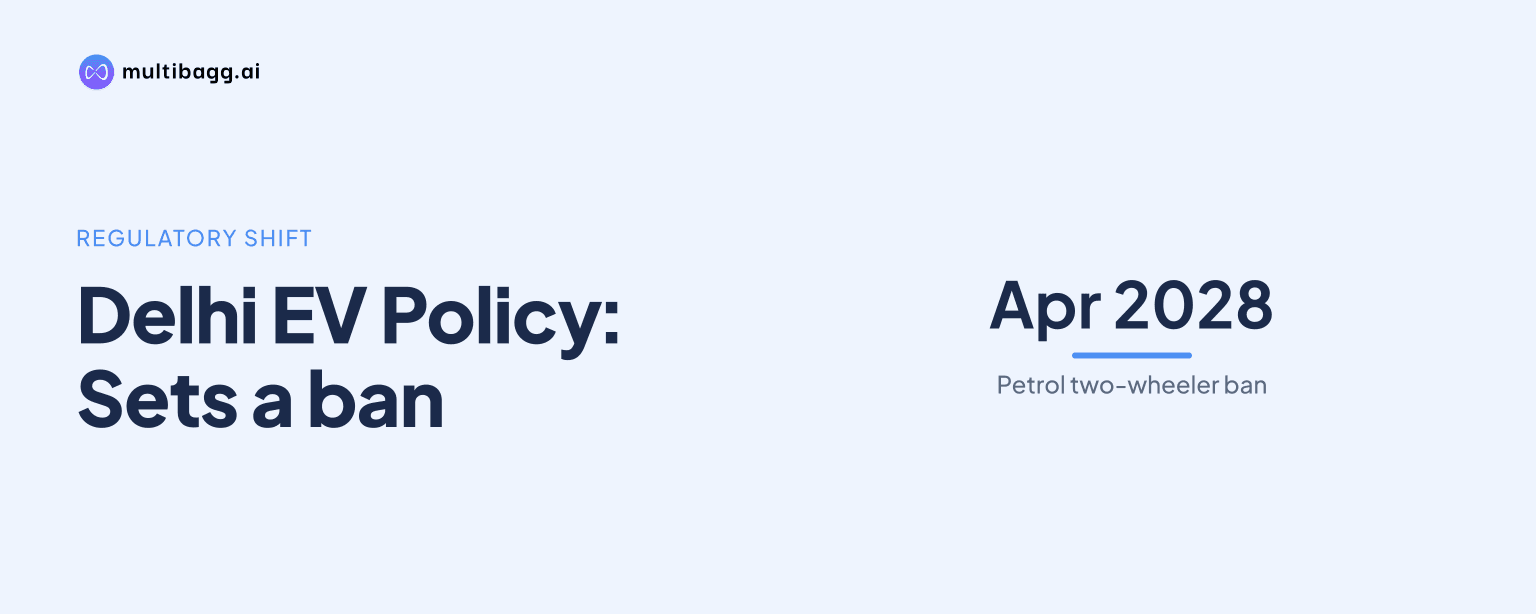
Delhi Electric Vehicles Policy, 2026 says Delhi will bar registration of new petrol and CNG two-wheelers from April 1, 2028, while its Year 1 electric-two-wheeler schedule offers Rs 10,000 per kilowatt-hour, capped at Rs 30,000 for vehicles priced up to Rs 2.25 lakh. The presentation states that the policy takes effect on July 1, 2026.
Know RattanIndia Enterprises inside out
Results, valuation, peers and who's buying, in one view.
When does the Delhi EV Policy take effect?
The Delhi EV Policy is stated to take effect on July 1, 2026, after notification on June 30, 2026, and to remain valid until March 31, 2030. The presentation describes the policy as approved and places its stated duration at nearly four years from the effective date to expiry.
The Delhi EV Policy presentation cites about Rs 15,000 crore of policy support and identifies zero-emission battery electric vehicles, or BEVs, as its focus. Its stated tax and incentive provisions apply only to BEVs, while its tax-benefit panel explicitly excludes hybrid vehicles.
The policy timetable covers several vehicle categories. The presentation says electric passenger and goods three-wheelers become the only vehicles eligible for new registration in 2027, electric two-wheelers in 2028, and school buses are to have a minimum 30% electric fleet in 2030. It also says government fleets will shift towards electric vehicles, without setting a numerical government-fleet target.
When will petrol and CNG two-wheelers stop being registered in Delhi?
The Delhi EV Policy says new petrol and CNG two-wheelers will be completely banned from registration from April 1, 2028. Its mandate table presents the same 2028 change as only electric two-wheelers being eligible for new registration, so the disclosed measure concerns new registrations rather than existing petrol or CNG two-wheelers.
The two-wheeler deadline follows an earlier electrification milestone. A policy-highlight page says that, from January 1, 2027, only electric three-wheelers and N1 trucks can be registered; N1 refers to commercial goods vehicles. However, the mandate table on the following page refers to passenger and goods three-wheelers in 2027 and does not separately list N1 trucks.
The presentation also describes phased electrification requirements for last-mile delivery and aggregator services, with deadlines from 2026 to 2028. It provides no numerical target for those fleets in the supplied pages, making the April 2028 two-wheeler registration rule the clearest disclosed deadline affecting new two-wheeler registrations.
What electric-two-wheeler incentive does the Delhi EV Policy offer?
The Delhi EV Policy lists a Year 1 incentive of Rs 10,000 per kilowatt-hour for electric two-wheelers, with a maximum of Rs 30,000 for models priced up to Rs 2.25 lakh. The schedule is degressive: both the rate per kilowatt-hour and the maximum payment fall in Years 2 and 3.
Year 2 lowers the rate by Rs 3,400 per kilowatt-hour from Year 1 and reduces the cap by Rs 10,000. In Year 3, the rate is Rs 3,300 per kilowatt-hour and the cap is Rs 10,000, compared with Rs 30,000 in Year 1.
A separate policy-highlight page says purchase and scrappage subsidies for pure electric two-wheelers can be up to Rs 40,000. The detailed schedule instead sets a Year 1 purchase-incentive cap of Rs 30,000 and does not specify a rupee amount for two-wheeler scrappage, stating only that the benefit requires scrapping an old polluting vehicle and buying a new electric vehicle.
Got a follow-up? Ask IRIS
What tax and scrappage benefits does the Delhi EV Policy provide?
The Delhi EV Policy says BEVs receive a 100% exemption from road tax and registration fees, and its tax-benefit panel says electric cars priced up to Rs 30 lakh qualify. Cars above Rs 30 lakh receive no exemption under that panel, and hybrid vehicles are not eligible.
The presentation contains differing descriptions of the vehicle coverage. One additional-benefits table says goods vehicles receive no exemption, while the tax-benefits panel says the 100% exemption is for all BEVs. It also says incentives and tax benefits are capped for vehicles priced from Rs 25 lakh to Rs 30 lakh, without supplying a complete vehicle-by-vehicle tax schedule.
For scrappage, the detailed table lists Rs 25,000 for three-wheelers, Rs 10,000 for cars priced at or below Rs 30 lakh, and Rs 50,000 for goods vehicles. The presentation says higher benefits are linked to scrapping Bharat Stage IV, or BS-IV, or older petrol and diesel vehicles, but it provides no cash amount for the two-wheeler scrappage row.
Which Revolt models are below the Delhi EV Policy price cap?
All six Revolt models listed in the presentation are below the Delhi EV Policy's Rs 2.25 lakh electric-two-wheeler price cap. The listed range begins with the RV1 at Rs 99,999 and extends to the RV400 at Rs 1.3995 lakh and RVX at Rs 1.3999 lakh.
In the commuter segment, Revolt lists the RV1 with a 2.2 kilowatt-hour battery and 100-kilometre range at Rs 99,999. The RV1+ is listed at Rs 1.1999 lakh with a 3.24 kilowatt-hour battery and 160-kilometre range, while the RV BlazeX is priced at Rs 1.3499 lakh with a 3.24 kilowatt-hour battery and 150-kilometre range.
Revolt's sports line-up includes the RV400 at Rs 1.3995 lakh, the RV400 BRZ at Rs 1.2995 lakh and the RVX at Rs 1.3999 lakh. Each has a listed 3.24 kilowatt-hour battery; the RV400 and RV400 BRZ have a stated 150-kilometre range, compared with 160 kilometres for the RVX.
The presentation's RVX launch page separately gives an introductory price of Rs 1.2499 lakh and a Delhi effective price of Rs 84,990 after state subsidy and scrappage incentive. That introductory price differs from the Rs 1.3999 lakh RVX price in the sports-line-up page, although both stated prices are below the Rs 2.25 lakh policy cap.
Conclusion
The Delhi EV Policy combines a dated restriction on new fossil-fuel two-wheelers with a declining three-year purchase-incentive schedule and BEV-focused tax provisions. The April 1, 2028 registration ban is the defined two-wheeler market-access measure, while the Rs 2.25 lakh eligibility ceiling covers each of the six Revolt models listed in the presentation.
Next, the disclosed milestones are the July 1, 2026 effective date, the 2027 three-wheeler registration change and the April 2028 two-wheeler deadline. The presentation also leaves matters to watch: the difference between its Rs 40,000 two-wheeler summary and Rs 30,000 detailed purchase cap, the differing goods-vehicle tax descriptions, and the two stated RVX prices.