










Revolt RVX claims 160 km range but presentation lists two prices
Key highlights
- Revolt lists RVX at a Rs 1.25 lakh introductory price and Rs 1.40 lakh in its sports line-up, a Rs 15,000 difference.
- RVX has a claimed 160 km IDC range, 90 km/h top speed and 3.24 kilowatt-hour battery.
- Revolt says RVX reaches 80% charge in 3 hours and 30 minutes with a standard charger and 80 minutes with a fast charger.
- Revolt estimates five-year RVX ownership cost at Rs 1.55 lakh versus Rs 3.70 lakh for its petrol-motorcycle example.
powered by IRIS
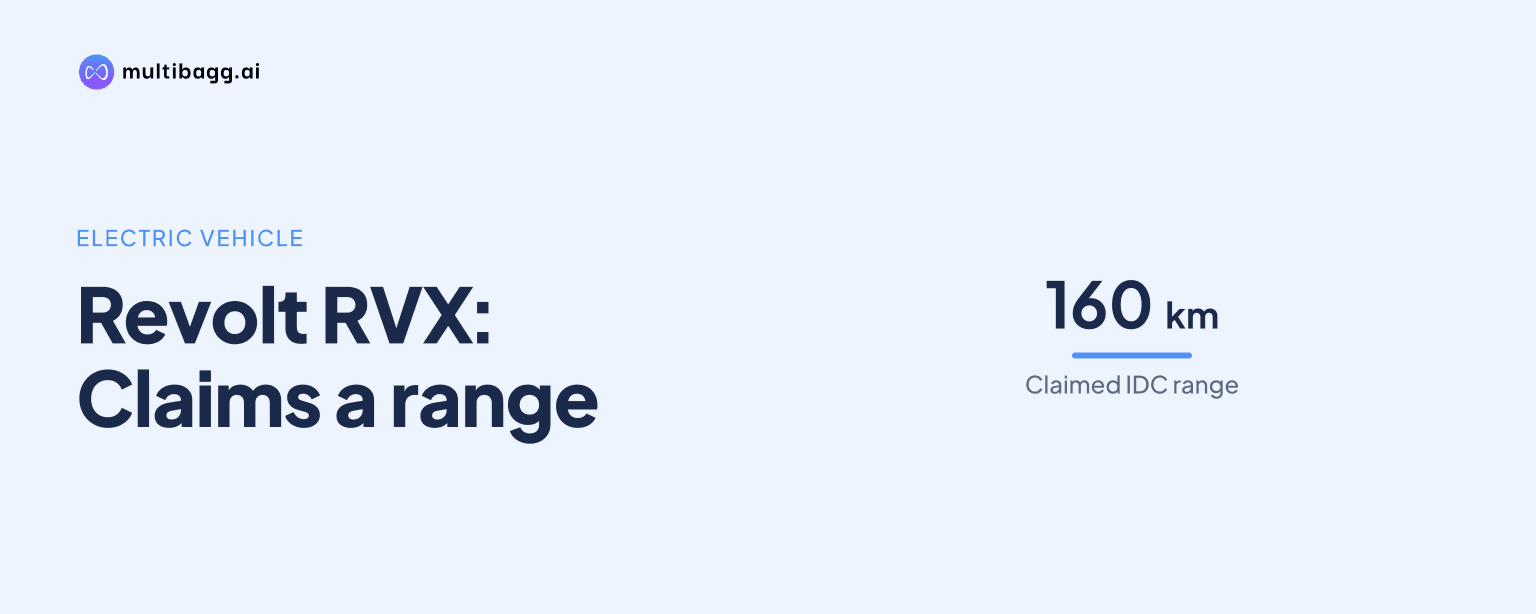
Revolt Motors presents the RVX as a sports electric motorcycle with a claimed 160 km Indian Driving Conditions, or IDC, range, but the same presentation lists a Rs 1.25 lakh introductory price and a Rs 1.40 lakh price in its sports line-up, a difference of Rs 15,000.
Know RattanIndia Enterprises inside out
Results, valuation, peers and who's buying, in one view.
What price does Revolt list for the RVX?
Revolt lists an introductory RVX price of Rs 1.25 lakh, while its sports-segment line-up lists Rs 1.40 lakh, so the presentation does not establish a single applicable price. The launch page also gives a Delhi effective price of Rs 84,990 after state subsidy and scrappage incentive, but does not explain the calculation or specify eligibility conditions for that result.
The two figures position the RVX differently against Revolt’s other sports motorcycles. At the Rs 1.40 lakh line-up price, RVX is Rs 400 above the Rs 1.40 lakh RV400 and Rs 10,000 above the Rs 1.30 lakh RV400 BRZ. At the Rs 1.25 lakh introductory price, RVX would be Rs 15,000 below the RV400 BRZ.
The presentation’s Delhi policy pages provide context, rather than a reconciliation, for the Rs 84,990 effective price. The Delhi Electric Vehicles Policy, 2026 is shown as effective from 1 July 2026 through 31 March 2030, with a first-year electric two-wheeler incentive of Rs 10,000 per kilowatt-hour, capped at Rs 30,000, for vehicles priced up to Rs 2.25 lakh. It also states that scrappage incentives apply when an old polluting vehicle is scrapped to buy a new electric vehicle.
What range, battery and charging does Revolt claim for RVX?
Revolt claims a 160 km IDC range, a 90 km/h top speed and a 3.24 kilowatt-hour battery for RVX. The launch page calls 160 km the highest range in the Revolt line-up, while the sports-feature page uses the wording “up to 160 km.” IDC is the range measurement identified in the presentation; Revolt does not provide a separate real-world range estimate.
Revolt says the standard charger takes 3 hours and 30 minutes to charge RVX from 0% to 80%. Its fast-charger claim is 80% charge in 80 minutes. The material does not state the time required for a 0% to 100% charge, the charging-input specification, or the commercial terms for the fast-charger option.
RVX is presented with instant torque, Boost Mode, Hill Hold and Walk Assist, alongside a digital dashboard and RevOS connectivity. Revolt says the motorcycle delivers three times the instant torque of 150cc motorcycles, describing this as three times more instant mechanical force. However, the presentation provides no torque figure in newton-metres and does not name the 150cc motorcycles used for comparison.
How does RVX compare with Revolt’s other motorcycles?
RVX is the only sports model in the presentation with a 160 km claimed range, 10 km above the 150 km claims for RV400 and RV400 BRZ. It matches the commuter-focused RV1+ at 160 km, while the RV BlazeX is listed at 150 km and the RV1 at 100 km. All listed models except RV1 have a 3.24 kilowatt-hour battery; RV1 has a 2.2 kilowatt-hour unit.
The sports-segment feature list covering RV400, RV400 BRZ and RVX includes Eco, Normal, Sport and Boost modes, dual disc brakes, mobile-app monitoring, reverse mode and a smart digital display. It also lists 90/80-17 front and 110/80-17 rear tyres and ground clearance of up to 200 mm. Revolt gives a 90 km/h top speed for RVX but does not show equivalent speed figures for the other five models.
Got a follow-up? Ask IRIS
What does Revolt estimate for RVX ownership costs?
Revolt estimates a five-year total cost of ownership of Rs 1.55 lakh for RVX, compared with Rs 3.70 lakh for a petrol motorcycle in its illustration. The RVX calculation uses the Rs 1.40 lakh ex-showroom price, Rs 250 monthly electricity expense and Rs 15,000 electricity expense over five years. The petrol example starts with a Rs 1 lakh motorcycle price and assumes Rs 2.70 lakh of fuel spending over five years.
Revolt characterises the RVX example as 60% cheaper than its petrol motorcycle over five years. This is a company comparison rather than a universally applicable ownership estimate, because the presentation does not disclose annual distance travelled, electricity tariff, petrol price, maintenance costs, insurance, registration charges or resale value behind the calculations.
Revolt’s monthly-cost illustration puts the RVX equated monthly instalment, or EMI, at Rs 3,900 and electricity at Rs 250, for a Rs 4,150 monthly total. The petrol example uses a Rs 2,800 EMI and Rs 4,500 fuel cost, producing Rs 7,300 monthly. Revolt says the RVX total is 43% lower, but does not disclose loan tenure, interest rate or down payment assumptions.
What warranty and access does Revolt disclose for RVX?
Revolt presents an extended battery warranty of eight years or 80,000 km, whichever comes earlier, for RVX and the sports range. The stated warranty period extends beyond the five-year ownership-cost illustration, but the presentation does not provide the extension’s price, exclusions, transferability or conditions for making a claim.
Revolt reports 203 active dealer stores across 181 cities in 20 states and Union Territories. Its regional store count is 60 in North India, 60 in West India, 46 in East India and 37 in South India. The company also states that it operates dealerships in Sri Lanka and Nepal and plans to enter other geographies.
The company says it received approval under Government of India electric-vehicle subsidy schemes on 1 August 2024 and receives Rs 5,000 per motorcycle under the PM-E Drive subsidy scheme. Separately, Revolt says proposed Delhi EV Policy 2026 incentives of up to about Rs 40,000 per electric two-wheeler, including scrappage incentives, could support demand. The presentation does not link that proposed maximum directly to the RVX Delhi effective-price calculation.
Conclusion
Revolt positions RVX at the upper end of its sports range through a claimed 160 km IDC range, 90 km/h top speed, 3.24 kilowatt-hour battery and an eight-year or 80,000 km extended battery warranty. Its cost illustration uses the Rs 1.40 lakh figure, making the separate Rs 1.25 lakh introductory price a material unresolved point for assessing the launch proposition.
The next item to watch is Revolt’s clarification of the applicable RVX price, the terms behind the Rs 84,990 Delhi effective price, and the conditions of the extended warranty. The presentation also identifies a policy timetable: Delhi’s policy is shown as effective until 31 March 2030, while its two-wheeler purchase incentive falls from a first-year maximum of Rs 30,000 to Rs 20,000 in year two and Rs 10,000 in year three.