










RattanIndia Enterprises raises TAS stake to 90% amid NCLT challenge
Key highlights
- REL's indirect TAS stake rose from 60% to 90% during the quarter ended 30 September 2026.
- The NCLT directed that the TAS rights issue will remain subject to further orders.
- REL concluded that no impairment of TAS net assets was required as at 30 September 2026.
- REL reported consolidated assets of Rs 3,313.152 crore at 30 September 2026, compared with Rs 2,770.888 crore at 31 March 2026.
powered by IRIS
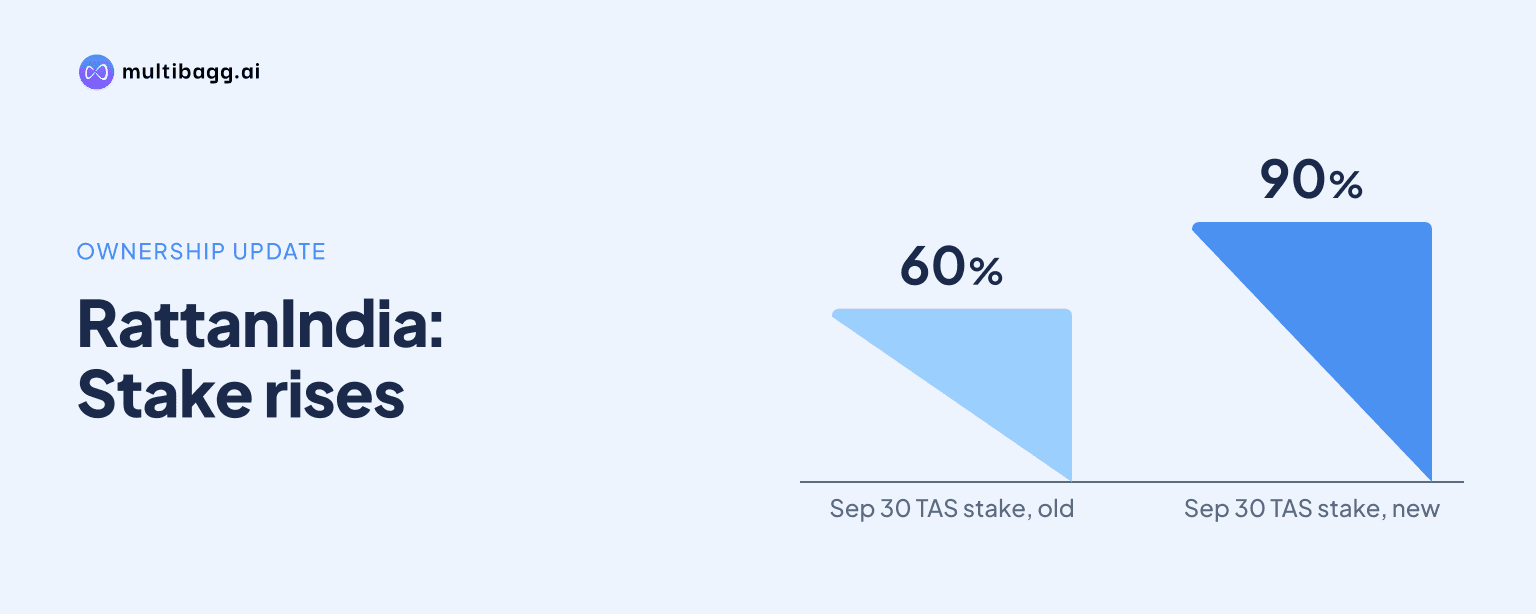
RattanIndia Enterprises Limited raised its indirect holding in Throttle Aerospace Systems Private Limited from 60% to 90% through a rights issue in the quarter ended 30 September 2026, but the National Company Law Tribunal made the issue subject to further orders following a minority shareholder challenge. REL concluded no impairment was required at period end.
Know RattanIndia Enterprises inside out
Results, valuation, peers and who's buying, in one view.
What changed in REL's holding of TAS?
REL increased its equity ownership in TAS from 60% to 90% during the quarter ended 30 September 2026 through a rights issue. The interest is held through Neosky India Limited, a wholly owned REL subsidiary, which means TAS remains a step-down subsidiary rather than a directly held company.
The 30-percentage-point increase did not give REL control of TAS for the first time because the group controlled TAS before and after the rights issue. That retained control determined the accounting treatment under Indian Accounting Standard 110, or Ind AS 110, as a transaction involving a change in ownership within an existing subsidiary.
REL reported consolidated non-controlling interests of Rs 6.36 crore at 30 September 2026, compared with Rs 1.183 crore at 31 March 2026. The filing does not separately quantify how much of that group-level movement relates to TAS, so this balance cannot be used to calculate the accounting adjustment from the rights issue.
Why is the TAS rights issue before NCLT?
The TAS rights issue is before the Bengaluru Bench of the National Company Law Tribunal, or NCLT, because one minority shareholder challenged it after REL's holding rose to 90% in the quarter ended 30 September 2026. The NCLT directed that the rights issue would remain subject to further orders, leaving the outcome unresolved at the reporting date.
REL disclosed earlier NCLT proceedings in which TAS minority shareholders made allegations against REL and others. Those shareholders had secured an order requiring maintenance of the existing TAS shareholding pattern, but that status quo order was subsequently vacated following an application filed by TAS.
Neosky India Limited and TAS also jointly filed a petition before the High Court of Delhi under Section 9 of the Arbitration and Conciliation Act, 1996, against TAS minority shareholders. The court disposed of the petition after the parties agreed to appoint an arbitrator, although arbitration proceedings had not commenced as at 30 September 2026.
REL said these matters remained sub judice as at the date of its 3 November 2026 results approval. Management stated that, based on its assessment, no further adjustment was required to the consolidated financial results for the quarter and half year ended 30 September 2026; this is a management assessment rather than a final legal resolution.
How did REL account for the TAS ownership change?
REL accounted for the increase from 60% to 90% as an equity transaction under Ind AS 110 because it retained control of TAS both before and after the rights issue. The resulting adjustment to non-controlling interests was recognised directly in equity, with no effect on the consolidated statement of profit and loss.
REL also reassessed the recoverability of net assets attributable to TAS using the current fair value of TAS shares as at 30 September 2026. The group concluded that no impairment was required at that date, but did not disclose the fair value used, the carrying value of TAS net assets or a numerical impairment headroom.
The distinction is material to the reported results because an ownership adjustment in a controlled subsidiary is recorded in equity, while an impairment would be charged to profit or loss. REL disclosed the direct-equity treatment and no impairment charge for the 30 September 2026 period.
REL reported consolidated profit before tax of Rs 5.753 crore for the half year ended 30 September 2026, compared with Rs 136.218 crore for the corresponding 2025 half year. The filing does not attribute that change to TAS and specifically states that the rights-issue ownership adjustment did not affect consolidated profit or loss.
Got a follow-up? Ask IRIS
How does the TAS matter fit REL's reported portfolio?
The TAS development sits within REL's technology-focused portfolio, which includes retail e-commerce, electric vehicles, drones and other businesses through subsidiaries. REL reported consolidated assets of Rs 3,313.152 crore at 30 September 2026, compared with Rs 2,770.888 crore at 31 March 2026.
REL does not disclose TAS as a separate reporting segment with its own revenue, assets, liabilities or earnings. The disclosed segments are retail e-commerce, electric motorcycles, investment and others, meaning the filing does not allow TAS's 90% ownership position to be matched with a standalone drone revenue or profit figure.
Retail e-commerce generated segment income of Rs 3,844.445 crore in the half year ended 30 September 2026, up from Rs 3,741.688 crore in the corresponding 2025 period. The electric-motorcycle segment, by comparison, reported a loss of Rs 17.315 crore, widening from a Rs 11.343 crore loss a year earlier; neither measure is TAS-specific.
REL's investment segment reported profit of Rs 16.849 crore for the September 2026 half year, compared with Rs 152.146 crore in the prior-year half. The filing says the earlier period included fair-value movements in RattanIndia Power Limited, whereas the current period reflected share of profit from the associate, including Rs 7.678 crore in the September 2026 quarter.
What should investors monitor in the TAS dispute?
Investors should monitor further NCLT orders because the tribunal has expressly made the TAS rights issue subject to future directions. Any change to the validity or implementation of the rights issue could affect the 90% ownership position disclosed for the quarter ended 30 September 2026.
The start and progress of arbitration is also unresolved because proceedings had not commenced after the Delhi High Court petition was disposed of. REL's future financial disclosures may also indicate whether management's 30 September 2026 conclusion of no impairment and no further adjustment remains unchanged.
Conclusion
REL increased its indirect TAS stake by 30 percentage points to 90% during the quarter ended 30 September 2026 while retaining control of the drone subsidiary. The result was a direct equity adjustment under Ind AS 110 rather than a profit-and-loss item, and REL's fair-value-based review found no impairment requirement at the reporting date.
The next disclosed trigger is a further NCLT direction on the minority shareholder's rights-issue challenge, since the issue remains subject to the tribunal's orders. Investors should also watch for the commencement of arbitration and any later reporting that revises REL management's assessment as at 30 September 2026.