










Venugopal Nandlal Dhoot declared bankrupt over Rs 12,668 crore
Key highlights
- Dhoot was declared bankrupt by the National Company Law Tribunal on November 5, 2026.
- State Bank of India stated Rs 12,668.06 crore of default as of September 30, 2026.
- Dhoot’s repayment proposal offered Rs 600 crore over 36 months through a Siliguri project.
- Bankruptcy trustee Asish Narayan must submit a preliminary report within 90 days.
powered by IRIS
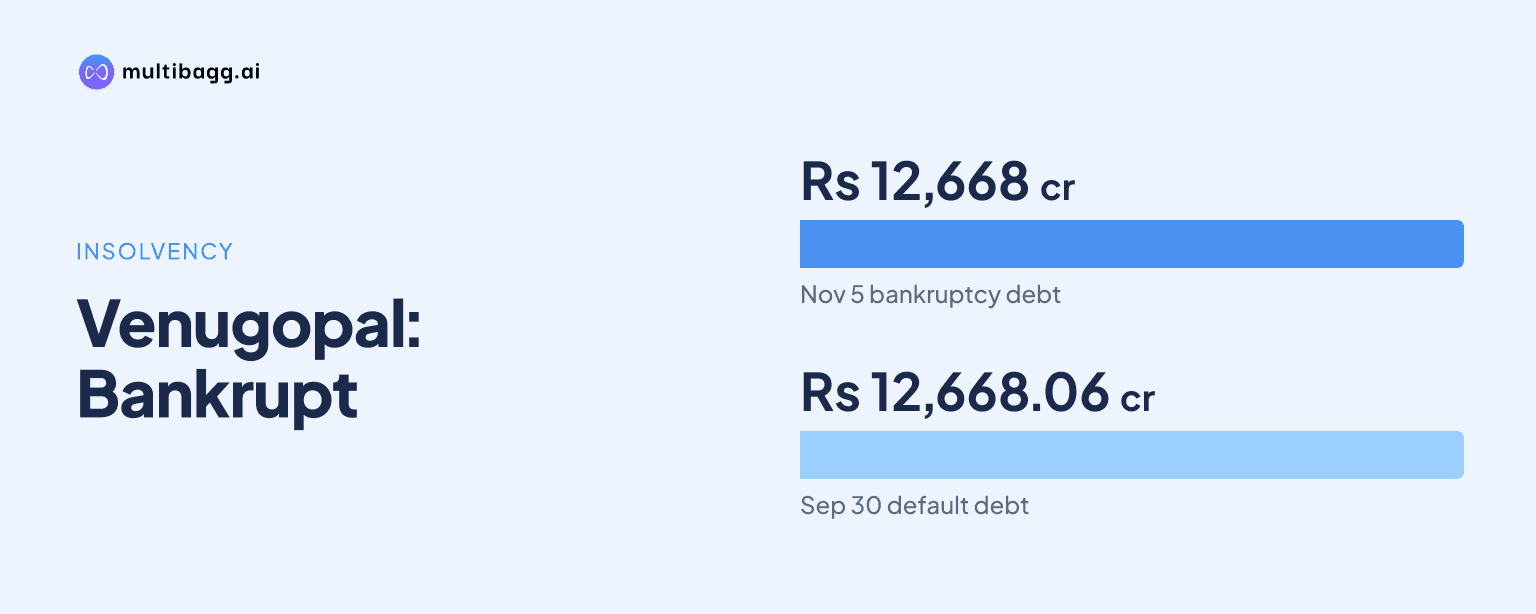
Venugopal Nandlal Dhoot was declared bankrupt by the National Company Law Tribunal on November 5, 2026, after his Rs 600 crore, 36-month repayment proposal was rejected and State Bank of India stated total default of Rs 12,668.06 crore as of September 30, 2026. The order placed his estate under a bankruptcy trustee.
Know Videocon Industries inside out
Results, valuation, peers and who's buying, in one view.
Why was Dhoot declared bankrupt?
Dhoot was declared bankrupt because the National Company Law Tribunal, Mumbai Bench V, found State Bank of India’s September 24, 2026 bankruptcy petition compliant with Section 123 of the Insolvency and Bankruptcy Code, 2016. The tribunal delivered its order under Section 126 on November 5, 2026, after terminating Dhoot’s personal insolvency resolution process on July 17, 2026.
The case arose from Dhoot’s personal guarantees for credit facilities extended to Videocon Industries Limited, identified in the order as the corporate debtor. The facilities included a Rs 2,972 crore rupee term loan agreement dated August 8, 2012, a Rs 1,700 crore Videocon Telecommunications Limited facility assumed by Videocon Industries Limited in June 2016, and Rs 720 crore of working-capital facilities.
State Bank of India and its merged associate banks issued three guarantee-invocation notices in February 2018. Those notices sought Rs 3,171.37 crore under the rupee term loan guarantee, Rs 676.91 crore under the Videocon Telecommunications facility guarantee and Rs 795.57 crore under the working-capital guarantee. The order records that Dhoot gave irrevocable and unconditional guarantees for repayment obligations under these arrangements.
What debt did State Bank of India claim from Dhoot?
State Bank of India stated that Dhoot’s total default, including interest and penalties, was Rs 12,668.06 crore as of September 30, 2026. The rupee term loan facility accounted for Rs 9,322.11 crore, the largest component, followed by the working-capital agreement at Rs 1,908.19 crore and the Videocon Telecommunications facility at Rs 1,437.76 crore.
The September 2026 debt total was higher than the amounts in the three 2018 guarantee demands because the tribunal’s stated total included interest and penalties. The Rs 3,171.37 crore rupee-term-loan demand was outstanding as of December 31, 2017, while the Rs 795.57 crore working-capital demand was dated December 27, 2017. The order does not provide a separate year-by-year reconciliation of the change.
Videocon Industries Limited entered corporate insolvency resolution process, or CIRP, on June 6, 2018, on a State Bank of India petition. Its process was consolidated with those of 12 other Videocon group companies on August 8, 2019, and the tribunal approved Twin Star Technologies Limited’s resolution plan on June 8, 2021. Dhoot’s appeal against that approval was dismissed by the National Company Law Appellate Tribunal on January 5, 2022.
Got a follow-up? Ask IRIS
Why did creditors reject Dhoot’s repayment plan?
Creditors rejected Dhoot’s repayment plan because it offered Rs 600 crore over 36 months but depended on future development, approvals and cash flows from a proposed Siliguri project. The petition stated that the proposal was approximately 0.42% of admitted dues, offered no payment upfront and could generate any realisation only after the project’s successful development.
Dhoot first emailed a Combined Revised Repayment Plan on May 11, 2026, saying a detailed plan would follow within 15 days. At the June 11, 2026 creditors’ meeting, the proposal was found contingent and non-compliant, prompting an adjournment to June 16. Dhoot then submitted the combined plan and detailed project report shortly before the rescheduled meeting.
The resolution professional reported on June 17, 2026 that the plan had not been prepared in consultation with him, as required under Section 105 of the Code. The report said potential recovery depended on a Siliguri project expected to take three to four years, with future approvals and cash flows that could not then be verified. Creditors decided that no compliant plan had been submitted under Sections 105 to 107.
The tribunal’s July 17, 2026 order rejected the plan under Section 114, terminated the personal insolvency resolution process and ended the moratorium, if one was in force. It held that the proposal was conditional and subject to Siliguri-project contingencies. State Bank of India filed the bankruptcy application on September 24, 2026, within the three-month period stipulated after a Section 115(2) order.
What happens to Dhoot’s estate after the bankruptcy order?
Dhoot’s estate vested immediately in bankruptcy trustee Asish Narayan under Sections 128 and 154 of the Code, and the estate is to be divided among creditors. The tribunal appointed Narayan on November 5, 2026 after recording his written consent dated September 21, 2026 and an authorisation for assignment valid until December 31, 2026.
Dhoot must submit his statement of financial position to the trustee within seven days of the bankruptcy commencement date. The trustee must notify creditors within 10 days and publish a public notice inviting claims in one English and one vernacular newspaper with sufficient circulation where Dhoot resides. The trustee may also seek information from Dhoot, creditors or other persons, who must respond within seven days of receiving a request.
The trustee must administer and distribute the estate under Chapter V of the Code, while Dhoot becomes subject to restrictions and disqualifications specified in Sections 140 and 141. The tribunal directed State Bank of India to make an ad-hoc payment of Rs 2 lakh to the trustee. The bankruptcy order remains effective until Dhoot is discharged under Section 138.
Conclusion
The November 5, 2026 order moves Dhoot from a failed personal insolvency resolution process into bankruptcy, with the tribunal accepting a stated Rs 12,668.06 crore default and rejecting a Rs 600 crore project-linked proposal. Its immediate legal effect is to place Dhoot’s estate with the bankruptcy trustee for administration and distribution among creditors.
The next disclosed milestones are procedural: Dhoot’s financial-position statement is due within seven days, creditor notices within 10 days, and the trustee’s preliminary report within 90 days of the bankruptcy commencement date. The trustee must then file progress reports within 15 days after every quarter ends, while the order continues until any discharge under Section 138.