










Dhoot Transmission Limited lifts EV revenue share to 31% in Q2
Key highlights
- Dhoot said EV supplied 31% of consolidated revenue in Q2 FY27, up from 27% in Q1 FY27.
- Batteries, electronics and components represented 31% of Q2 FY27 revenue, while wiring harnesses represented 69%.
- Dhoot reported a 110% increase in battery manufacturing capacity in H1 FY27.
- Dhoot had 29 plants as of September 2026, compared with 22 operational plants at March 31, 2026.
powered by IRIS
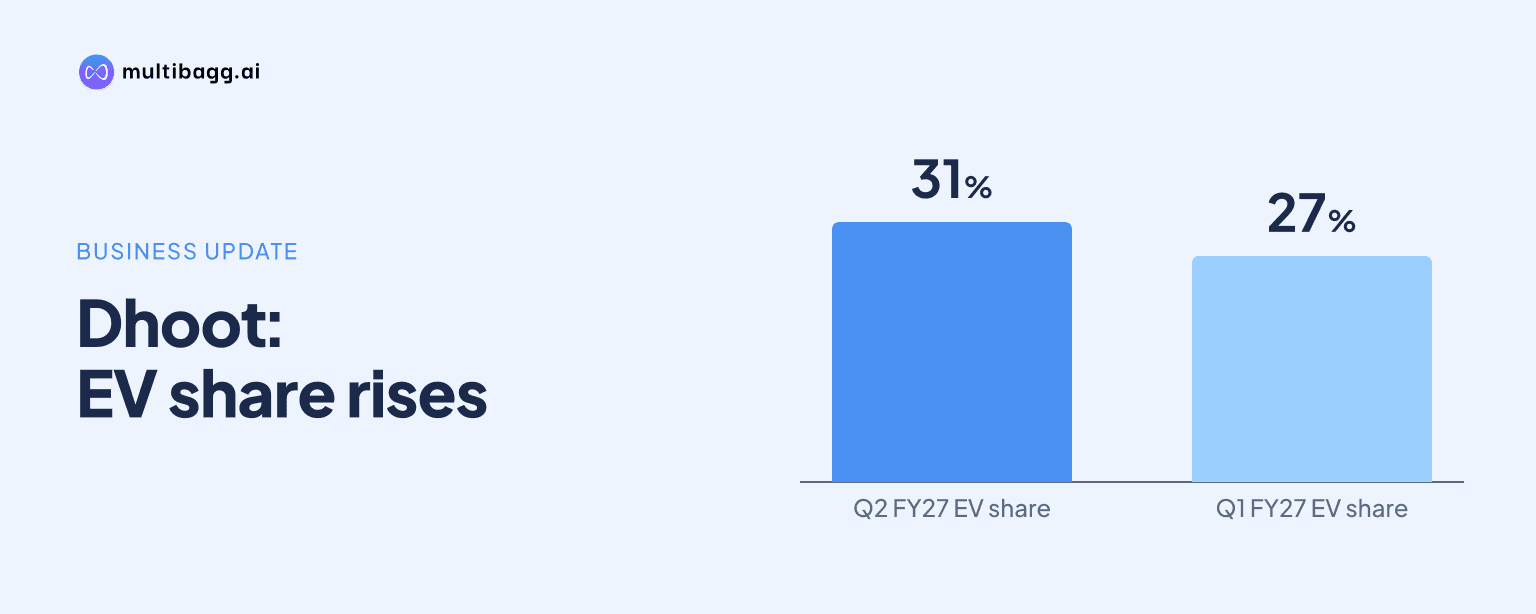
Dhoot Transmission Limited said EV supplied 31% of consolidated revenue in Q2 FY27, up from 27% in Q1 FY27, as it expanded content beyond wiring harnesses into battery packs, charging equipment, electronic control units and sensors. Dhoot also said about 95% of its portfolio is EV-focused or powertrain-neutral.
Know Dhoot Transmission inside out
Results, valuation, peers and who's buying, in one view.
How much of Dhoot revenue came from EV in Q2 FY27?
Dhoot said EV revenue represented 31% of consolidated revenue in Q2 FY27, a four-percentage-point increase from 27% in Q1 FY27. The company defines EV share as EV revenue divided by consolidated revenue, and said Multilink was consolidated from Q1 FY27.
The Q2 FY27 result followed a multi-year change in the reported mix. EV accounted for 16% of revenue in FY24, rose to 25% in FY25, declined to 24% in FY26 and then increased to 27% in Q1 FY27 before reaching 31% in Q2 FY27. The EV share was therefore 15 percentage points higher in Q2 FY27 than in FY24.
Dhoot reported a separate shift in product mix during Q2 FY27. Wiring harnesses accounted for 69% of revenue, compared with 78% in Q1 FY27 and 82% in FY24, while batteries, electronics and components accounted for 31% in Q2 FY27. The presentation does not state that product mix and EV revenue share are identical measures, but both indicate a larger contribution from non-harness products.
What electric two-wheeler components does Dhoot supply today?
Dhoot lists low-voltage wiring harnesses, high-voltage harnesses, charging guns and connectors, battery packs, switches, electronic control units, anti-lock braking system sensors, wheel-speed sensors and USB Type-C chargers as in-production electric-scooter products. Its schematic describes the low-voltage harness as a 12V control-and-signal system and the high-voltage cable as serving traction and charging.
The in-production range covers wiring and connection, battery and power, and controls and sensors. Dhoot also identifies a 48V traction pack, 12V auxiliary pack and charging gun as current battery and EV-electronics products, while its connection-systems portfolio includes connectors, terminals, fuses and junction boxes.
The broader product base is visible in the revenue mix. Wiring harnesses fell from 82% of revenue in FY24 to 77% in FY26 and 69% in Q2 FY27, while other products, comprising batteries, electronics and components, increased from 18% to 23% and then 31%. Dhoot said Multilink contributed for a full quarter in Q2 FY27.
Got a follow-up? Ask IRIS
Which Dhoot EV products remain in the pipeline?
Dhoot identifies a 12V battery-management system, a DC-DC converter, an off-board charger and tyre-pressure monitoring system sensors as pipeline products for electric scooters. The company also lists a 48V battery-management system among pipeline and longer-term battery and EV-electronics products.
Dhoot’s safety roadmap includes an advanced driver-assistance system camera and controller through a joint-venture pipeline. The company disclosed an agreement to enter a 67:33 joint venture with Ride Vision for advanced driver-assistance systems and advanced rider-assistance systems, and said proof-of-concept discussions with EV players were ongoing in Q2 FY27.
Its longer-term connection-systems roadmap includes power-distribution units, battery-distribution units and high-voltage harnesses for commercial vehicles and passenger vehicles. Dhoot also lists head-up displays, emergency-call systems and switches among pipeline or longer-term powertrain-agnostic electronics, alongside its current relays, EV power relays and USB chargers.
Dhoot said it had 237 research, design and engineering employees as of March 2026 and four engineering and design centres. Its disclosed development areas include EV battery packs, battery-management systems and chargers; high-voltage harnesses and connectors; sensors and electronic controllers; and premiumisation products such as switches and displays.
What battery capacity and customer milestones did Dhoot disclose?
Dhoot disclosed a new EV customer relationship with Hero, saying EV-related components started because of the Multilink acquisition. It also said powertrain-battery manufacturing for a new south India-based leading original equipment manufacturer had a stated start of production in June 2026.
Dhoot listed two new powertrain-battery manufacturing facilities in Hosur and Pune, with production commencement shown as June 2027 and September 2027. The company further said battery manufacturing capacity increased by 110% in H1 FY27, although the presentation does not provide the base capacity or an output measure.
The battery additions form part of a wider manufacturing programme. Dhoot reported 29 plants as of September 2026, compared with 22 operational plants at March 31, 2026, after adding three Multilink facilities, two battery plants and two wiring-harness plants in the preceding six months. It deployed Rs 292.9 crore of capital expenditure in H1 FY27 and revised FY27 capital expenditure to about Rs 750 crore from an initial budget of Rs 510 crore.
Dhoot has scheduled new wiring-harness facilities in Pune and Chennai for Q3 FY27, a Jhajjar facility for Q4 FY27, another Jhajjar site for Q2 FY28 and a Hosur facility for Q1 FY28. Management’s stated plan is to grow harness, EV charging and battery content per vehicle while adding capacity ahead of demand.
Conclusion
Dhoot’s Q2 FY27 presentation shows EV and electronics becoming a larger part of its revenue and product portfolio. EV supplied 31% of consolidated revenue, compared with 16% in FY24, while batteries, electronics and components reached 31% of Q2 FY27 revenue and wiring harnesses accounted for 69%.
The next disclosed milestones are the June 2027 and September 2027 production starts at the Hosur and Pune battery facilities, progress in the 67:33 Ride Vision joint venture and proof-of-concept discussions with EV players. Dhoot has also revised FY27 capital expenditure to about Rs 750 crore, but the presentation does not quantify future revenue from its pipeline products or new facilities.