










Dhoot Transmission targets local ADAS in a 90% import market
Key highlights
- Dhoot Transmission says about 90% of ADAS and ARAS products are imported today.
- Dhoot Transmission has agreed to a 67:33 JV with Ride Vision for ADAS and ARAS.
- The proposed venture has more than five customer engagements across multiple segments.
- EV represented 31% of Dhoot Transmission's Q2 FY27 revenue, versus 24% in FY26.
powered by IRIS
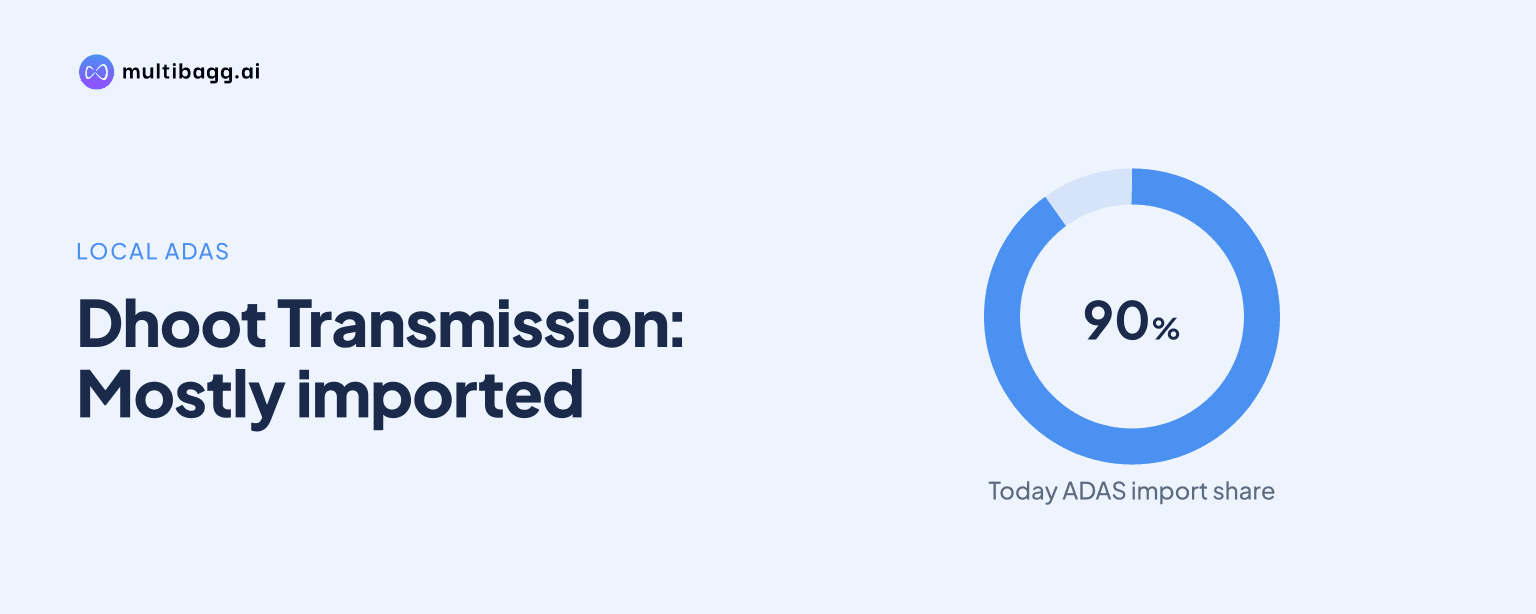
Dhoot Transmission Limited is pursuing a 67:33 joint venture with Ride Vision to localise camera-based advanced driver-assistance and rider-assistance systems, in a category where the company says about 90% of ADAS and ARAS products are imported. The proposed offering combines cameras, controllers, alert displays, harnesses and cables for five application areas.
Know Dhoot Transmission inside out
Results, valuation, peers and who's buying, in one view.
What is Dhoot Transmission's Ride Vision JV designed to do?
Dhoot Transmission's proposed Ride Vision joint venture is designed to bring camera-based safety and control devices to Indian vehicle applications using Ride Vision technology alongside Dhoot Transmission's harnesses, controllers and original-equipment manufacturer, or OEM, access. The company describes the ownership arrangement as 67:33 and says Ride Vision brings patented and proven camera-based driver-assist technology.
The proposed system has four stated hardware elements: a camera, controller, alert display or human-machine interface, and harnesses and cables. Human-machine interface, or HMI, means the display through which a rider or driver receives alerts. This configuration extends the company beyond supplying standalone wiring and electronic components into an integrated safety-device proposition.
Dhoot Transmission lists rider-assistance systems, or ARAS, alongside advanced driver-assistance systems, or ADAS, in its safety research-and-development focus. Its engineering organisation had 237 research, design and engineering employees as of March 2026, supported by four engineering and design centres and two international technology partners for electronics research and development.
The company’s stated development process runs from co-development with OEM engineering teams through in-house design, simulation, prototyping, testing, validation, industrialisation and serial production. Its serial-production model includes localised plants near customers and continuous value analysis and value engineering, or VAVE.
Why does Dhoot Transmission see an import-localisation opportunity?
Dhoot Transmission says approximately 90% of ADAS and ARAS is imported today, making localisation the central rationale for the Ride Vision venture. The presentation does not provide the size of this market, pricing, a production date or a revenue target, so the 90% figure is a company-stated import-share assessment rather than a disclosed sales forecast.
The company says the venture has more than five customer engagements across multiple segments. These engagements span two-wheelers, electric two-wheelers, forklifts, commercial vehicles and the aftermarket, creating a wider application set than rider alerts alone. The presentation does not identify those customers or say which engagements have advanced to purchase orders.
For two-wheelers, the stated use is rider alerts through ARAS. For electric two-wheelers, Dhoot Transmission specifies a camera and software application; for forklifts, it identifies human detection. Commercial vehicles and aftermarket applications complete the five named use cases, but the source does not disclose product specifications, programme volumes or launch schedules for any of them.
The localisation proposition also uses the company’s existing connection systems. Dhoot Transmission already supplies low-voltage and high-voltage harnesses, while the proposed JV product includes the cables and harnesses needed to connect the camera, controller and alert-display system. The presentation identifies that overlap as part of the portfolio fit between the camera-controller package and its wiring business.
Got a follow-up? Ask IRIS
How does the JV fit Dhoot Transmission's existing product portfolio?
Dhoot Transmission's Ride Vision plan fits a portfolio that is becoming less dependent on wiring harnesses: harnesses represented 69% of Q2 FY27 revenue, down from 82% in FY24, while batteries, electronics and other components represented 31%, up from 18%. The change coincided with the integration of Multilink, which the company acquired for sensors, relays and other electronic products.
Safety-critical electronics already include current products such as anti-lock braking system, or ABS, sensors, lean-angle sensors, gear-position sensors and flashers. In the pipeline and longer-term category, Dhoot Transmission lists ADAS cameras and electronic control units, access systems and tyre-pressure monitoring systems, or TPMS. The Ride Vision venture directly addresses the ADAS camera and controller part of that product roadmap.
The company also identifies an ADAS camera and controller as a joint-venture pipeline item within an electric-scooter schematic. In that same schematic, low-voltage harnesses, high-voltage harnesses, charging guns and connectors are in production, while a 12V battery-management system, direct-current to direct-current converter and off-board charger are in the pipeline. This places the proposed camera system beside existing and planned electric-vehicle components rather than as a separate business line.
Electrification is relevant because electric vehicles accounted for 31% of Dhoot Transmission's Q2 FY27 revenue, compared with 24% in FY26 and 27% in Q1 FY27. The company says about 95% of its portfolio is either electric-vehicle focused or powertrain-neutral. That exposure explains why electric two-wheelers are one of the five applications cited for the Ride Vision offering.
What evidence is there of engineering and customer readiness?
Dhoot Transmission has four engineering and design centres, including electronics facilities in Pune and Chhatrapati Sambhajinagar, a Bengaluru centre for wiring-harness components, and a Bengaluru electronics centre associated with Multilink. These locations support the company’s stated focus on electrification, connection, safety and premiumisation, with ADAS, sensors and electronic controllers listed under safety.
The company says its engineering team can develop products from concept to serial production in-house, including reliability and durability testing. However, the presentation does not state whether the Ride Vision camera and controller have completed local validation, received customer approvals or entered serial production. It says programme milestones will be added once cleared.
Customer discussions remain at an early stated stage in at least one adjacent area. Dhoot Transmission says proof-of-concept-level discussions are ongoing with electric-vehicle players, though the presentation does not explicitly assign those discussions to Ride Vision. More than five engagements indicate market outreach, but they are not disclosed contracts, nominated programmes or booked revenue.
The company’s broader electronics base expanded in Q2 FY27 because Multilink contributed a full quarter, while the proposed Ride Vision system would add a camera-and-software safety layer. The presentation therefore shows a strategic product fit, but it leaves commercial matters unresolved, including localisation timing, manufacturing location, customer conversion and venture economics.
Conclusion
Dhoot Transmission is attempting to move from a wiring-harness core into camera-based safety electronics through the 67:33 Ride Vision venture. Its case is based on a company-stated 90% import share for ADAS and ARAS, more than five customer engagements, and the ability to combine cameras and controllers with its existing harness and electronics portfolio. The shift is consistent with non-harness products increasing to 31% of Q2 FY27 revenue from 18% in FY24.
What to watch next are the programme milestones that Dhoot Transmission says will be added once cleared, and evidence that engagements convert into named customer programmes or serial production. The company’s roadmap places the ADAS camera and controller in the joint-venture pipeline rather than current production, while EV represented 31% of Q2 FY27 revenue.