










Dhoot raises FY27 capex to about ₹750 crore for capacity
Key highlights
- Dhoot revised FY27 capex to about ₹750 crore from an initial ₹510 crore budget.
- Dhoot deployed ₹292.9 crore of capex in H1 FY27, versus ₹328.1 crore in FY26.
- Dhoot had 29 plants in September 2026, up from 22 operational plants on 31 March 2026.
- Dhoot added 110% of additional battery-manufacturing capacity in H1 FY27.
powered by IRIS
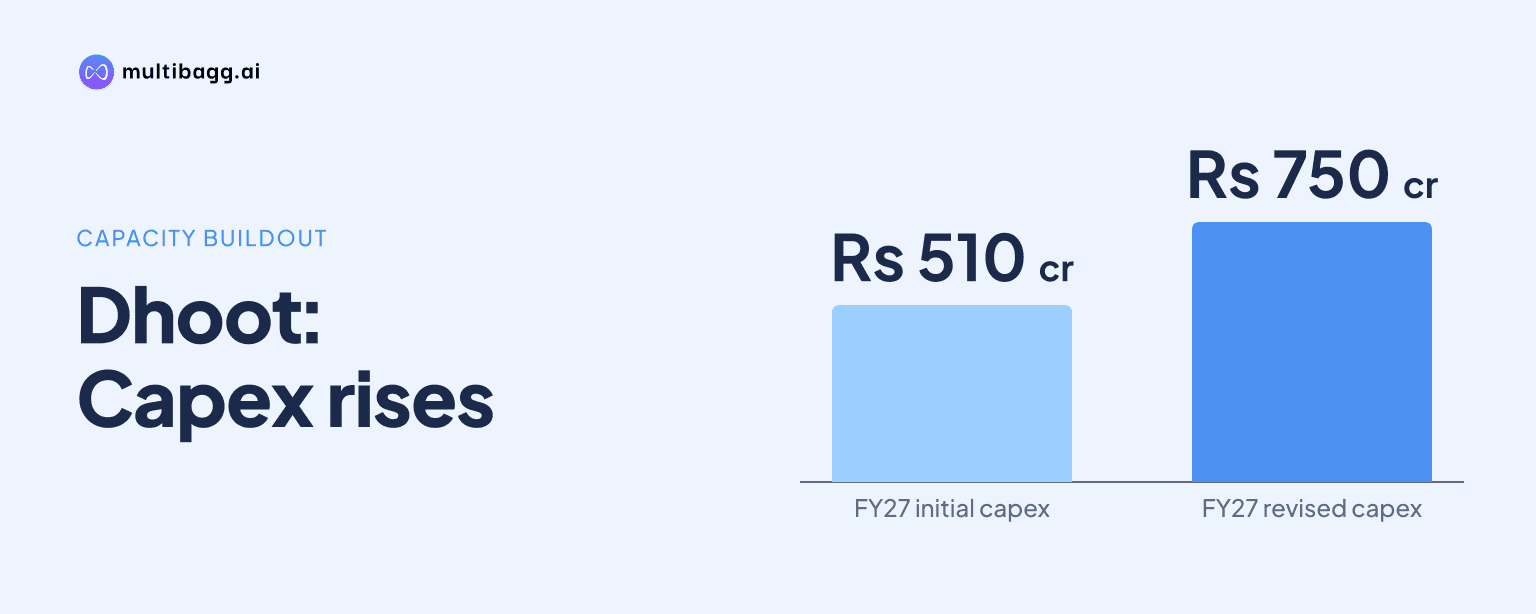
Dhoot Transmission Limited has revised FY27 capital expenditure to about ₹750 crore from an initial ₹510 crore budget, after deploying ₹292.9 crore in H1 FY27 and adding wiring-harness and battery capacity ahead of customer demand. Dhoot had 29 plants in September 2026, compared with 22 operational plants on 31 March 2026.
Know Dhoot Transmission inside out
Results, valuation, peers and who's buying, in one view.
Why did Dhoot raise FY27 capex?
Dhoot raised the FY27 capex plan to add manufacturing capacity before customer demand materialises under its core-business strategy. The revised outlay of about ₹750 crore is ₹240 crore above the initial ₹510 crore budget, while the company recorded ₹292.9 crore of capex deployed during H1 FY27.
The spending plan supports Dhoot’s stated aim of deepening its two-wheeler and three-wheeler presence through premium product content and capacity additions. Harness revenue increased 43% year on year in H1 FY27, versus 20% growth in two-wheeler industry retail units; Dhoot notes that this comparison measures its revenue against industry unit growth and is therefore indicative rather than like-for-like.
Electrification is another stated driver of the expansion. Dhoot’s electric-vehicle volumes rose 91% year on year in H1 FY27, compared with 76% growth in electric two-wheeler industry retail, while EV revenue reached ₹939.4 crore from ₹489.9 crore in H1 FY26. EVs accounted for 29% of H1 FY27 revenue.
How does Dhoot’s FY27 capex compare with earlier years?
Dhoot’s revised FY27 capex estimate of about ₹750 crore is above each prior annual amount disclosed and above the ₹500 crore shown for FY28. The planned FY27 outlay is more than twice FY26 capex of ₹328.1 crore and is nearly double the FY24 amount of ₹272.4 crore.
The capex trend rose from ₹272.4 crore in FY24 to ₹384.9 crore in FY25, declined to ₹328.1 crore in FY26, and then moved to a higher FY27 budget. H1 FY27 deployment of ₹292.9 crore was already close to the full FY26 total, but the remaining FY27 expenditure remains a revised plan rather than reported spending.
Dhoot’s presentation says FY27 capex will exceed earlier estimates, while its disclosed FY28 figure is ₹500 crore. The difference indicates that the larger FY27 programme includes spending linked to construction and commissioning schedules that extend beyond the current financial year, including wiring-harness capacity planned through FY29.
Which plants and wiring-harness facilities is Dhoot adding?
Dhoot had 29 plants in September 2026, up from 22 operational plants as of 31 March 2026. The company attributed the seven-facility increase over six months to three Multilink facilities, two battery plants and two wiring-harness plants.
Of the 29 existing plants, 26 are in India and three are outside India. The Indian network comprises nine sites in Chhatrapati Sambhajinagar, seven in Hosur, three in Pune, two each in Kanchipuram and Manesar, and one each in Mysore, Jhajjar and Pithampur.
Dhoot has listed five new wiring-harness plants under construction across four locations. A leased Pune plant and a leased Chennai plant are scheduled for Q3 FY27, a leased Jhajjar unit for Q4 FY27, a Hosur facility for Q1 FY28, and an owned Jhajjar facility for Q2 FY28.
The stated commissioning timetable means the capacity programme continues into FY28 rather than ending with FY27 capex deployment. Dhoot says about 55% of its new wiring-harness capacity is spread over two-and-a-half years from FY27 to FY29, and it has acquired land for two further plants at Chhatrapati Sambhajinagar and one site near Indore where construction is likely to start.
Got a follow-up? Ask IRIS
How is Dhoot expanding battery capacity and EV products?
Dhoot added 110% of additional battery-manufacturing capacity in H1 FY27 as part of its expansion programme. It also disclosed two new powertrain battery manufacturing facilities, at Hosur and Pune, with production commencement scheduled for June and September 2027, respectively.
Dhoot already has low-voltage wiring harnesses, high-voltage harnesses, charging guns, connectors and battery packs in production for electric scooters. Its product pipeline includes a 12-volt battery-management system, a direct-current-to-direct-current converter and an off-board charger, while an advanced driver-assistance systems camera and controller is listed as a joint-venture pipeline product.
EV revenue mix rose to 31% in Q2 FY27 from 27% in Q1 FY27 and 24% in FY26. Dhoot says approximately 95% of its portfolio is EV-focused or powertrain-neutral, and that EV-related components began through the Multilink acquisition, which was consolidated from Q1 FY27.
The product mix also changed during the expansion of non-harness activities. Wiring harnesses represented 69% of Q2 FY27 revenue, down from 77% in FY26 and 82% in FY24, while battery, electronics and components increased to 31% from 23% in FY26 and 18% in FY24.
What operating indicators accompany Dhoot’s capacity plan?
Dhoot’s H1 FY27 operating data shows growth above the disclosed two-wheeler retail indicators. Its EV volumes increased 91% year on year against 76% growth in industry electric two-wheeler retail, while total two-wheeler retail rose 20% and Dhoot harness revenue rose 43%.
Premium motorcycle mix is a further element of Dhoot’s core strategy. Dhoot’s share gain in 125cc-and-above bike volumes was 2.5 percentage points in H1 FY27 versus H1 FY26, compared with a 1.2-percentage-point gain for industry bikes over the same period.
Revenue from operations increased 23.1% in FY25, 31.4% in FY26 and 56% year on year in H1 FY27. H1 FY27 revenue reached ₹3,273.6 crore, equal to 72% of FY26 revenue of ₹4,525 crore, although Dhoot has not disclosed a full-year FY27 revenue target.
Conclusion
Dhoot’s revision of FY27 capex to about ₹750 crore combines a larger near-term spending plan with plant additions, 110% additional battery-manufacturing capacity in H1 FY27 and a multi-year wiring-harness buildout. The programme follows faster reported growth in harness revenue and EV volumes than the industry retail measures disclosed by the company, alongside a higher EV and non-harness revenue mix.
What to watch next is execution against the disclosed timetable: the Pune and Chennai leased wiring-harness plants are scheduled for Q3 FY27, the leased Jhajjar facility for Q4 FY27, and the Hosur and owned Jhajjar facilities for FY28. Dhoot has also said construction is likely to start on acquired land near Indore, while FY27 spending remains subject to delivery against the revised estimate of about ₹750 crore.