










Dhoot EV revenue reaches 31% of total revenue in Q2 FY27
Key highlights
- Dhoot's EV revenue share rose from 27% in Q1 FY27 to 31% in Q2 FY27.
- Wiring harnesses represented 69% of Q2 FY27 revenue, while batteries, electronics and components represented 31%.
- Dhoot reported 110% additional battery-manufacturing capacity in H1 FY27.
- Dhoot had 29 plants in September 2026, compared with 22 operational plants at 31 March 2026.
powered by IRIS
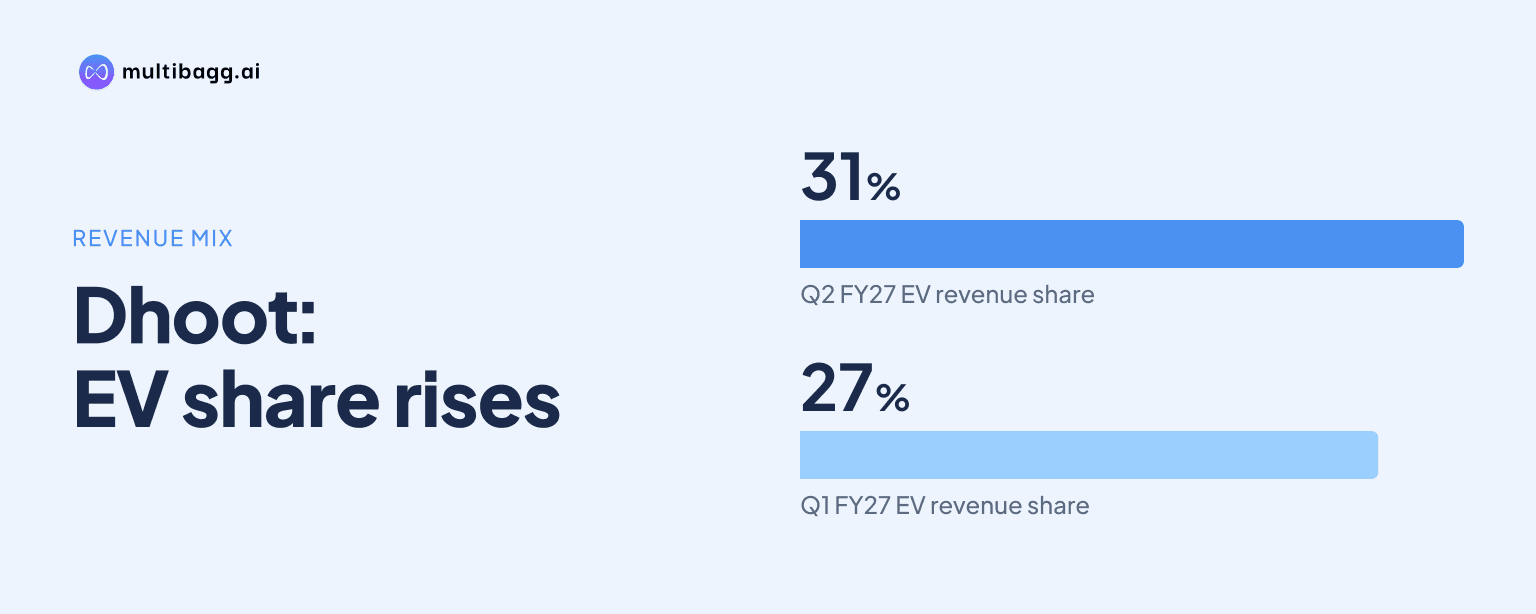
Dhoot Transmission Limited reported EV revenue equal to 31% of consolidated revenue in Q2 FY27, up from 27% in Q1 FY27 and 24% in FY26. The increase came as Dhoot expanded battery, high-voltage harness and electronics content, while Multilink was consolidated from Q1 FY27.
Know Dhoot Transmission inside out
Results, valuation, peers and who's buying, in one view.
How quickly has Dhoot's EV revenue mix changed?
Dhoot's EV revenue share increased by 4 percentage points sequentially to 31% in Q2 FY27 from 27% in Q1 FY27. It was also 7 percentage points above FY26's 24% and 15 percentage points higher than FY24's 16%, based on the company's definition of EV revenue as a share of consolidated revenue.
The rise was not continuous across the full period. EV revenue accounted for 25% of revenue in FY25, before slipping by 1 percentage point to 24% in FY26, then rising through the first two quarters of FY27. Dhoot says Multilink was consolidated from Q1 FY27, which is relevant because the acquired business supplies sensors, relays and other electronic products.
Dhoot also says about 95% of its portfolio is EV-focused or powertrain-neutral. This describes the applicability of its product range, including components that can be used regardless of propulsion type, rather than indicating that 95% of Q2 FY27 revenue was EV revenue. The separately reported EV-revenue share was 31%.
Which electric-two-wheeler products does Dhoot make today?
Dhoot lists low-voltage main wiring harnesses, high-voltage harnesses, charging guns and connectors, and battery packs as in production for electric two-wheelers. In its electric-scooter schematic, the low-voltage harness handles 12-volt control and signal functions, while the high-voltage cable supports traction and charging.
Dhoot also identifies switches, electronic control units, anti-lock braking system, or ABS, sensors or wheel-speed sensors, and USB Type-C chargers as current products. These components span wiring and connection, battery and power, and controls and sensors, extending Dhoot's content beyond the main wiring harness.
The pipeline includes a 12-volt battery-management system, or BMS, a DC-DC converter, an off-board charger and tyre-pressure monitoring system, or TPMS, sensors. An advanced driver-assistance system, or ADAS, camera and controller is classified as a joint-venture pipeline product, rather than a Dhoot product already in production.
Dhoot's product-family roadmap also lists 48-volt traction packs, 12-volt auxiliary packs and charging guns as current battery and EV-electronics products. It identifies off-board chargers, DC-DC converters, 12-volt and 48-volt BMS products, power-distribution units and battery-distribution units as pipeline or longer-term opportunities.
What has changed in Dhoot's product mix beyond wiring harnesses?
Dhoot's wiring-harness share of revenue fell to 69% in Q2 FY27 from 78% in Q1 FY27, while other products rose to 31% from 23%. The other-products category includes batteries, electronics and components; its 31% Q2 FY27 share is not defined by Dhoot as the same measure as its separately reported EV-revenue share.
The longer comparison also shows a change in mix. Wiring harnesses represented 82% of revenue in FY24 and 77% in FY26, while other products rose from 18% to 23%. By Q2 FY27, the non-harness share was 13 percentage points above FY24, with Dhoot citing the integration of Multilink.
Dhoot says Multilink, which is involved in sensors, relays and other electronic products, contributed a full quarter in Q2 FY27. Dhoot also identifies Hero as a new EV customer and says EV-related components started through the Multilink acquisition, linking the new customer development with the electronics expansion.
Got a follow-up? Ask IRIS
How is Dhoot expanding battery manufacturing and EV content?
Dhoot disclosed two new powertrain-battery manufacturing facilities in Hosur and Pune, with commencement of production listed for June and September 2027. The company also reported 110% additional battery-manufacturing capacity in H1 FY27, although the presentation does not disclose capacity in units, energy capacity or output.
Separately, Dhoot listed powertrain-battery manufacturing for a new south India-based leading original equipment manufacturer, or OEM, with start of production in June 2026. The customer was not named. Dhoot's disclosed battery programme therefore combines production for a new customer with facilities scheduled to commence production in 2027.
The expansion is part of a wider capacity plan. Dhoot deployed Rs 292.9 crore of capital expenditure in H1 FY27 and revised FY27 capital expenditure from an initial Rs 510 crore budget to about Rs 750 crore. It reported 29 plants in September 2026, compared with 22 operational plants at 31 March 2026, after adding three Multilink facilities, two battery plants and two wiring-harness plants in six months.
What capabilities support Dhoot's electronics roadmap?
Dhoot reported 237 research, development, design and engineering employees as of March 2026 across four engineering and design centres. The centres include electronics locations in Pune and Chhatrapati Sambhajinagar, a Bengaluru centre for wiring-harness components, and a Bengaluru electronics Multilink centre.
Its stated research and development priorities include EV battery packs, BMS products and chargers under electrification; wiring, high-voltage harnesses and connectors under connection; and ADAS, sensors and electronic controllers under safety. Dhoot also reported two international technology partners supporting electronics research and development, without naming them.
Dhoot describes an in-house sequence that begins with co-development alongside OEM engineering teams and moves through design, simulation, prototyping, testing, industrialisation and serial production. The process includes reliability and durability laboratories, tooling engineering, bill-of-material customisation and localised plants near customers.
Conclusion
Dhoot's Q2 FY27 presentation shows that EV revenue reached 31% of consolidated revenue as wiring harnesses declined to 69% of revenue and batteries, electronics and components reached 31%. Current EV content includes battery packs, high-voltage harnesses, charging products, electronic control units and sensors, while several power-electronics and safety products remain in the pipeline.
The next disclosed milestones are June and September 2027 production commencements for the Hosur and Pune powertrain-battery facilities. Dhoot's execution will also be measured against its revised FY27 capital-expenditure plan of about Rs 750 crore and progress in converting BMS, chargers, converters and joint-venture ADAS products from pipeline status into production.