










Diensten Tech Limited GCC share was 60.6% as concentration fell
Key highlights
- DTL earned Rs 98.7 crore, or 60.6% of Rs 162.8 crore FY26 revenue, from GCC clients.
- DTL's top-five client concentration declined to 57.3% in FY26 from 69.4% in FY25.
- DTL's billing clients increased from 36 in FY25 to 65 in FY26.
- DTL reported 2,058 professionals deployed at clients in H1 FY27, versus 1,896 in FY26.
powered by IRIS
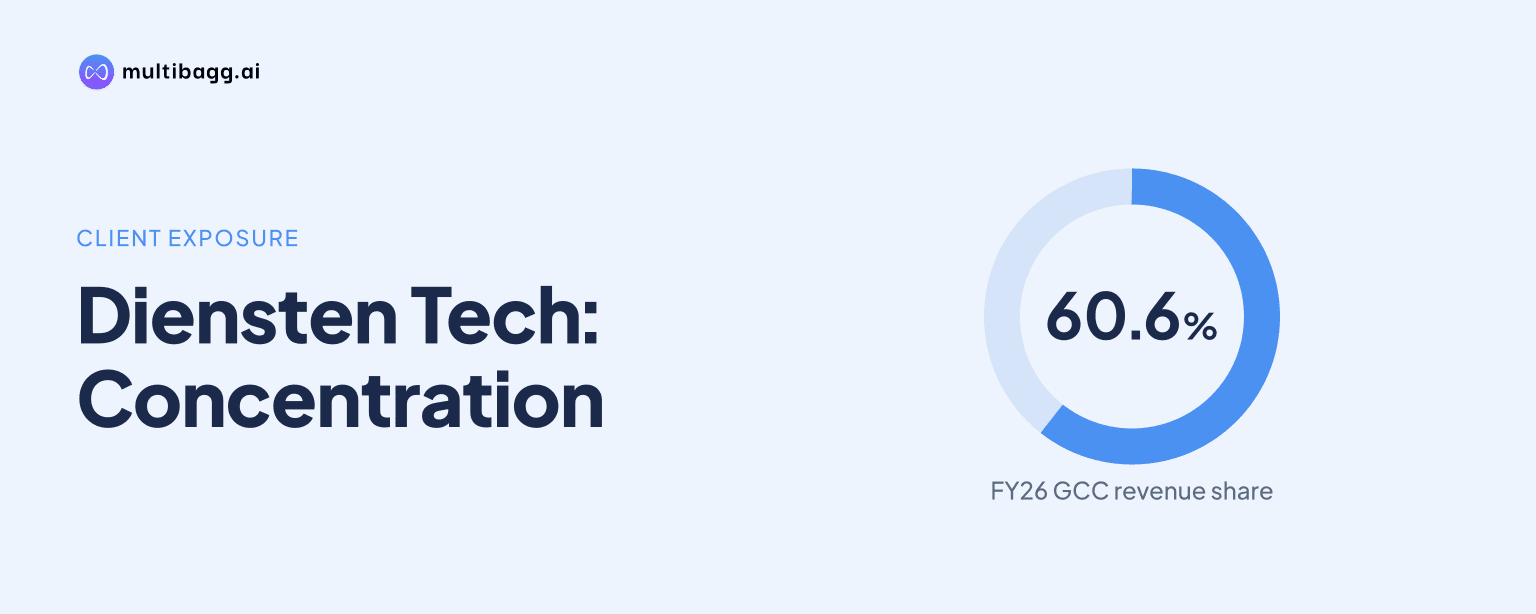
Diensten Tech Limited derived 60.6% of FY26 revenue, or Rs 98.7 crore of Rs 162.8 crore, from Global Capability Centre clients, while its top-five client share fell to 57.3% from 69.4% in FY25. The mix shows DTL remained closely tied to GCC demand even as billing clients increased from 36 to 65.
Know Diensten Tech inside out
Results, valuation, peers and who's buying, in one view.
How dependent was DTL on GCC clients in FY26?
DTL received Rs 98.7 crore from GCC clients in FY26, representing 60.6% of its Rs 162.8 crore total revenue. Domestic clients supplied the remaining Rs 64.1 crore, or 39.4%, making GCCs DTL’s larger client channel by Rs 34.6 crore during the year.
The GCC share moderated from 71.3% in FY25 to 60.6% in FY26, but remained above the 48.4% recorded in FY24. GCC revenue grew 114% in FY26 over FY25, according to DTL, while domestic revenue rose 244% after a FY25 decline. This means the domestic channel grew faster in FY26, reducing GCCs’ percentage contribution despite continued GCC revenue growth.
DTL describes its direction as moving from a staffing provider to a long-term GCC delivery partner. Its FY27 priorities include deepening wallet share with existing GCC clients, expanding the client base and building a growing Middle East presence. The presentation also cites FY27 Union Budget measures involving a unified safe-harbour margin for IT services and an extended tax holiday for foreign cloud providers as supportive for GCCs and cloud.
Did DTL reduce its reliance on its biggest clients?
DTL reduced the top-five clients’ share of revenue to 57.3% in FY26 from 69.4% in FY25, a decline of 12.1 percentage points. The change coincided with billing clients rising from 36 in FY25 to 65 in FY26, broadening the reported revenue base while DTL continued to derive more than half of revenue from five customers.
The reduction was concentrated among clients ranked two through five, whose combined contribution fell to 37.2% in FY26 from 47.0% in FY25. The largest client accounted for 20.1%, down from 22.4% in FY25 but above 17.9% in FY24. Revenue from all other clients rose to 25.1% from 10.6% in FY25, while the top six through ten supplied 17.6%, compared with 20.0% a year earlier.
DTL reported 23 clients generating more than Rs 1 crore in FY26, alongside 65 client logos overall. Its revenue-quality data show 60.4% of FY26 revenue came from continuing clients, 24.0% from first-time clients and 15.6% from returning clients. These categories indicate that both existing and newly active relationships contributed to FY26 billing.
Got a follow-up? Ask IRIS
Which sectors generated DTL’s FY26 revenue?
DTL’s largest FY26 vertical was system integration at Rs 57.3 crore, followed by engineering research and development, or ER&D, at Rs 22.9 crore and automobiles at Rs 22.8 crore. GCC Tech generated Rs 16.8 crore and consulting Rs 11.8 crore, showing that GCC client-channel concentration did not correspond to one reported industry vertical.
System integration represented about 35% of DTL’s Rs 162.8 crore FY26 revenue, substantially above the next two verticals, each close to Rs 23 crore. DTL’s industry overview separately groups 35% of activity in IT Services and system integration, with 65% in other verticals including healthcare or pharma, ER&D, automotive and consulting. This reported split is broader than the detailed vertical revenue listing.
Other reported FY26 verticals included oil and gas at Rs 5.9 crore, healthcare at Rs 5.5 crore, electronics at Rs 3.4 crore, e-commerce at Rs 2.7 crore and retail at Rs 2.6 crore. Eleven other verticals together contributed Rs 11.1 crore. DTL stated that it had 68 active clients spanning 18 industries, covering technology, financial services, automotive and manufacturing, energy, oil and gas, telecom and consumer categories.
What operating model supports DTL’s GCC client work?
DTL reported 2,058 professionals deployed at clients in H1 FY27, up from 1,896 in FY26 and 741 in FY25. DTL’s Hire–Train–Deploy model uses its in-house learning and development function to upskill available personnel in artificial intelligence, data and cloud skills before placement with clients.
The workforce included 761 people in Enterprise Platforms, or 37.0% of the 2,058 deployed professionals, and 261 in AI, Data & Cloud, or 12.7%. The AI, Data & Cloud group included 31 people in generative AI, machine learning and natural language processing. Infrastructure & Operations accounted for 317 deployed professionals, while Engineering & Embedded had 238.
DTL says it can provide first shortlisted profiles in one to three days, compared with more than 45 days for critical roles in the market cited in its presentation. It reports a two-to-five-day backfill turnaround time, or TAT, and 25 to 30 days for joining. DTL had about 2,300 people on rolls, 38 on the bench and a 171-person core team, supported by 415 or more sourcing locations and five delivery centres.
Contract staffing accounted for about 98% of DTL’s FY26 revenue and managed services about 2%. DTL says a statement of work, or SOW, contract can outlast the deployment of an individual resource. Its stated plan is to increase managed-services, SOW and outcome-based revenue, where DTL owns delivery rather than only supplying resources.
Conclusion
DTL’s FY26 client mix combined a Rs 98.7 crore GCC revenue stream with a measurable broadening of its customer base. GCC revenue remained 60.6% of total revenue, lower than FY25’s 71.3% share but above FY24’s 48.4%, while top-five concentration declined by 12.1 percentage points to 57.3% and all-other-client contribution reached 25.1%.
The next disclosed milestones are management’s FY29 ambitions for five-times revenue growth and 10-times earnings before interest, tax, depreciation and amortisation, or EBITDA, growth. Investors can also watch execution of the stated Middle East expansion, the plan to scale AI, data and cloud Hire–Train–Deploy capacity, and the effort to raise managed-services and SOW revenue from its current roughly 2% FY26 share.