










DTL deployed workforce rose to 2,058, versus 741 in FY25
Key highlights
- DTL deployed 2,058 professionals in H1 FY27, compared with 1,896 in FY26 and 741 in FY25.
- Enterprise Platforms employed 761 deployed professionals, representing 37.0% of DTL's H1 FY27 workforce.
- DTL reported 38 people on the bench, 171 core-team members and about 2,300 people on rolls in H1 FY27.
- Contract staffing contributed about 98% of FY26 revenue, while managed services contributed about 2%.
powered by IRIS
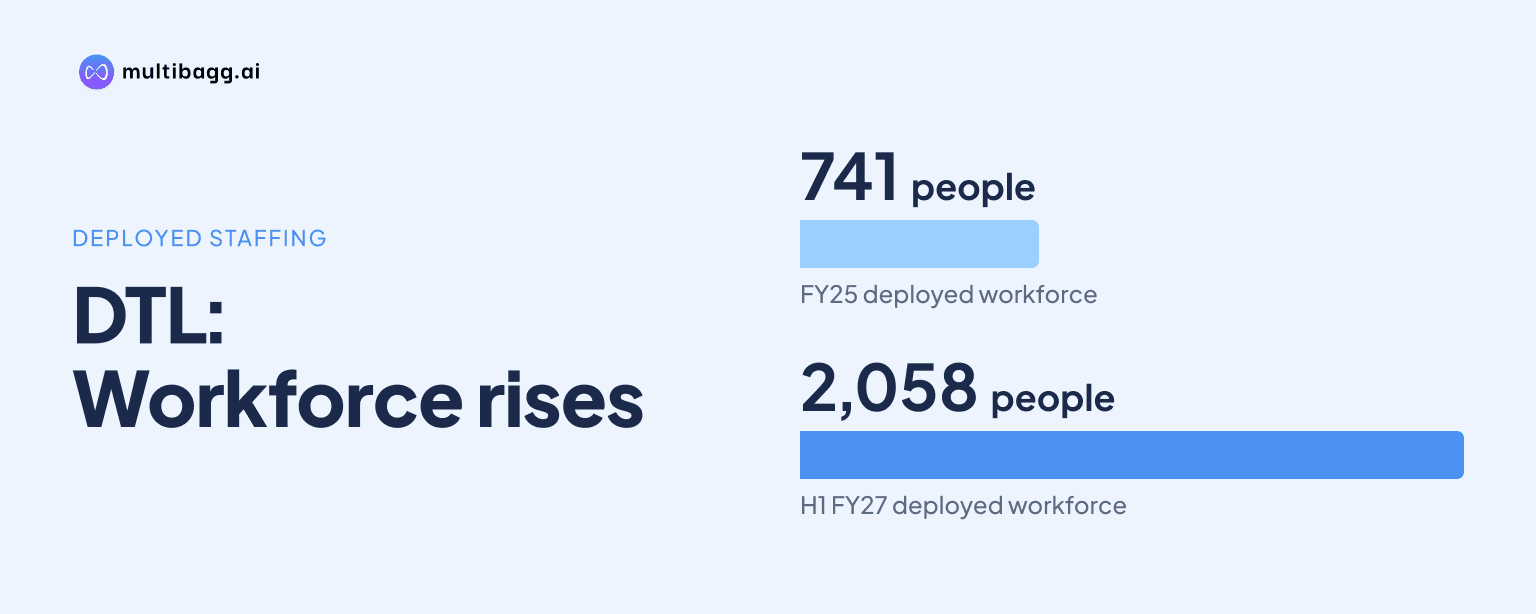
Diensten Tech Limited reported 2,058 professionals deployed at clients in H1 FY27, compared with 1,896 in FY26 and 741 in FY25, while Enterprise Platforms accounted for 761 people, or 37.0%, of the latest workforce. The presentation does not disclose the 42% annual associate-attrition figure stated in the topic.
Know Diensten Tech inside out
Results, valuation, peers and who's buying, in one view.
How large was DTL's deployed workforce in H1 FY27?
DTL had 2,058 professionals deployed at clients in H1 FY27, up 162 from 1,896 in FY26 and 1,317 from 741 in FY25. The deployed workforce more than doubled between FY25 and FY26 before increasing further in H1 FY27. DTL reported 68 active enterprise logos on multi-year master service agreements and more than 415 sourcing locations across tier 1, tier 2 and tier 3 cities.
DTL's H1 FY27 workforce-location data showed about 2,300 people on rolls, including 2,058 deployed at clients, 38 on the bench and 171 in the core team. The total of deployed workers, bench and core team equals 2,267, while the on-roll figure is presented as an approximation. The company says its in-house learning and development, or L&D, function keeps bench talent deployable between assignments to reduce time to bill.
The supplied presentation does not state an annual associate-attrition rate, define associate attrition or provide an earlier-period comparison. Therefore, the stated 42% figure cannot be verified from these pages. The disclosed workforce measures instead cover deployment headcount, bench size, sourcing coverage, candidate activity and hiring turnaround times.
Which skills made up DTL's deployed workforce?
Enterprise Platforms was DTL's largest practice in H1 FY27, with 761 deployed professionals, or 37.0% of the 2,058 total. Infrastructure & Operations was next with 317 people, or 15.4%, followed by AI, Data & Cloud with 261, or 12.7%. The practice mix indicates that enterprise-platform capabilities formed the largest part of the deployed workforce.
Within Enterprise Platforms, DTL listed 186 SAP personnel, 156 in Java, Spring and Angular, 138 in Oracle, and 133 in .Net, C# and Azure. AI, Data & Cloud included 77 people in business intelligence and analytics, 77 in cloud, DevOps and big data, and 31 in generative artificial intelligence, machine learning and natural language processing. These component counts describe roles within the 261-person AI, Data & Cloud practice.
Infrastructure & Operations included 177 personnel in infrastructure L1, L2 and L3 roles and 140 in information-technology-enabled services and customer support. Engineering & Embedded comprised 238 C, C++ and embedded-systems personnel. Quality Engineering included 61 software development engineers in test and 52 automation-testing personnel within its 232-person practice total.
Got a follow-up? Ask IRIS
How does DTL move people from sourcing to deployment?
DTL says it can provide first shortlisted profiles in one to three days, compared with an in-house benchmark of more than 45 days for critical roles. The company reported a backfill turnaround time, or TAT, of two to five days and an overall joining time of about 25 to 30 days. These are stated operating capabilities rather than a disclosed measurement of completed placements or employee retention.
The sourcing model covers more than 415 locations and five delivery centres across Delhi NCR, Bengaluru, Hyderabad, Mumbai and the United States. In Q2FY27, DTL reported sourcing 131,137 candidates and releasing 508 offers. The company says its Hire-Train-Deploy approach trains talent for the specific technology stacks used by clients instead of waiting for the external labour market to supply those skills.
DTL says its L&D arm upskills bench talent in artificial intelligence, data and cloud technologies. Its stated purpose is to keep people deployable between assignments and shorten time to bill. The company reported a 38-person bench in H1 FY27 against 2,058 deployed professionals, but did not provide a historical bench comparison or a utilisation percentage.
How does DTL's staffing model connect workforce and revenue?
Contract staffing contributed about 98% of DTL's FY26 revenue, while managed services contributed about 2%. This engagement mix makes deployed personnel central to the revenue model. DTL says a statement of work, or SOW, contract can outlast an individual resource, describing a mechanism through which a client engagement may continue when personnel change.
DTL reported FY26 revenue of Rs 162.8 crore, including Rs 98.7 crore from Global Capability Centre, or GCC, clients and Rs 64.1 crore from domestic clients. GCC clients accounted for about 60% of total billing, and DTL reported 65 client logos in FY26. The GCC share was 60.6% in FY26, down from 71.3% in FY25 but above 48.4% in FY24.
Client concentration declined as billing clients increased. The top five clients represented 57.3% of FY26 revenue, compared with 69.4% in FY25, while billing clients rose from 36 to 65 over the same period. DTL also reported that continuing clients produced 60.4% of FY26 revenue, first-time clients produced 24.0%, and returning clients produced 15.6%.
Conclusion
DTL expanded its deployed workforce from 741 professionals in FY25 to 1,896 in FY26 and 2,058 in H1 FY27. Enterprise Platforms was the largest practice at 37.0% of deployed professionals, while contract staffing accounted for about 98% of FY26 revenue. GCC clients remained the larger revenue channel at Rs 98.7 crore, compared with Rs 64.1 crore from domestic clients.
What to watch next is execution of DTL's stated Hire-Train-Deploy and L&D model, including its ability to keep bench talent deployable between assignments while supporting client demand through 415-plus sourcing locations. The presentation also leaves associate attrition, utilisation and placement-completion measures undisclosed, despite reporting a 38-person bench and a joining time of about 25 to 30 days.