










Diensten Tech Limited H1 FY27 revenue up 162%, net profit ₹3.30 crore
Key highlights
- DTL’s H1 FY27 revenue from operations rose 161.6% to ₹134.31 crore.
- H1 FY27 EBITDA increased 256.4% to ₹9.98 crore and margin rose to 7.4% from 5.4%.
- H1 FY27 PAT turned to a ₹3.30 crore profit from a ₹1.03 crore loss.
- GCC clients contributed around 60% of DTL’s H1 FY27 revenue, with 68 active enterprise logos.
powered by IRIS
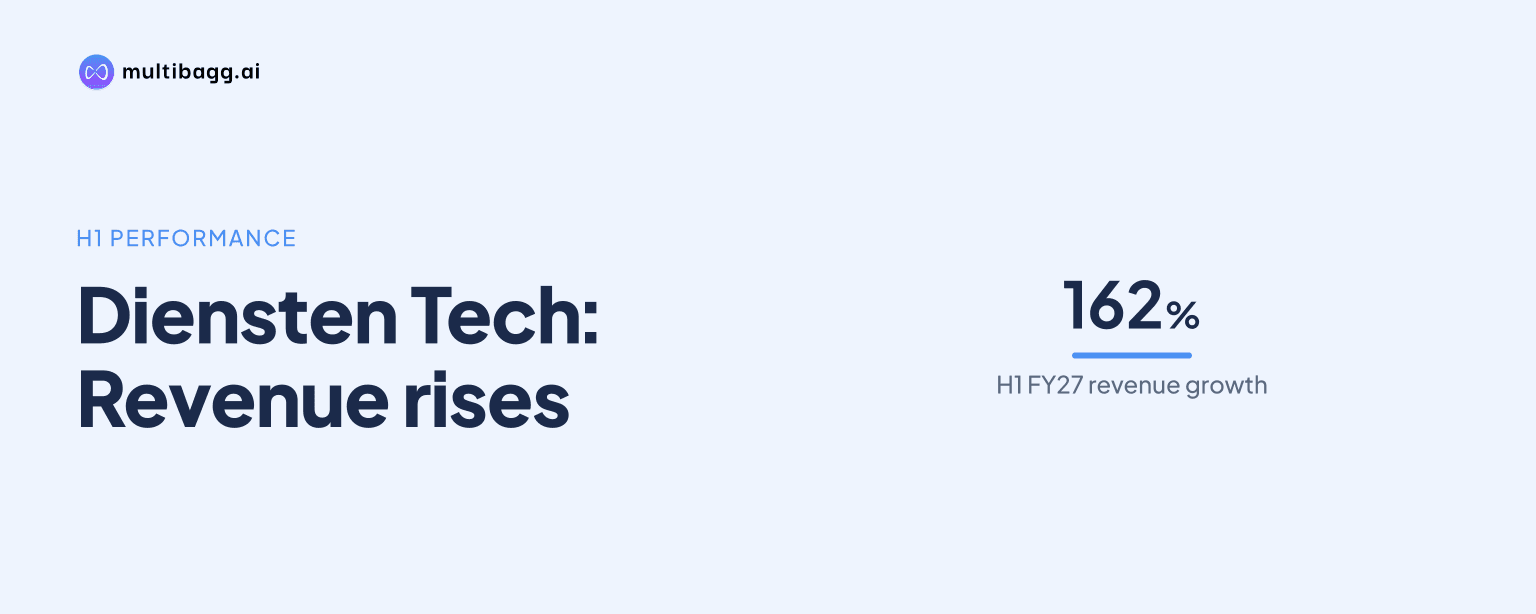
Diensten Tech Limited reported H1 FY27 revenue from operations of ₹134.31 crore, up 161.6% from ₹51.35 crore a year earlier, while net profit turned to ₹3.30 crore from a ₹1.03 crore loss. Earnings before interest, tax, depreciation and amortisation margin rose 200 basis points to 7.4%.
Know Diensten Tech inside out
Results, valuation, peers and who's buying, in one view.
How did DTL perform in H1 FY27?
DTL delivered higher revenue, operating earnings and net profit in H1 FY27. Revenue from operations increased by ₹82.96 crore year on year to ₹134.31 crore, while total income rose 160.7% to ₹135.76 crore from ₹52.08 crore. The company reported earnings before interest, tax, depreciation and amortisation, or EBITDA, of ₹9.98 crore, compared with ₹2.80 crore in H1 FY26.
The increase in EBITDA exceeded the increase in revenue. EBITDA grew 256.4%, lifting the EBITDA margin to 7.4% from 5.4% in H1 FY26. Profit before tax, or PBT, reversed from a loss of ₹1.32 crore to a profit of ₹4.82 crore, and profit after tax, or PAT, reversed from a ₹1.03 crore loss to ₹3.30 crore. PAT margin moved to 2.5% from negative 2.0%.
What changed in DTL’s margins and costs?
DTL’s operating margin rose because EBITDA grew faster than revenue in H1 FY27. Its ₹9.98 crore EBITDA represented 7.4% of revenue, compared with ₹2.80 crore and 5.4% in H1 FY26. This was a 200-basis-point improvement, where one basis point equals one-hundredth of a percentage point, alongside an ₹82.96 crore increase in revenue from operations.
Costs increased in absolute terms but at differing rates during the half year. Employee benefits expense rose 134.1% to ₹99.66 crore from ₹42.57 crore, below the 161.6% revenue increase. Other expenses increased 289.4% to ₹26.13 crore from ₹6.71 crore, while depreciation and amortisation declined 3.2% to ₹1.82 crore. Finance costs rose 49.8% to ₹3.34 crore from ₹2.23 crore, yet PBT reached ₹4.82 crore.
The net-profit reversal included a higher tax charge. DTL recorded tax expense of ₹1.52 crore in H1 FY27, compared with a ₹0.29 crore tax credit in H1 FY26. Despite that year-on-year shift, PAT was ₹3.30 crore and diluted earnings per share were ₹3.94, compared with a loss per share of ₹1.23 in the previous corresponding half year.
What does Q2 FY27 indicate about DTL’s recent momentum?
DTL’s Q2 FY27 revenue from operations was ₹68.88 crore, 135.9% above ₹29.20 crore in Q2 FY26 and 5.3% above ₹65.43 crore in Q1 FY27. The quarter therefore added ₹3.45 crore of revenue sequentially. Management attributed the quarter-on-quarter revenue increase primarily to new customer logos and increased business in the GCC market.
Q2 EBITDA increased 205.8% year on year to ₹5.29 crore, and rose 12.8% from ₹4.69 crore in Q1 FY27. EBITDA margin increased to 7.6% from 5.8% a year earlier and 7.0% in the preceding quarter. Management attributed the sequential EBITDA improvement to operational efficiency, while it said employee benefits as a percentage of revenue declined by about 4% sequentially because of automation and improved productivity.
Quarterly PAT was ₹1.67 crore, reversing a ₹0.41 crore loss in Q2 FY26 and increasing 2.5% from ₹1.63 crore in Q1 FY27. PAT margin was 2.4%, versus negative 1.4% a year earlier, although it was 10 basis points below Q1 FY27’s 2.5%. Finance costs rose to ₹1.79 crore in Q2 FY27 from ₹1.25 crore a year earlier and ₹1.55 crore in Q1 FY27.
Got a follow-up? Ask IRIS
How significant is GCC business and DTL’s operating scale?
GCC, the presentation’s label for a key customer market, accounted for about 60% of DTL’s H1 FY27 revenue. DTL also reported 68 active enterprise logos in H1 FY27. The chief executive identified GCC as a key growth market and said the company’s forward focus was on sustaining growth, strengthening profitability and pursuing opportunities across GCC and other markets.
Deployment data show associates deployed rose to 481 in Q2 FY27 from 444 in Q1 FY27, though they remained below 607 in Q3 FY26. Karnataka accounted for 41.9% of the deployed mix, followed by Uttar Pradesh at 19.0%, Telangana at 15.9%, Maharashtra at 11.2% and Haryana at 9.4%. DTL’s internal core headcount was 171 in September 2026, compared with 180 in June 2026.
The presentation also reported 2,058 associates in Q2 FY27, up from 1,988 in Q1 FY27 and 815 in Q2 FY26. Revenue per associate was ₹3.3 lakh in both Q1 and Q2 FY27, versus ₹3.6 lakh in Q2 FY26. EBITDA per associate was ₹25,700 in Q2 FY27, compared with ₹23,600 in Q1 FY27 and ₹21,300 in Q2 FY26.
How does H1 FY27 fit DTL’s longer financial trend?
DTL’s H1 FY27 outcome followed a full-year recovery in FY26. Revenue increased to ₹162.80 crore in FY26 from ₹64.90 crore in FY25, a reported 151% increase, while EBITDA rose to ₹9.80 crore from ₹2.30 crore. The EBITDA margin improved to 5.9% from 3.6%, an expansion of 230 basis points, and PBT returned to ₹1.80 crore after a ₹2.90 crore loss in FY25.
Over the four financial years shown, revenue rose from ₹37.50 crore in FY23 to ₹162.80 crore in FY26, which the presentation describes as a 4.3-times scale-up. EBITDA moved from ₹1.60 crore in FY23 to a loss of ₹1.60 crore in FY24, then to ₹2.30 crore in FY25 and ₹9.80 crore in FY26. PBT was positive at ₹0.20 crore in FY23, negative in FY24 and FY25, and positive again in FY26.
Conclusion
DTL’s H1 FY27 results show that revenue growth was accompanied by higher operating profitability and a reversal to net profit. Revenue expanded 161.6% to ₹134.31 crore, while EBITDA increased 256.4% to ₹9.98 crore, producing a 7.4% EBITDA margin. The movement from a ₹1.03 crore PAT loss to ₹3.30 crore profit is the clearest measure of the reported turnaround.
The next indicators are whether DTL sustains revenue growth, profitability and GCC’s contribution to revenue. Management has identified sustained growth, stronger profitability, and opportunities across GCC and other markets as its forward focus, while Q2 FY27 associate deployment rose to 481 from 444 in Q1 FY27.