










Digitide mobilises nearly 700 for 1,000-person Philippines BOT
Key highlights
- Digitide signed a Philippines BOT mandate requiring 1,000 hires and said nearly 700 people were already in mobilisation.
- Digitide disclosed five GCC implementations: four India managed-services assignments and one Philippines BOT engagement.
- AI revenue was Rs 30.5 crore in Q2, or 4.1% of overall revenue, compared with 1.9% in Q1.
- ACV bookings rose to Rs 160 crore in Q2 from Rs 118 crore in Q1, while AI’s share increased to 29% from 14%.
powered by IRIS
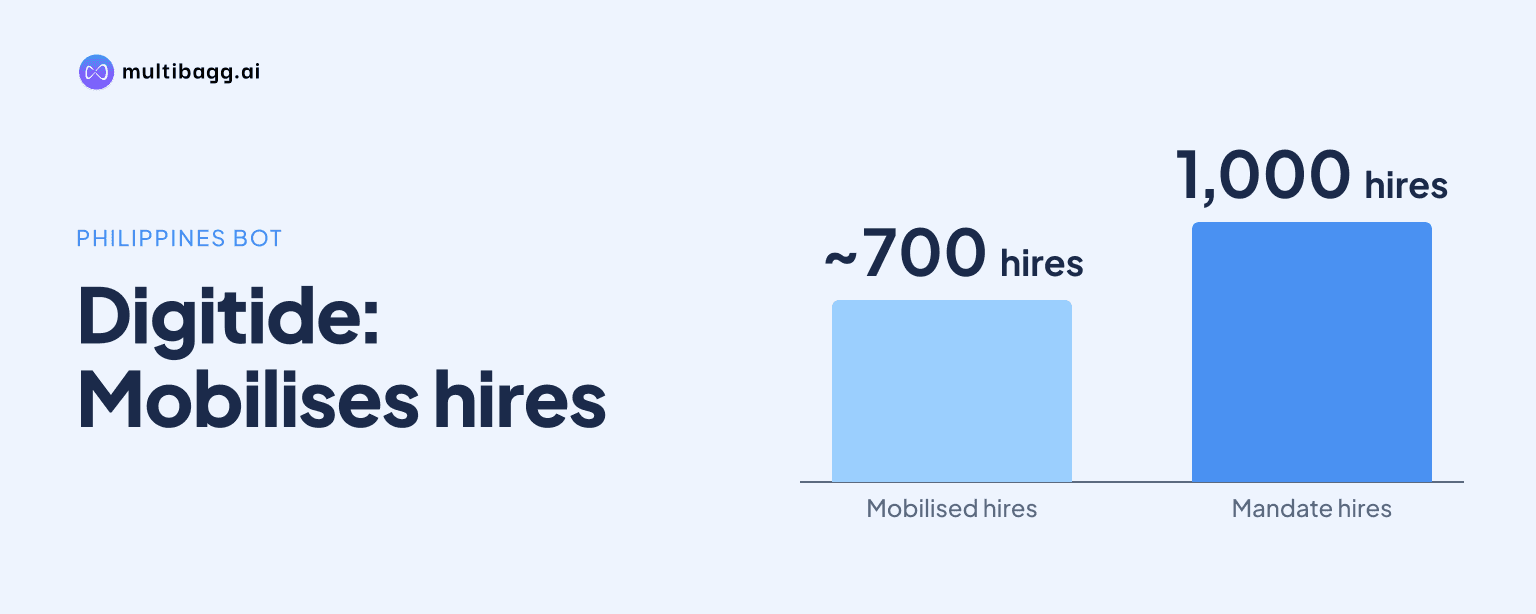
Digitide Solutions signed a Philippines build-operate-transfer mandate in Q2 to hire 1,000 people and had nearly 700 people in mobilisation when management spoke, making it the company’s first disclosed overseas BOT engagement within five global capability centre implementations.
Know Digitide Solutions inside out
Results, valuation, peers and who's buying, in one view.
What is Digitide’s Philippines BOT mandate?
Digitide’s Philippines assignment is a build-operate-transfer, or BOT, mandate under which it has been ordered to hire 1,000 people, transition the work, stabilise the operation and hand it back to the client. Management said the contract was signed in Q2 and that almost 700 people were already being mobilised in the Philippines.
The 700-person mobilisation represents about 70% of the instructed workforce, but Digitide did not disclose the client’s name, contract value, term, transfer date or expected billing schedule. The update therefore establishes execution progress on the workforce build-out rather than a quantified revenue contribution from the mandate.
Digitide said four of its five global capability centre, or GCC, implementations are managed-services assignments for GCCs in India. The Philippines contract is the sole disclosed BOT implementation, changing the portfolio from four India-based managed-services operations to a five-implementation mix that includes an overseas build, transition and stabilisation engagement.
How does the Philippines BOT contract extend Digitide’s GCC offering?
The Philippines mandate extends Digitide’s GCC offering beyond its four managed-services implementations in India because the company must build a 1,000-person operation before transferring it to the customer. In a managed-services model, Digitide operates services for a GCC; under this BOT construct, its disclosed role also includes hiring, transition and operational stabilisation.
Management cited the Q2 BOT signing as evidence of its plan to scale GCC offerings, alongside a 95% quarter-on-quarter increase in total contract value, or TCV, bookings. It did not state whether the Philippines order was included in the roughly Rs 400 crore of TCV discussed during the call, or what proportion of that booking pool it represents.
The time from booking to billing varies across Digitide’s businesses. Management said platform orders generally take about 10 to 16 weeks to enter realisation, business process outsourcing, or BPO, orders take about four to six weeks, and consulting work converts more immediately; it did not identify which timetable applies to the Philippines BOT mandate.
For the roughly Rs 400 crore TCV pool, management said it had assumed that more than 30% to 35% would convert into revenue in the fiscal year. That is a company-wide planning assumption rather than BOT-specific guidance, since Digitide did not disclose the mandate’s contract value, revenue profile or mobilisation completion date.
What did Digitide report on AI revenue and bookings?
Digitide reported Rs 30.5 crore of artificial intelligence, or AI, revenue in Q2, equivalent to 4.1% of overall revenue, compared with 1.9% in Q1. Management also reported annual contract value, or ACV, bookings of Rs 160 crore in Q2, up from Rs 118 crore in Q1.
AI accounted for 29% of Q2 ACV bookings, up from 14% in Q1, while the AI funnel increased to about Rs 170 crore from about Rs 100 crore. Management described the funnel increase as almost 70% quarter on quarter, although it did not provide an expected conversion rate or dates for closing those opportunities.
Management said about 35% to 37% of the Rs 30.5 crore AI revenue came from AI BPM services, about 30% to 35% from platform businesses and about 27% to 28% from professional services. It also said professional services signed six new orders in Q2, without disclosing their values or the amount of AI revenue attributable to new customers.
Got a follow-up? Ask IRIS
How could the AWS alliance support Digitide’s commercial activity?
Digitide said its Amazon Web Services, or AWS, partnership has three commercial routes: selling with AWS, buying from AWS and reselling with value-add, and selling services to Amazon. Digitide reached AWS advanced-tier status in Q2, while teams on both sides were working toward premier partner status.
Under the buy-from and resale route, Digitide said it completed its first US deal in Q2. Under the sell-to-Amazon route, it said it already provides payroll services to AWS in India, establishing that the relationship includes both a newly disclosed US transaction and an existing India delivery engagement.
Management said it was working through a joint co-sell programme with AWS, with activities and go-to-market actions agreed. Management’s stated intent is to increase the partnership fivefold as it progresses to the next status tier, but it did not provide a linked revenue figure, pipeline value, time frame or forecast for a material contribution.
Digitide also referenced an Anthropic alliance in Q2 as part of its broader partnership effort, but gave commercial detail only on AWS in this exchange. The disclosed AWS mechanisms cover joint selling, resale and delivery to Amazon, rather than a single channel agreement, while Q3 is the point management named for a further progress update.
What is affecting Digitide’s profit-before-tax improvement?
Digitide reported profit before tax, or PBT, of Rs 14 crore in Q2 FY27, compared with Rs 12 crore in Q2 FY26. Management said lease liabilities affect PBT but do not affect earnings before interest, tax, depreciation and amortisation, or EBITDA, and said it was not yet satisfied with the position because of issues in India BPM.
Management said the India BPM portfolio is moving from time-and-materials and people-based contracts towards outcome-based pricing. Its stated measures include account-level pricing discipline, automation, business-mix changes, repricing existing contracts and walking away from lower-return work; it cautioned that the transformation would take more than one quarter.
The company also cited wage revisions, contract repricing and India-specific micro and macro effects in explaining the work required. Separately, management said cash received from Alldigi would predominantly reduce standalone debt, with excess retained on the balance sheet for future opportunities.
Conclusion
Digitide’s Q2 Philippines BOT mandate is a tangible expansion of its GCC delivery model: it is a 1,000-person order with nearly 700 people already mobilised, alongside four managed-services GCC implementations in India. The company also reported a rise in AI revenue share from 1.9% to 4.1%, higher ACV bookings and a larger AI funnel, while AWS creates several potential commercial routes.
The next disclosed checkpoint is Q3, when management said it would report progress on the AWS joint co-sell programme and other execution measures. Investors can also watch whether the Philippines operation advances from its nearly 700-person mobilisation toward stabilisation and transfer, whether more than 30% to 35% of TCV converts into fiscal-year revenue, and whether India BPM actions lift PBT beyond Rs 14 crore.